Carbapenem-resistant Acinetobacter baumannii

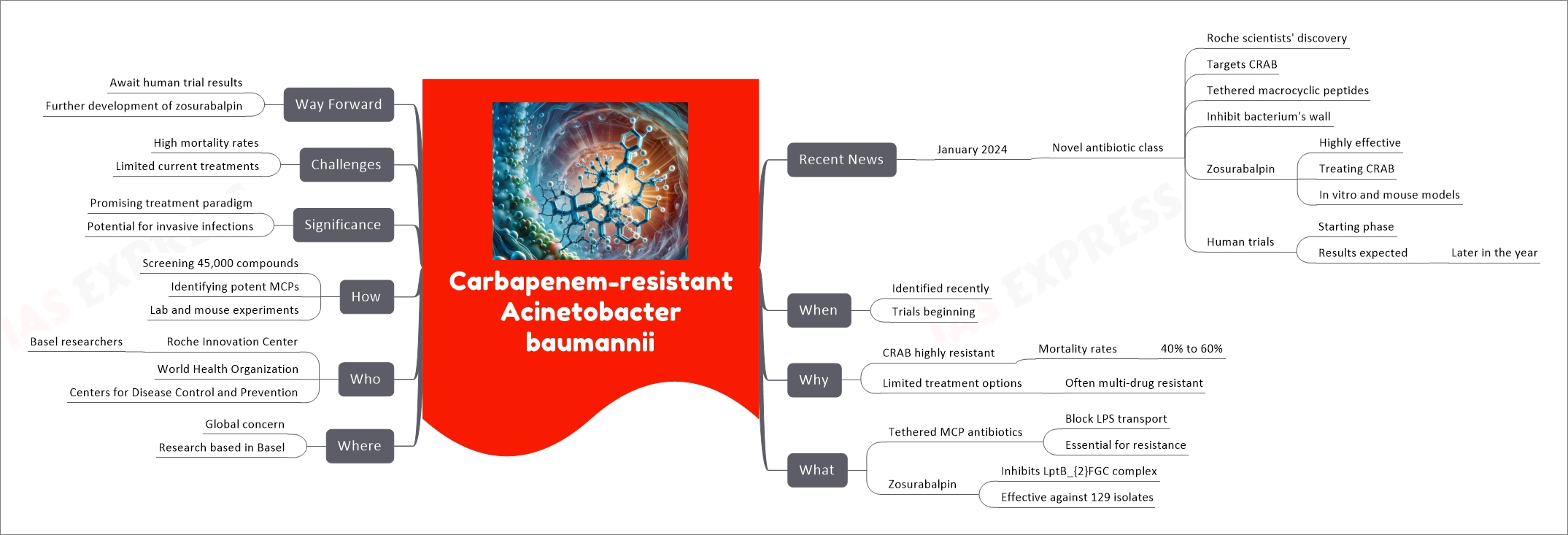
Carbapenem-resistant Acinetobacter baumannii mind map

  Recent News
    January 2024
      Novel antibiotic class
        Roche scientists' discovery
        Targets CRAB
        Tethered macrocyclic peptides
        Inhibit bacterium's wall
        Zosurabalpin
          Highly effective
          Treating CRAB
          In vitro and mouse models
        Human trials
          Starting phase
          Results expected
            Later in the year
  When
    Identified recently
    Trials beginning
  Why
    CRAB highly resistant
      Mortality rates
        40% to 60%
    Limited treatment options
      Often multi-drug resistant
  What
    Tethered MCP antibiotics
      Block LPS transport
      Essential for resistance
    Zosurabalpin
      Inhibits LptB_{2}FGC complex
      Effective against 129 isolates
  Where
    Global concern
    Research based in Basel
  Who
    Roche Innovation Center
      Basel researchers
    World Health Organization
    Centers for Disease Control and Prevention
  How
    Screening 45,000 compounds
    Identifying potent MCPs
    Lab and mouse experiments
  Significance
    Promising treatment paradigm
    Potential for invasive infections
  Challenges
    High mortality rates
    Limited current treatments
  Way Forward
    Await human trial results
    Further development of zosurabalpin

Carbapenem-resistant Acinetobacter baumannii (CRAB) is a highly drug-resistant bacterial pathogen causing nosocomial infections with mortality rates between 40% to 60%. Recently, scientists at Roche have discovered a novel class of tethered macrocyclic peptide (MCP) antibiotics effective against CRAB. These MCPs work by blocking the transport of lipopolysaccharide, crucial for the bacterium’s resistance. The promising antibiotic candidate, zosurabalpin, has shown high efficacy in vitro and in mouse models, with human clinical trials underway. In India, a study highlighted the presence of bla_{OXA-51-like} in all CRAB isolates, with bla_{OXA-23-like} and bla_{NDM-like} being predominant, indicating a potential emerging lineage of carbapenem resistance.
Related Posts

If you like this post, please share your feedback in the comments section below so that we will upload more posts like this.

Responses

🖍️ Highlight
HomeCoursesPlansAccount