Apophis (God of Chaos) Asteroid

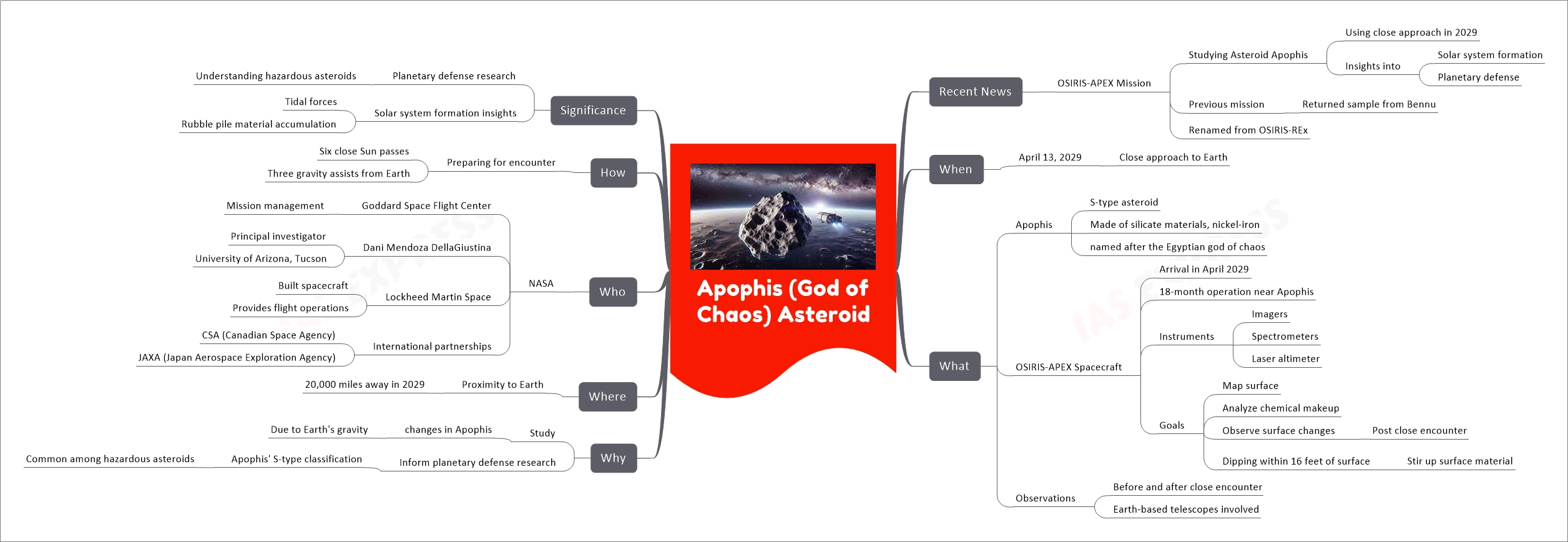
Apophis (God of Chaos) Asteroid mind map

  Recent News
    OSIRIS-APEX Mission
      Studying Asteroid Apophis
        Using close approach in 2029
        Insights into
          Solar system formation
          Planetary defense
      Previous mission
        Returned sample from Bennu
      Renamed from OSIRIS-REx
  When
    April 13, 2029
      Close approach to Earth
  What
    Apophis
      S-type asteroid
      Made of silicate materials, nickel-iron
      named after the Egyptian god of chaos
    OSIRIS-APEX Spacecraft
      Arrival in April 2029
      18-month operation near Apophis
      Instruments
        Imagers
        Spectrometers
        Laser altimeter
      Goals
        Map surface
        Analyze chemical makeup
        Observe surface changes
          Post close encounter
        Dipping within 16 feet of surface
          Stir up surface material
    Observations
      Before and after close encounter
      Earth-based telescopes involved
  Why
    Study
      changes in Apophis
        Due to Earth's gravity
    Inform planetary defense research
      Apophis' S-type classification
        Common among hazardous asteroids
  Where
    Proximity to Earth
      20,000 miles away in 2029
  Who
    NASA
      Goddard Space Flight Center
        Mission management
      Dani Mendoza DellaGiustina
        Principal investigator
        University of Arizona, Tucson
      Lockheed Martin Space
        Built spacecraft
        Provides flight operations
      International partnerships
        CSA (Canadian Space Agency)
        JAXA (Japan Aerospace Exploration Agency)
  How
    Preparing for encounter
      Six close Sun passes
      Three gravity assists from Earth
  Significance
    Planetary defense research
      Understanding hazardous asteroids
    Solar system formation insights
      Tidal forces
      Rubble pile material accumulation

The ‘God of Chaos’ asteroid, known as Apophis, is an S-type asteroid that NASA’s OSIRIS-APEX mission is set to study in 2029. This mission aims to observe the asteroid’s close approach to Earth, which will be within 20,000 miles, closer than some satellites. Scientists anticipate that Earth’s gravity will affect Apophis, potentially leading to surface changes like quakes and landslides. This mission is significant for understanding hazardous asteroids and solar system formation, contributing to planetary defense research.

Related Posts
If you like this post, please share your feedback in the comments section below so that we will upload more posts like this.

Responses

🖍️ Highlight
HomeCoursesPlansAccount