Polar Stratospheric Clouds (PSCs)

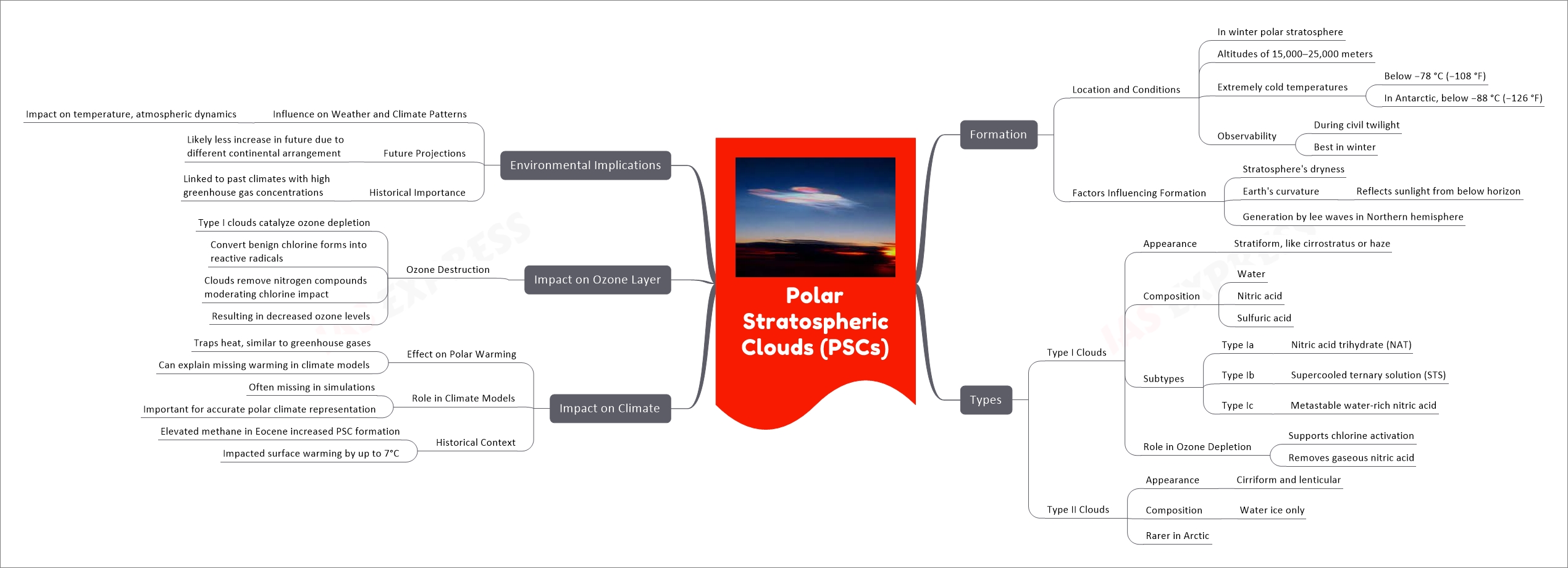
Polar Stratospheric Clouds (PSCs) mind map

  Formation
    Location and Conditions
      In winter polar stratosphere
      Altitudes of 15,000–25,000 meters
      Extremely cold temperatures
        Below −78 °C (−108 °F)
        In Antarctic, below −88 °C (−126 °F)
      Observability
        During civil twilight
        Best in winter
    Factors Influencing Formation
      Stratosphere's dryness
      Earth's curvature
        Reflects sunlight from below horizon
      Generation by lee waves in Northern hemisphere
  Types
    Type I Clouds
      Appearance
        Stratiform, like cirrostratus or haze
      Composition
        Water
        Nitric acid
        Sulfuric acid
      Subtypes
        Type Ia
          Nitric acid trihydrate (NAT)
        Type Ib
          Supercooled ternary solution (STS)
        Type Ic
          Metastable water-rich nitric acid
      Role in Ozone Depletion
        Supports chlorine activation
        Removes gaseous nitric acid
    Type II Clouds
      Appearance
        Cirriform and lenticular
      Composition
        Water ice only
      Rarer in Arctic
  Impact on Climate
    Effect on Polar Warming
      Traps heat, similar to greenhouse gases
      Can explain missing warming in climate models
    Role in Climate Models
      Often missing in simulations
      Important for accurate polar climate representation
    Historical Context
      Elevated methane in Eocene increased PSC formation
      Impacted surface warming by up to 7°C
  Impact on Ozone Layer
    Ozone Destruction
      Type I clouds catalyze ozone depletion
      Convert benign chlorine forms into reactive radicals
      Clouds remove nitrogen compounds moderating chlorine impact
      Resulting in decreased ozone levels
  Environmental Implications
    Influence on Weather and Climate Patterns
      Impact on temperature, atmospheric dynamics
    Future Projections
      Likely less increase in future due to different continental arrangement
    Historical Importance
      Linked to past climates with high greenhouse gas concentrations

Polar Stratospheric Clouds (PSCs) are unique atmospheric phenomena occurring at high altitudes in the polar stratosphere, particularly during the extreme cold of polar winters. These clouds, observable during civil twilight, are classified into two main types: Type I, composed of water, nitric acid, and sulfuric acid, and Type II, consisting only of water ice. Type I PSCs play a crucial role in ozone depletion by facilitating the conversion of benign forms of chlorine into reactive, ozone-destroying radicals and removing nitrogen compounds that would otherwise moderate this destructive effect. PSCs also influence climate, particularly polar warming, by trapping heat similarly to greenhouse gases. Their formation and behavior have significant implications for climate modeling, offering insights into past climate conditions and future projections. Their impact highlights the intricate connections between atmospheric phenomena, climate change, and environmental health.
Related Posts
If you like this post, please share your feedback in the comments section below so that we will upload more posts like this.

Responses

🖍️ Highlight
HomeCoursesPlansAccount