EU New Pact on Migration and Asylum

EU New Pact on Migration and Asylum mind map

  Recent News
    Major breakthrough in EU migration management
    Agreements reached on five key files
  When
    Pact implementation starts from 2024
    Full effect in two years
  Why
    Manage migration humanely, dignifiedly
    Shift from ad-hoc to long-term solutions
  What
    New Solidarity Mechanism
      Share asylum applications among EU countries
      Based on GDP, population, irregular border crossings
      Countries unwilling to host can offer financial support
    Expedited Border Procedure
      For those unlikely to win asylum
      Maximum 12-week process
      Return within 12 weeks if rejected
      Applies to dangerous, uncooperative individuals
      Or from countries with low asylum recognition rates
    Gathering Accurate Data
      Detect unauthorized movements
      Improve security in Schengen area
    Uniform Identification Rules
      For non-EU nationals
      Increasing security
    Crisis Preparedness
      Future crisis situations
    Opposition from Rights Groups
      Concerns over overcrowded camps
      Risk of detaining minors
      Focus on keeping people away
  Where
    Across the European Union
  Who
    European Commission
    Member States of EU
  How
    Formal adoption by European Parliament and Council
    Legislative acts to be adopted
    Commission to assist Member States
  Significance
    Fair, orderly migration management
    Long-term, sustainable solutions
  Challenges
    Rights groups' criticisms
    Potential for overcrowded camps
    Protracted detention concerns
  Way Forward
    Implementation of proposals
    Adoption of specific legislative acts
    Assisting Member States in national legislation

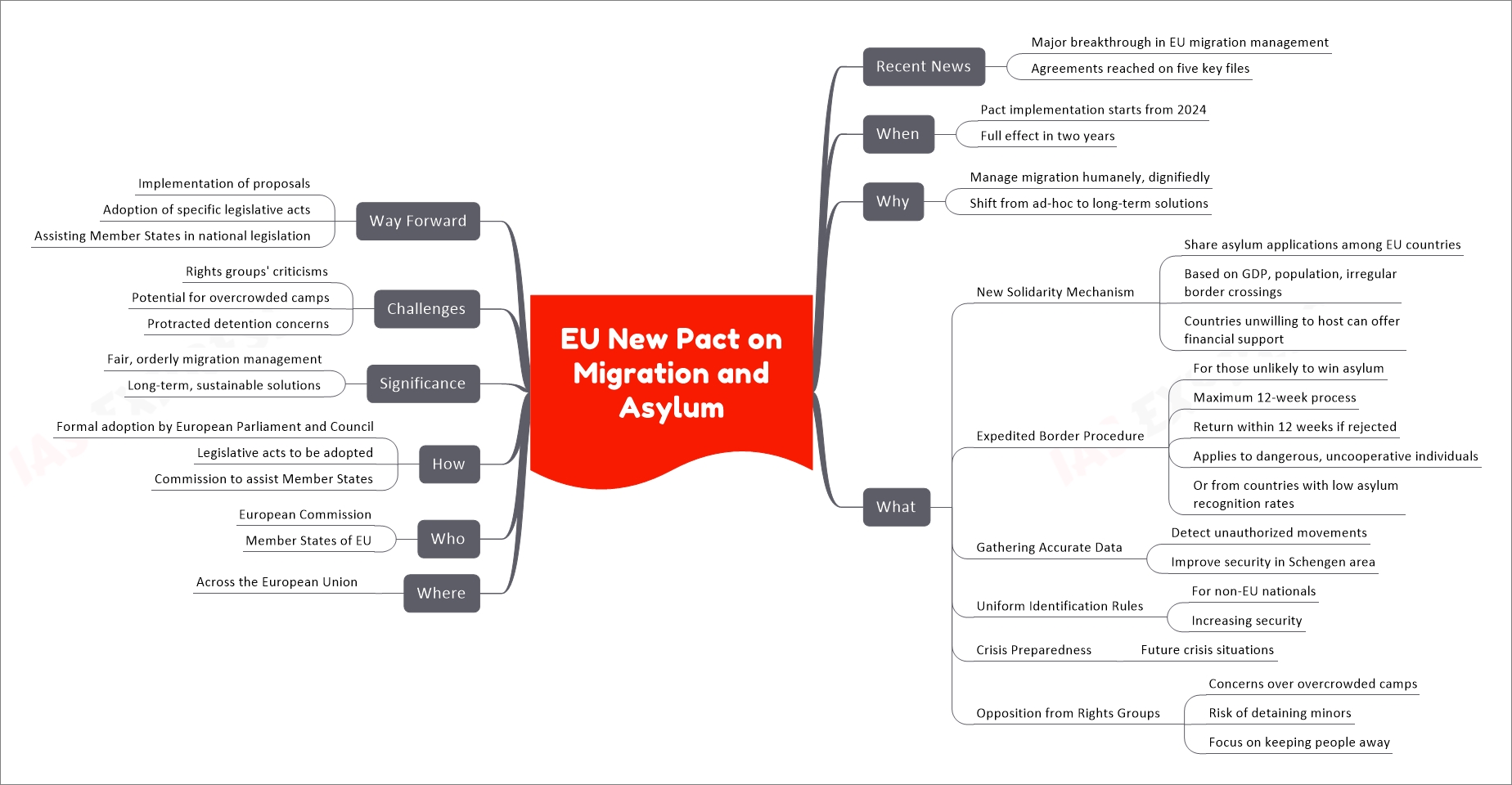
The EU’s New Pact on Migration and Asylum, agreed upon in 2023, marks a significant advancement in the European Union’s approach to managing migration. The pact encompasses several key provisions aimed at establishing a more humane, dignified, and effective system. These include a new solidarity mechanism for sharing asylum applications among EU countries based on various criteria, an expedited border procedure for processing and potentially returning individuals unlikely to win asylum, measures for gathering more accurate data to detect unauthorized movements, the creation of uniform rules for the identification of non-EU nationals to enhance security within the Schengen area, and preparedness for future crisis situations.

Despite these measures, the pact has faced criticism from rights groups concerned about the potential for overcrowded migration camps and the protracted detention of minors. The implementation of the pact, starting from 2024 and expected to take full effect within two years, will involve the formal adoption of these proposals by the European Parliament and Council, followed by the adoption of specific legislative acts. The European Commission will assist member states in implementing the new rules in their national legislation, moving towards long-term and sustainable solutions for migration management in the EU.

Related Posts

If you like this post, please share your feedback in the comments section below so that we will upload more posts like this.

Responses

🖍️ Highlight
HomeCoursesPlansAccount