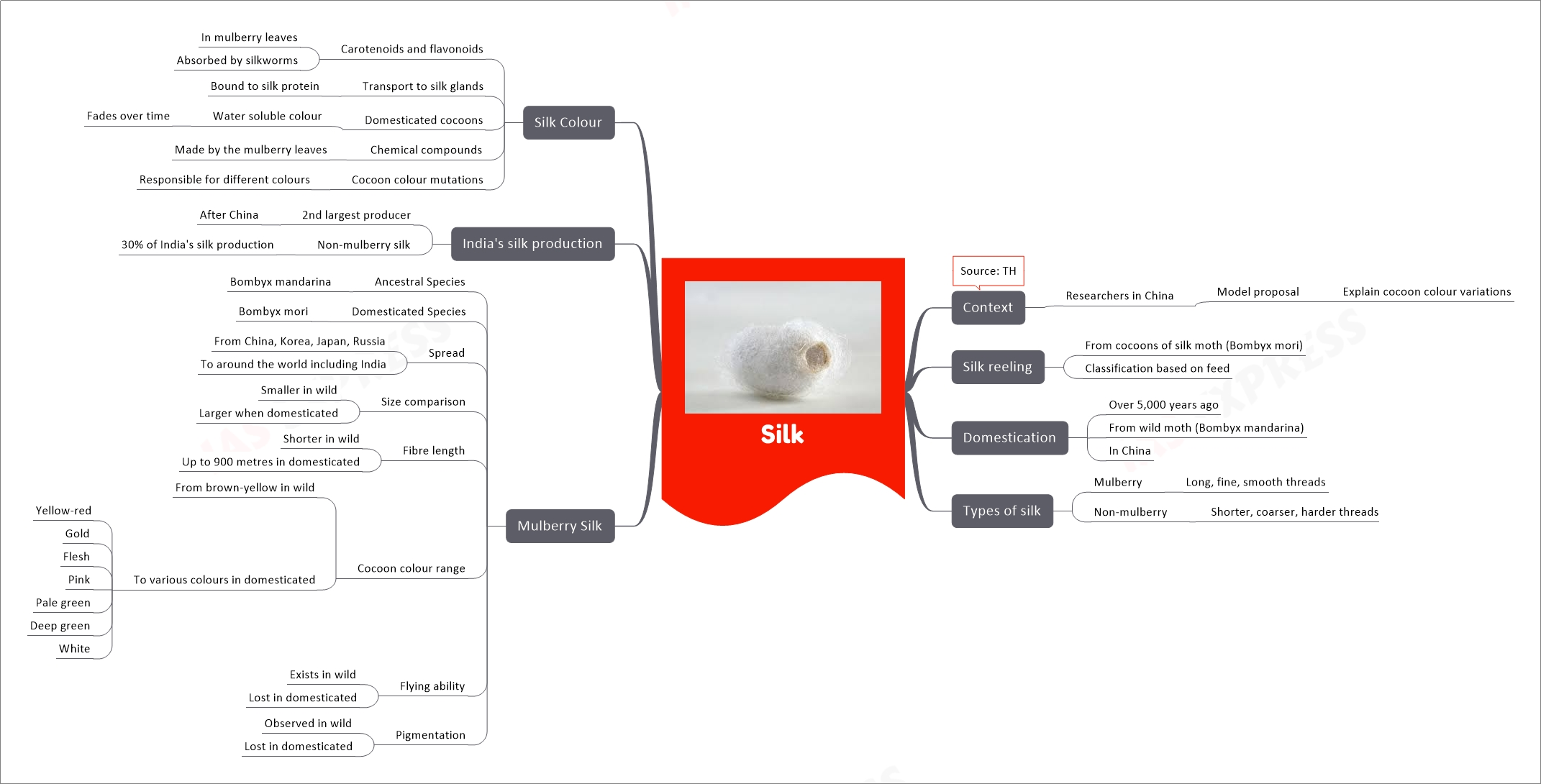
Silk

Silk mind map
  Context 
    Researchers in China
      Model proposal
        Explain cocoon colour variations
    Source: TH
  Silk reeling
    From cocoons of silk moth (Bombyx mori)
    Classification based on feed
  Domestication
    Over 5,000 years ago
    From wild moth (Bombyx mandarina)
    In China
  Types of silk
    Mulberry
      Long, fine, smooth threads
    Non-mulberry
      Shorter, coarser, harder threads
  Mulberry Silk
    Ancestral Species
      Bombyx mandarina
    Domesticated Species
      Bombyx mori
    Spread
      From China, Korea, Japan, Russia
      To around the world including India
    Size comparison
      Smaller in wild
      Larger when domesticated
    Fibre length
      Shorter in wild
      Up to 900 metres in domesticated
    Cocoon colour range
      From brown-yellow in wild
      To various colours in domesticated
        Yellow-red
        Gold
        Flesh
        Pink
        Pale green
        Deep green
        White
    Flying ability
      Exists in wild
      Lost in domesticated
    Pigmentation
      Observed in wild
      Lost in domesticated
  India's silk production
    2nd largest producer
      After China
    Non-mulberry silk
      30% of India's silk production
  Silk Colour
    Carotenoids and flavonoids
      In mulberry leaves
      Absorbed by silkworms
    Transport to silk glands
      Bound to silk protein
    Domesticated cocoons
      Water soluble colour
        Fades over time
    Chemical compounds
      Made by the mulberry leaves
    Cocoon colour mutations
      Responsible for different colours

Related Posts

If you like this post, please share your feedback in the comments section below so that we will upload more posts like this.

Responses

🖍️ Highlight
HomeCoursesPlansAccount