UNODC Global Study on Homicide Report 2023

UNODC Global Study on Homicide Report 2023 mind map

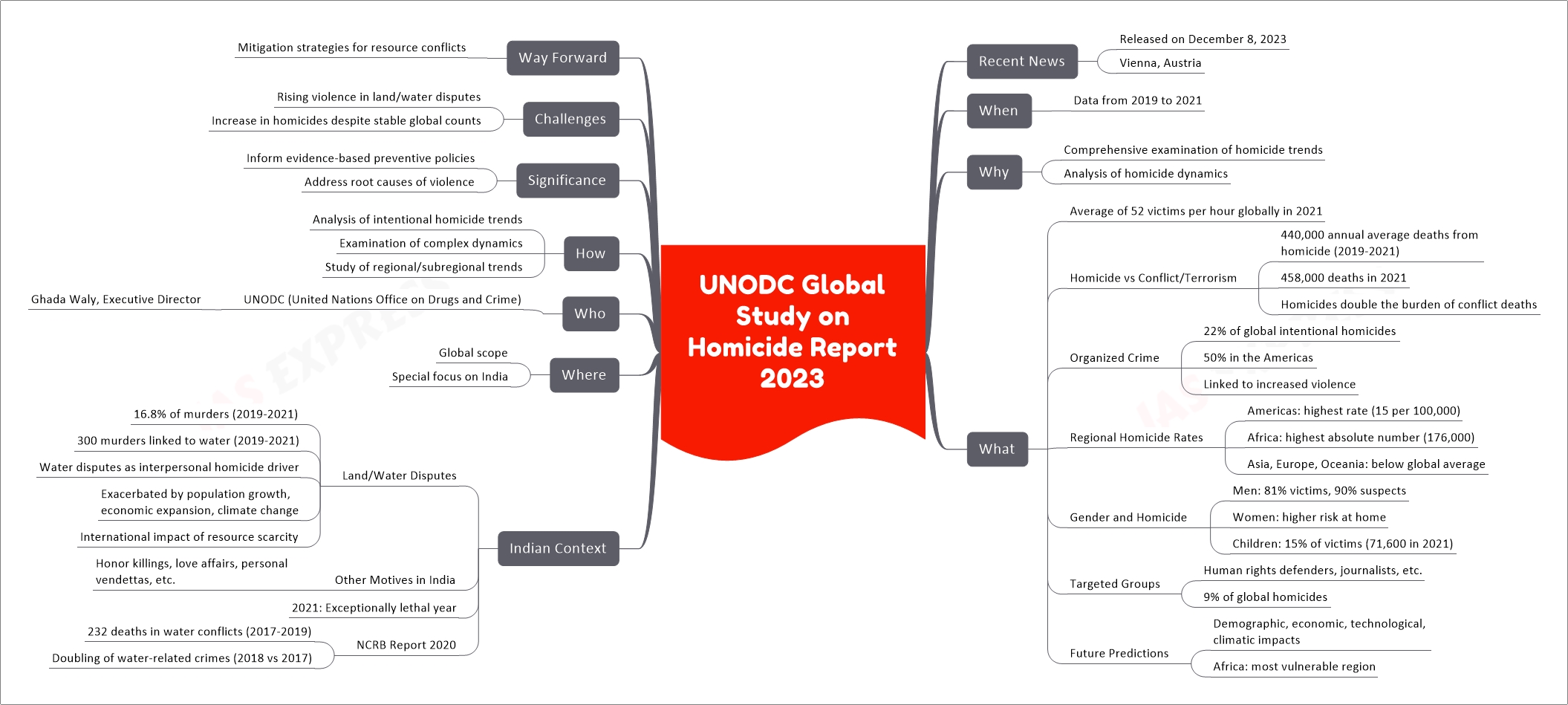
  Recent News
    Released on December 8, 2023
    Vienna, Austria
  When
    Data from 2019 to 2021
  Why
    Comprehensive examination of homicide trends
    Analysis of homicide dynamics
  What/Full Provisions
    Average of 52 victims per hour globally in 2021
    Homicide vs Conflict/Terrorism
      440,000 annual average deaths from homicide (2019-2021)
      458,000 deaths in 2021
      Homicides double the burden of conflict deaths
    Organized Crime
      22% of global intentional homicides
      50% in the Americas
      Linked to increased violence
    Regional Homicide Rates
      Americas: highest rate (15 per 100,000)
      Africa: highest absolute number (176,000)
      Asia, Europe, Oceania: below global average
    Gender and Homicide
      Men: 81% victims, 90% suspects
      Women: higher risk at home
      Children: 15% of victims (71,600 in 2021)
    Targeted Groups
      Human rights defenders, journalists, etc.
      9% of global homicides
    Future Predictions
      Demographic, economic, technological, climatic impacts
      Africa: most vulnerable region
  Indian Context
    Land/Water Disputes
      16.8% of murders (2019-2021)
      300 murders linked to water (2019-2021)
      Water disputes as interpersonal homicide driver
      Exacerbated by population growth, economic expansion, climate change
      International impact of resource scarcity
    Other Motives in India
      Honor killings, love affairs, personal vendettas, etc.
    2021: Exceptionally lethal year
    NCRB Report 2020
      232 deaths in water conflicts (2017-2019)
      Doubling of water-related crimes (2018 vs 2017)
  Where
    Global scope
    Special focus on India
  Who
    UNODC (United Nations Office on Drugs and Crime)
      Ghada Waly, Executive Director
  How
    Analysis of intentional homicide trends
    Examination of complex dynamics
    Study of regional/subregional trends
  Pros/Significance
    Inform evidence-based preventive policies
    Address root causes of violence
  Cons and/or Challenges
    Rising violence in land/water disputes
    Increase in homicides despite stable global counts
  Way Forward
    Mitigation strategies for resource conflicts

The UNODC’s Global Study on Homicide Report 2023 provides a comprehensive analysis of global homicide trends, highlighting the prevalence and patterns of intentional homicides. The report, released in December 2023, shows an average of 52 homicide victims per hour worldwide in 2021, with homicide accounting for more deaths than armed conflict and terrorism combined. It emphasizes the significant role of organized crime in these homicides, particularly in the Americas, and the varied homicide rates across regions, with the Americas and Africa having the highest rates. The study also sheds light on gender disparities in homicide victims and perpetrators, the risks faced by certain groups like human rights defenders, and the future impact of demographic and environmental changes on homicide rates. Significantly, the report includes a special focus on India, noting the rise in homicides related to land and water disputes, exacerbated by factors like population growth and climate change. The study aims to inform evidence-based preventive policies and address the root causes of violence.

Related Posts
If you like this post, please share your feedback in the comments section below so that we will upload more posts like this.

Responses

🖍️ Highlight
HomeCoursesPlansAccount