Supreme Court Legal Services Committee

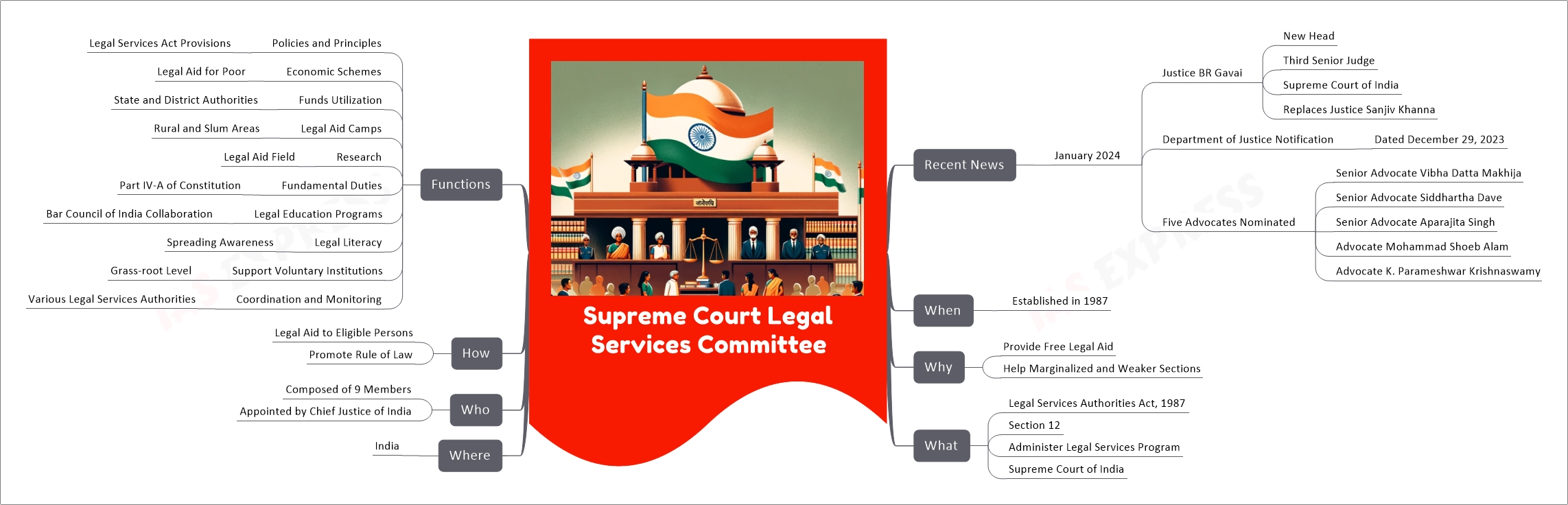
Supreme Court Legal Services Committee mind map

  Recent News
    January 2024
      Justice BR Gavai
        New Head
        Third Senior Judge
        Supreme Court of India
        Replaces Justice Sanjiv Khanna
      Department of Justice Notification
        Dated December 29, 2023
      Five Advocates Nominated
        Senior Advocate Vibha Datta Makhija
        Senior Advocate Siddhartha Dave
        Senior Advocate Aparajita Singh
        Advocate Mohammad Shoeb Alam
        Advocate K. Parameshwar Krishnaswamy
  When
    Established in 1987
  Why
    Provide Free Legal Aid
    Help Marginalized and Weaker Sections
  What
    Legal Services Authorities Act, 1987
    Section 12
    Administer Legal Services Program
    Supreme Court of India
  Where
    India
  Who
    Composed of 9 Members
    Appointed by Chief Justice of India
  How
    Legal Aid to Eligible Persons
    Promote Rule of Law
  Functions
    Policies and Principles
      Legal Services Act Provisions
    Economic Schemes
      Legal Aid for Poor
    Funds Utilization
      State and District Authorities
    Legal Aid Camps
      Rural and Slum Areas
    Research
      Legal Aid Field
    Fundamental Duties
      Part IV-A of Constitution
    Legal Education Programs
      Bar Council of India Collaboration
    Legal Literacy
      Spreading Awareness
    Support Voluntary Institutions
      Grass-root Level
    Coordination and Monitoring
      Various Legal Services Authorities

The Supreme Court Legal Services Committee (SCLSC) in India, established in 1987, primarily focuses on providing free legal aid to marginalized and weaker sections of society. This is in line with the provisions of the Legal Services Authorities Act of 1987. The SCLSC is responsible for administering the legal services program as it relates to the Supreme Court. Composed of nine members appointed by the Chief Justice of India, it recently saw Justice BR Gavai appointed as its new head in January 2024. The committee’s key functions include formulating policies and principles, developing economical schemes for legal aid, and promoting legal literacy and awareness, particularly among the poorer segments of society.
Related Posts
If you like this post, please share your feedback in the comments section below so that we will upload more posts like this.

Responses

🖍️ Highlight
HomeCoursesPlansAccount