Section 194-O of the Income Tax Act

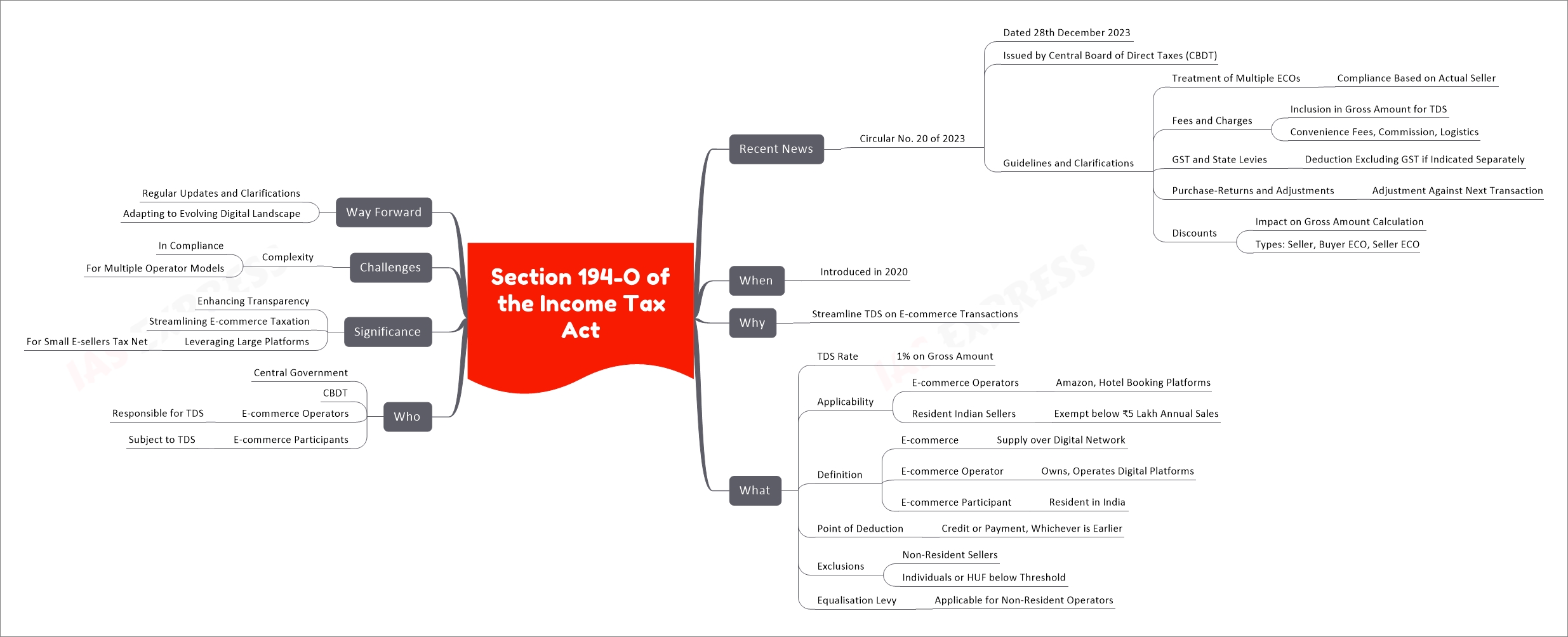
Section 194-O of the Income Tax Act mind map

  Recent News
    Circular No. 20 of 2023
      Dated 28th December 2023
      Issued by Central Board of Direct Taxes (CBDT)
      Guidelines and Clarifications
        Treatment of Multiple ECOs
          Compliance Based on Actual Seller
        Fees and Charges
          Inclusion in Gross Amount for TDS
          Convenience Fees, Commission, Logistics
        GST and State Levies
          Deduction Excluding GST if Indicated Separately
        Purchase-Returns and Adjustments
          Adjustment Against Next Transaction
        Discounts
          Impact on Gross Amount Calculation
          Types: Seller, Buyer ECO, Seller ECO
  When
    Introduced in 2020
  Why
    Streamline TDS on E-commerce Transactions
  What
    TDS Rate
      1% on Gross Amount
    Applicability
      E-commerce Operators
        Amazon, Hotel Booking Platforms
      Resident Indian Sellers
        Exempt below ₹5 Lakh Annual Sales
    Definition
      E-commerce
        Supply over Digital Network
      E-commerce Operator
        Owns, Operates Digital Platforms
      E-commerce Participant
        Resident in India
    Point of Deduction
      Credit or Payment, Whichever is Earlier
    Exclusions
      Non-Resident Sellers
      Individuals or HUF below Threshold
    Equalisation Levy
      Applicable for Non-Resident Operators
  Who
    Central Government
    CBDT
    E-commerce Operators
      Responsible for TDS
    E-commerce Participants
      Subject to TDS
  Significance
    Enhancing Transparency
    Streamlining E-commerce Taxation
    Leveraging Large Platforms
      For Small E-sellers Tax Net
  Challenges
    Complexity
      In Compliance
      For Multiple Operator Models
  Way Forward
    Regular Updates and Clarifications
    Adapting to Evolving Digital Landscape

Section 194-O of the Income Tax Act, introduced in 2020, mandates e-commerce operators in India to deduct Tax Deduction at Source (TDS) at a rate of 1% on the gross amount of sales or services facilitated through their digital platforms. It covers resident Indian sellers and enterprises, termed e-commerce participants, and exempts those with annual sales below ₹5 lakh. The provision aims to streamline the taxation process for e-commerce transactions, enhancing transparency and compliance in the digital economy. The guidelines issued by the Central Board of Direct Taxes (CBDT) address various aspects of TDS deduction, including the treatment of fees, GST, purchase-returns, and discounts, ensuring clarity for multiple e-commerce operator models.

Related Posts
If you like this post, please share your feedback in the comments section below so that we will upload more posts like this.

Responses

🖍️ Highlight
HomeCoursesPlansAccount