
Electoral Trusts vs. Electoral Bonds: Understanding the Structural Shift in Political Finance

From Current Affairs Notes for UPSC » Editorials & In-depths » This topic
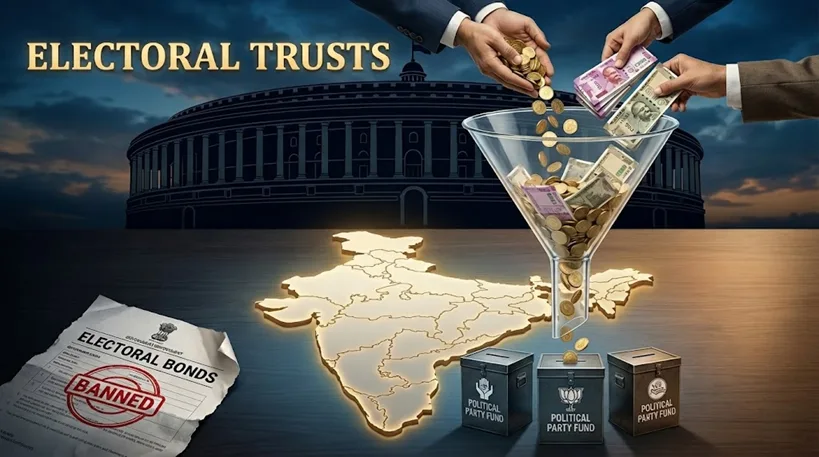
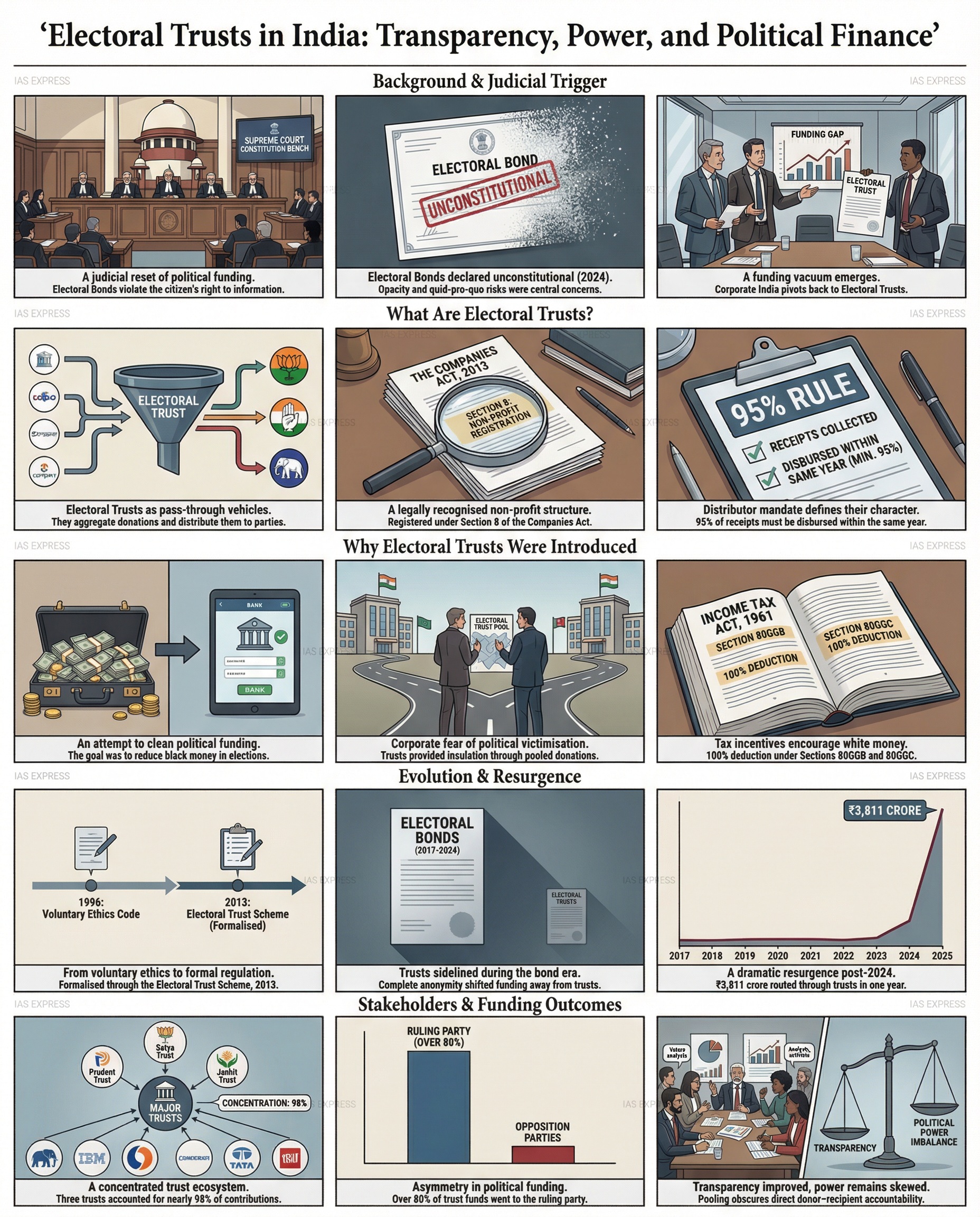
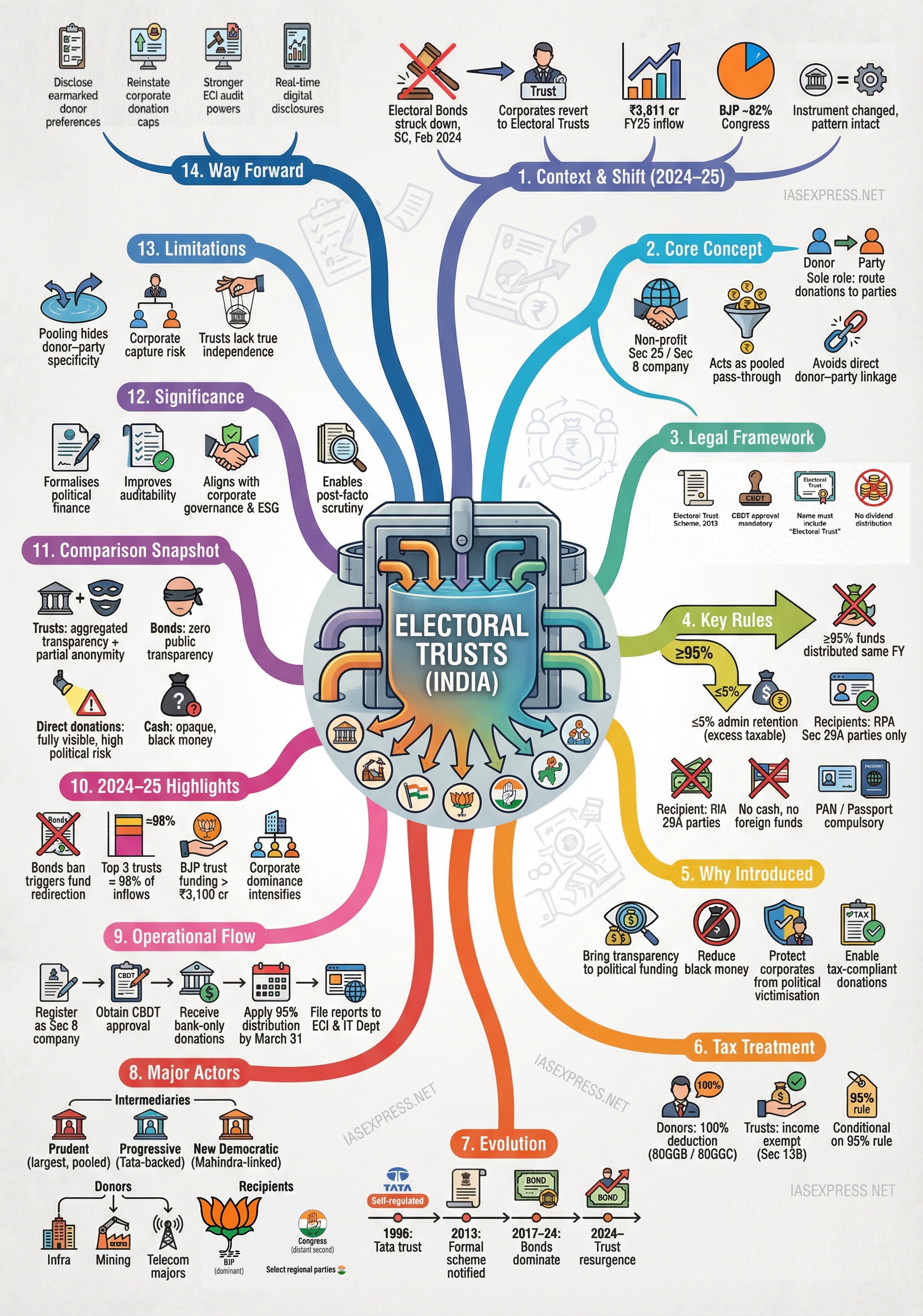
The ecosystem of political financing in India is witnessing a paradigm shift in the fiscal year 2024-25. In February 2024, a Constitution Bench of the Supreme Court of India delivered a historic verdict declaring the Electoral Bonds Scheme unconstitutional, citing violations of the right to information and the potential for quid pro quo arrangements. This judicial intervention created an immediate vacuum in the funding channels for political parties, compelling Corporate India to pivot back to the Electoral Trusts (ET) mechanism.
Recent data released by the Election Commission of India (ECI) highlights a dramatic resurgence in this transparent yet aggregated mode of funding. Contributions to electoral trusts skyrocketed to ₹3,811 crore in FY 2024-25, marking a more than threefold increase from the ₹1,218 crore recorded in the previous fiscal year. This surge is not merely a statistical anomaly but a structural realignment of how democracy is funded in the world’s largest electorate. The data reveals that the Bharatiya Janata Party (BJP) emerged as the primary beneficiary, securing nearly 82% of these routed funds, while the opposition Indian National Congress received less than 8%.
For UPSC aspirants, this topic serves as a critical intersection of Polity (Representation of People Act), Governance (Transparency & Accountability), and Economy (Corporate Governance & Taxation). This article provides an exhaustive, expert-level analysis of Electoral Trusts, decoding their mechanism, legal backing, historical evolution, and their complex role in Indian democracy.
What are Electoral Trusts?
The Core Definition
An Electoral Trust is a non-profit company established under Section 25 of the Companies Act, 1956 (corresponding to Section 8 of the Companies Act, 2013) with the sole objective of distributing voluntary contributions from other companies and individuals to eligible political parties.
Think of an electoral trust as a funnel or a pass-through vehicle. Instead of a corporation giving money directly to a political party—which might expose the company to political victimization if the opposing party comes to power—the company donates to the Trust. The Trust then aggregates these funds and distributes them to various political parties.
Legal Identity and Structure
- Non-Profit Status: By definition, these companies cannot declare dividends to their members. Their profits or surpluses, if any, must be applied solely towards their objectives—political distribution.
- Naming Convention: The name of the company must mandatorily include the phrase “Electoral Trust” to ensure public recognizability.
- Registration: These trusts must be approved by the Central Board of Direct Taxes (CBDT) under the Electoral Trusts Scheme, 2013.
The ‘Distributor’ Mandate
The most defining characteristic of an Electoral Trust is the statutory obligation regarding fund distribution. According to Clause 5(1)(a) of the Electoral Trust Scheme, 2013, an approved trust is required to distribute 95% of the total contributions it receives in a financial year to eligible political parties within that same financial year.
- Rationale: This rule prevents electoral trusts from becoming investment vehicles or holding companies. They are designed strictly as conduits to move money from donors to parties efficiently.
- Surplus Management: The trust is permitted to retain a maximum of 5% of the total contributions to cover its administrative expenses (e.g., employee salaries, audit fees, office rent). If the surplus exceeds this limit, it becomes taxable.
Eligibility of Beneficiaries
Not every political group can receive funds from these trusts. The beneficiaries must be political parties registered under Section 29A of the Representation of the People Act, 1951. This ensures that the funds enter the formal political system and are not diverted to fringe or unregistered entities.
Why were Electoral Trusts Introduced?
To understand the “Why,” we must look at the historical landscape of political funding in India, which has often been murky and dominated by black money.
1. The Need for Transparency
Before 2013, while some corporate trusts existed (like the Tata Electoral Trust formed in 1996), there was no standardized legal framework governing them. The Election Commission of India (ECI) expressed strong concerns that there was “no transparency requirement, either regarding the source of funding or disbursal of funds” routed through these early mechanisms. The 2013 Scheme was introduced to create a transparent audit trail. Unlike cash donations, every rupee entering and leaving a trust is documented via banking channels.
2. Sanitizing Corporate Funding
Corporates in India have historically faced a dilemma:
- If they donate to Party A, Party B might penalize them if it comes to power.
- If they donate in cash to avoid this, they fuel the black economy and lose tax benefits.
Electoral Trusts provided a middle path. By pooling funds from multiple companies into a single trust (like the Prudent Electoral Trust), individual donor preferences could be partially masked under the collective umbrella of the Trust, offering a layer of protection or “insulation” to the corporate donor.
3. Curbing Black Money
The scheme was part of a broader push to reduce the influence of illicit cash in elections. By mandating that no contributions can be received in cash and requiring PAN/Passport details for all donors, the scheme aimed to force political money into the formal banking system.
4. Tax Incentivization
To encourage white money donations, the government linked Electoral Trusts to tax exemptions.
- For Donors: Contributions are 100% deductible under Section 80GGB (for companies) and Section 80GGC (for individuals) of the Income Tax Act.
- For Trusts: The income of the trust itself is exempt from tax under Section 13B of the Income Tax Act, provided it adheres to the 95% distribution rule.
When did the System Evolve? (History)
The journey of Electoral Trusts is intertwined with India’s legislative attempts to regulate political finance.
Phase 1: The Early Experiments (1996–2013)
- 1996: The Tata Group pioneered the concept by establishing a trust to manage its political donations. This was a self-regulated initiative to ensure ethical funding based on the number of seats a party held in Parliament.
- Pre-2013: Other groups followed suit, but without a central scheme, operation methods varied. The ECI found it difficult to track these funds effectively.
Phase 2: Formalization (2013)
- January 31, 2013: The UPA-2 Government formally notified The Electoral Trusts Scheme, 2013 (Notification No. S.O. 309(E)). Simultaneously, the Income Tax Rules, 1962 were amended to insert Rule 17CA, which codified the functions and eligibility of these trusts.
- June 6, 2014: The ECI circulated strict Guidelines for Submission of Contribution Reports, mandating that trusts must disclose donor names and recipient parties annually.
Phase 3: The Challenge of Electoral Bonds (2017–2024)
- 2017: The Finance Act, 2017 introduced Electoral Bonds, which allowed for anonymous donations.
- Impact: Corporate funding shifted significantly toward bonds due to the complete secrecy they offered. However, Electoral Trusts did not disappear. They remained the preferred vehicle for companies that valued transparency and ESG (Environmental, Social, and Governance) compliance, such as the Tata Group and newer tech-infrastructure conglomerates.
- April 2024: The Supreme Court struck down Electoral Bonds.
Phase 4: The Resurgence (2024–Present)
- FY 2024-25: With bonds declared unconstitutional, Electoral Trusts reclaimed their position as the primary compliant vehicle for large-scale donations. The contributions surged to ₹3,811 crore, proving the system’s resilience and relevance.
Who are the Key Stakeholders?
The ecosystem involves a triad of actors: the Donors (Corporates), the Intermediaries (Trusts), and the Recipients (Political Parties), regulated by the ECI and CBDT.
1. The Intermediaries: Major Electoral Trusts
While there are approximately 18 registered trusts, the ecosystem is highly concentrated. In FY 2024-25, three specific trusts accounted for 98% of all contributions.
- Prudent Electoral Trust (formerly Satya Electoral Trust):
- Profile: The largest and most influential trust. It is a “pooled” trust, meaning it accepts donations from dozens of unrelated corporate groups (e.g., Bharti Airtel, DLF, Megha Engineering, ArcelorMittal).
- 2024-25 Activity: It collected a massive ₹2,668.46 crore and distributed the bulk of it (₹2,180.71 crore) to the BJP.
- Progressive Electoral Trust:
- Profile: Backed by the Tata Group. It is known for its rigorous internal criteria for distribution, often based on seat share in Parliament.
- 2024-25 Activity: Distributed ₹914.97 crore. Notable recipients included BJP (₹757 crore) and Congress (₹77 crore).
- New Democratic Electoral Trust:
- Profile: Associated with the Mahindra Group.
- 2024-25 Activity: Distributed ₹160 crore, with ₹150 crore going to the BJP.
- Others:
- Janhit Electoral Trust: Associated with the Vedanta Group.
- Samaj Electoral Trust: Associated with the KK Birla Group.
- Paribartan Electoral Trust: Associated with the MP Birla Group.
2. The Donors: Corporate India
The donor list for 2024-25 reads like a Who’s Who of Indian industry, with a notable dominance of infrastructure, mining, and telecom sectors—industries heavily regulated by the government.
- Megha Engineering & Infrastructures Ltd (MEIL): A consistent top donor. In addition to corporate donations of ₹175 crore to Prudent, its MD, PV Krishna Reddy, personally contributed nearly ₹150 crore.
- Jindal Steel & Power (OP Jindal Group): Contributed ₹157 crore.
- ArcelorMittal Nippon Steel: A heavy donor, contributing ₹100 crore.
- DLF Ltd: The real estate major donated ₹100 crore.
- Tata Group Companies: Donated collectively over ₹900 crore via their Progressive Electoral Trust.
- Vedanta: Through Janhit Electoral Trust, it has been a significant donor, with its annual report showing ₹97 crore to BJP in FY25.
3. The Recipients: Political Parties
The flow of funds reveals a stark asymmetry in Indian politics.
- Bharatiya Janata Party (BJP): Received ₹3,744 crore from trusts in 2024-25. This accounted for 61% of the party’s total declared income.
- Indian National Congress (INC): Received ₹313.76 crore, which was roughly 60% of its total donations.
- Regional Parties: Parties like Trinamool Congress (TMC), YSR Congress, and Bharat Rashtra Samiti (BRS) also received funds, largely from trusts with donors having business interests in their respective states (West Bengal, Andhra Pradesh, Telangana).
How does the Mechanism Work?
The operational lifecycle of an Electoral Trust is designed to create a documented financial trail.
Step 1: Registration
A company is formed under Section 8 of the Companies Act, 2013. It then applies to the CBDT for approval. This approval is usually valid for a block of three assessment years and must be renewed periodically.
Step 2: Inflow (Contributions)
The trust accepts contributions from eligible donors.
- KYC Check: The trust must collect the PAN (for residents) or Passport Number (for NRIs) from every contributor.
- Prohibitions: It cannot accept money from foreign citizens, foreign entities, or other electoral trusts.
- Banking Mode: Contributions must be made via cheque, bank draft, or electronic transfer. Cash is strictly prohibited.
Step 3: Allocation (The 95% Rule)
The trust must disburse 95% of the receipts to registered political parties by March 31st of the financial year.
- Decision Making: Who decides which party gets how much?
- In Group Trusts (like Tata’s Progressive), the distribution is often formulaic (e.g., based on the number of MPs a party has).
- In Pooled Trusts (like Prudent), the Board of Directors decides, often based on the aggregate preferences of the donors. However, the exact internal mechanism of how Prudent decides that 82% goes to BJP and 8% to Congress remains an internal corporate governance matter.
Step 4: Reporting
- To ECI: The trust submits an Annual Contribution Report detailing:
- List of all donors and amounts.
- List of all recipient parties and amounts.
- To Income Tax Dept: The trust files an audit report (Form 10BC) to claim tax exemption.
Step 5: Public Disclosure
The ECI publishes these contribution reports on its website, allowing the media and public to see the aggregate flows (e.g., “Prudent received ₹2000cr and gave ₹1500cr to BJP”).
What is the Recent News? (2024-25 Focus)
The fiscal year 2024-25 has been a watershed moment for Electoral Trusts.
The Trigger: The Supreme Court’s February 2024 judgment scrapping Electoral Bonds forced a massive redirection of funds. Companies that had budgeted for political donations via bonds suddenly had to find a compliant alternative before the General Elections.
The Surge:
- Total Contributions: ₹3,811 crore (up from ₹1,218 crore in 23-24).
- Recipient Dominance: The BJP received ₹3,112.50 crore from trusts. To put this in perspective, the BJP’s total corpus from all sources grew by 50% to over ₹6,088 crore.
- Top 3 Trusts:
- Prudent Electoral Trust: ₹2,668 crore.
- Progressive Electoral Trust: ₹915 crore.
- New Democratic Electoral Trust: ₹160 crore.
Key Observation: The data indicates that while the instrument changed (from Bonds to Trusts), the pattern of funding remained heavily skewed towards the incumbent government. The BJP received nearly 5 times the total contributions of a dozen opposition parties combined.
Specific Donor Examples:
- Vedanta: The mining giant’s annual report for FY25 explicitly mentioned a ₹97 crore donation to the BJP via its Janhit Electoral Trust, a level of specific disclosure that was missing during the bond era.
- Tata Group: Maintained its reputation for bipartisan funding, giving ₹757 crore to BJP and ₹77 crore to Congress via Progressive Electoral Trust.
How do Electoral Trusts Compare to Other Modes?
To understand the significance of trusts, we must compare them against other funding avenues: Electoral Bonds (now defunct), Direct Donations, and Cash.
Comparison Chart: Modes of Political Funding
| Feature | Electoral Trusts | Electoral Bonds (Scrapped) | Direct Corporate Donation | Cash Donation |
| Transparency | High (Aggregated): Public knows donors to trust & trust to party. | Zero: Public knew neither donor nor recipient link. | High: Direct link visible in company P&L and ECI reports. | Zero: Completely opaque and untraceable. |
| Anonymity | Partial: Individual donor’s link to specific party is masked by pooling. | Total: Designed for secrecy. | None: Direct quid-pro-quo is visible. | Total: No audit trail. |
| Limit | No cap (Post-2017 amendment to Companies Act). | No cap. | No cap (7.5% limit removed in 2017). | Max ₹2,000 per person (reduced from ₹20k). |
| Tax Benefit | 100% Deduction (Sec 80GGB/GGC). | 100% Deduction. | 100% Deduction. | No Deduction. |
| Govt Oversight | High (ECI + CBDT). | Limited (Only SBI/Govt had access to data). | High (ECI). | Impossible to regulate effectively. |
| Primary Risk | “Pooling” opacity obscuring specific favors. | Money laundering & anonymous lobbying. | Victimization of donor by rival parties. | Black money circulation. |
Key Differentiator: Trusts offer a transparency compromise. They provide enough disclosure to satisfy the regulator (ECI) but enough aggregation to provide the donor a “fig leaf” of neutrality, unlike direct donations where the allegiance is blatant.
What is the Significance?
1. Strengthening the Formal Economy
Electoral Trusts have successfully brought thousands of crores of political funding into the formal banking system. The shift from “suitcases of cash” to “cheques to trusts” is a significant step in the formalization of the Indian political economy. The requirement of PAN/Passport details ensures that the money is not coming from anonymous or foreign sources detrimental to national interest.
2. Corporate Governance & ESG
For large listed companies (like Tata, Mahindra, Airtel), donating through a trust is a matter of good governance. It ensures that shareholder money is routed through a legal, audited, and board-approved mechanism rather than discretionary cash handouts by promoters. This aligns with modern ESG (Environmental, Social, and Governance) norms where transparency is a premium.
3. A Template for Transparency
The disclosure standards of trusts (Annual Reports to ECI) serve as a model for how political funding should be reported. The fact that we can analyze the 2024-25 data so precisely—knowing exactly that Prudent gave ₹2,180 crore to BJP—is a testament to the transparency mechanism inherent in the Trust scheme, something that was impossible with Electoral Bonds.
What are the Limitations?
Despite their benefits, Electoral Trusts are not a silver bullet for political finance reform.
1. The “Pooling” Loophole
This is the most nuanced criticism. While we know Company A gave to Trust X, and Trust X gave to Party Y, we do not know if Company A’s specific money went to Party Y.
- Example: If Trust X receives ₹100cr from a mining company and ₹100cr from a telecom company, and then gives ₹150cr to the Ruling Party, the public cannot verify if the mining company specifically funded the Ruling Party to get a mining license. This “pooling” breaks the direct link of accountability.
2. Corporate Dominance (Plutocracy)
The sheer volume of funds—₹3,811 crore in one year—raises concerns about the corporate capture of democracy. With 98% of trust funds coming from mega-corporations and 82% going to the ruling party, there is a risk that policy-making becomes skewed towards the interests of these large donors rather than the common citizen. ADR has flagged this “unholy nexus” as a persistent threat.
3. Lack of Independence
Most major trusts are not truly independent.
- Progressive is staffed by Tata executives.
- Janhit is linked to Vedanta.
- New Democratic is linked to Mahindra.The decision on disbursement is often taken by individuals deeply embedded in the corporate structure, leading to questions about whether the “Trust” is just a corporate department in disguise.
What is the Way Forward?
The path to a cleaner democracy requires continuous reform.
1. Law Commission Recommendations (255th Report)
The Law Commission of India has suggested that transparency must be absolute. It recommended that trusts should be mandated to disclose the specific preferences of donors if any funds are earmarked. If a donor says “Give this to Party A,” the Trust should report that specific link, not aggregate it.
2. Reinstating Caps on Donations
The Finance Act 2017 removed the cap that prevented companies from donating more than 7.5% of their average net profits. Reinstating this cap is crucial to ensure that loss-making “shell companies” are not set up solely to funnel black money into politics.
3. Real-Time Digital Reporting
Currently, reports are submitted annually, often months after the election is over. A real-time digital portal managed by the ECI, where trusts must declare donations within 48 hours of receipt (similar to stock exchange disclosures), would empower voters to know who is funding whom before they cast their vote.
4. Strengthening the ECI
The Election Commission needs statutory power to conduct independent financial audits of these trusts and political parties, rather than relying on the trusts’ own auditors. A dedicated Political Finance Division within the ECI could monitor the “95% distribution rule” more rigorously.
Conclusion
The resurgence of Electoral Trusts in 2024-25 is a testament to the adaptability of Indian capital to the regulatory environment. Following the Supreme Court’s striking down of the opaque Electoral Bonds, trusts have re-emerged as the “gold standard” for compliant corporate funding. By channeling over ₹3,800 crore through audited banking channels, they have ensured that corporate India continues to participate in the democratic process within the bounds of the law.
However, the system is far from perfect. The overwhelming concentration of funds (82%) towards the ruling party and the “pooling” mechanism that obscures the direct donor-recipient link suggest that while the form of funding has become more transparent, the substance of corporate-political alignment remains deeply entrenched. The Electoral Trust is a vital bridge between the chaotic “cash era” of the past and a truly transparent future, but it requires further structural reforms—specifically regarding real-time disclosure and donation caps—to fully serve the democratic ideal.
Q. While Electoral Trusts have successfully formalized corporate political funding, data from FY 2024-25 reveals that 82% of total trust distributions favored the ruling party. Does this suggest that the Trust mechanism, despite its transparency, inadvertently reinforces a ‘winner-takes-all’ political economy, and if so, what structural safeguards (such as state funding or donation caps) are required to ensure a level playing field for opposition parties? (250 words)
Related Posts


If you like this post, please share your feedback in the comments section below so that we will upload more posts like this.

Responses