
CEC Act 2023 Explained: Is Election Commission’s Independence Under Threat?


From Current Affairs Notes for UPSC » Editorials & In-depths » This topic
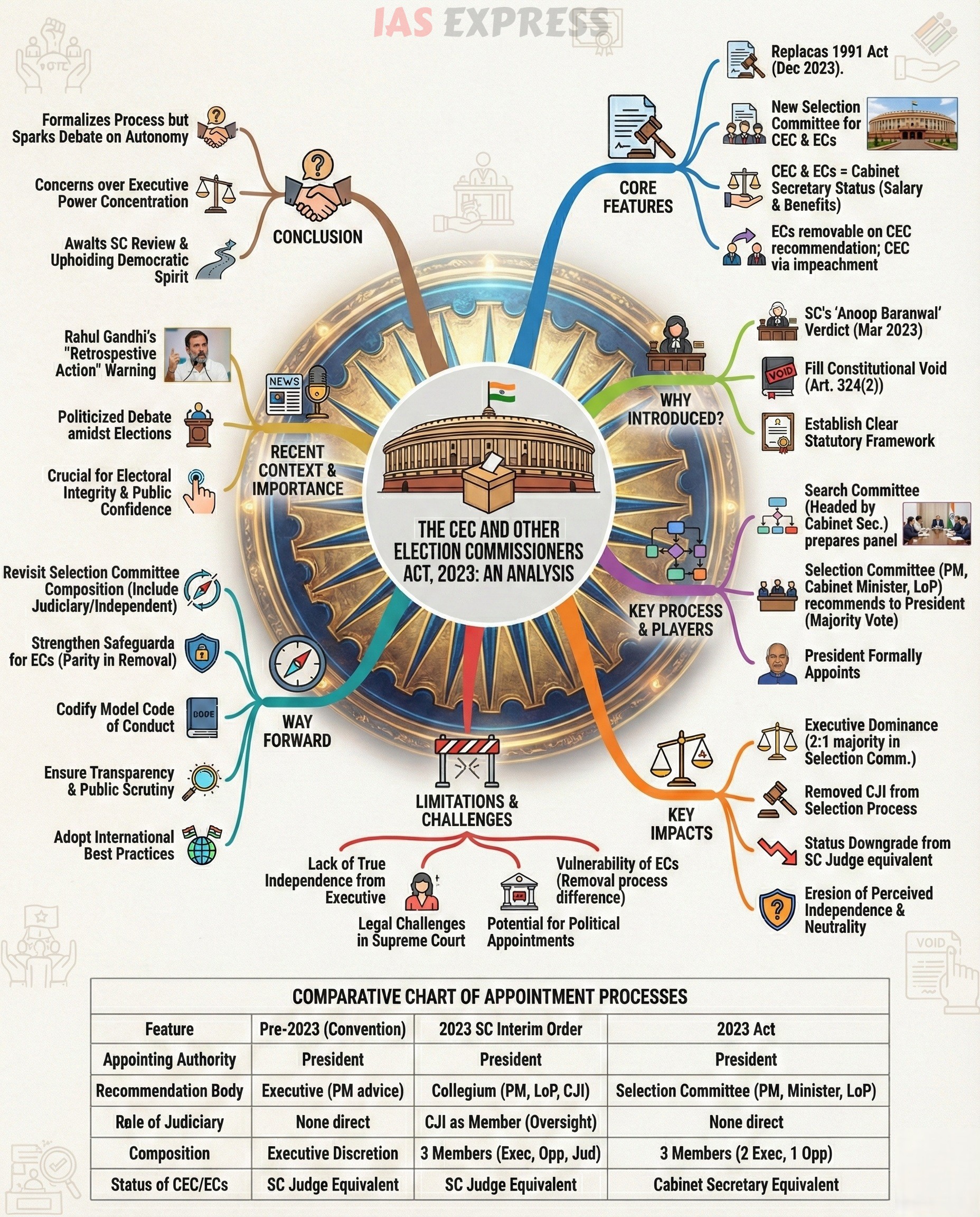
Recently, Rahul Gandhi warned the Election Commission about potential retrospective action, bringing significant attention to the controversial 2023 law he was referring to. This law, the Chief Election Commissioner and Other Election Commissioners (Appointment, Conditions of Service and Term of Office) Act, 2023, has reshaped how top election officials are chosen and removed. Passed on December 28, 2023, the Act has sparked widespread debate regarding the independence and autonomy of India’s electoral body. This article explores the details of this pivotal legislation, its historical context, key provisions, implications, and the ongoing discussions surrounding its impact on democratic processes in India.
What is the Core of the New Election Law?
- Defining the Act:
- The Chief Election Commissioner and Other Election Commissioners (Appointment, Conditions of Service and Term of Office) Act, 2023 is a new law.
- It came into effect on December 28, 2023, replacing the older Election Commission (Conditions of Service of Election Commissioners and Transaction of Business) Act, 1991.
- This new law focuses on how the Chief Election Commissioner (CEC) and Election Commissioners (ECs) are chosen, what their job conditions are, and how long they serve.
- Key Features of the Act:
- Appointment Process:
- The Act changes the way these important officials are appointed.
- Instead of a process involving the Chief Justice of India as suggested by a Supreme Court ruling in 2023, it introduces a new Selection Committee.
- This committee recommends names to the President for appointment.
- Selection Committee Composition:
- The new Selection Committee has three members.
- It includes the Prime Minister (as the Chairperson).
- It also includes a Union Cabinet Minister nominated by the Prime Minister.
- The third member is the Leader of the Opposition in the Lok Sabha. If there is no clear Leader of the Opposition, the leader of the single largest opposition party in the Lok Sabha becomes a member.
- This composition marks a significant shift from previous proposals for a more independent selection body.
- Conditions of Service:
- The Act sets out the salary and other benefits for the CEC and ECs.
- Their salary and allowances are now made equal to that of a Cabinet Secretary to the Government of India.
- Previously, their status was equivalent to a Supreme Court Judge, which typically has higher emoluments and security.
- Term of Office:
- CEC and ECs will hold office for a term of six years from the date they assume office, or until they reach the age of sixty-five years, whichever comes first.
- They cannot be reappointed.
- Resignation and Removal:
- They can resign by writing to the President.
- The Chief Election Commissioner (CEC) can be removed from office in the same way a Supreme Court Judge is removed, which involves a complex parliamentary process of impeachment for proven misbehavior or incapacity.
- However, the Election Commissioners (ECs) can be removed by the President on the recommendation of the CEC. This distinction in removal processes is a point of contention, raising concerns about the independence of ECs.
- Appointment Process:
Why Was This New Law Introduced in India?
- Responding to Judicial Intervention:
- The Supreme Court, in its Anoop Baranwal v. Union of India judgment on March 2, 2023, had pointed out a constitutional void.
- The Court noted that there was no specific law made by Parliament for the appointment of CEC and ECs, as required by Article 324(2) of the Constitution.
- It directed that until Parliament made such a law, a committee comprising the Prime Minister, the Leader of Opposition in Lok Sabha, and the Chief Justice of India would make appointments. This interim arrangement aimed to ensure impartiality.
- Government’s Stated Objectives:
- The government introduced this Act to fill the perceived legislative gap identified by the Supreme Court.
- It aimed to provide a clear, statutory framework for appointments, service conditions, and removal procedures for the Election Commission members.
- The government argued that the new law establishes a transparent and institutionalized process for these critical appointments.
- Ensuring Constitutional Mandate:
- Article 324(2) of the Indian Constitution states that the appointment of the CEC and ECs shall be made by the President, subject to the provisions of any law made by Parliament.
- The new Act is seen by the government as fulfilling this long-standing constitutional requirement.
- Before this Act, appointments were primarily guided by conventions and executive decisions, leading to demands for a more formalized process.
When Did This Legislation Come Into Force and What is its History?
- Passage and Enactment:
- The Chief Election Commissioner and Other Election Commissioners Bill, 2023 was introduced in the Rajya Sabha on August 10, 2023.
- It was passed by the Rajya Sabha on December 12, 2023, and by the Lok Sabha on December 21, 2023.
- It received the assent of the President of India on December 28, 2023, officially becoming an Act (Act No. 49 of 2023).
- Historical Context of Election Commission Appointments:
- Constitutional Provision:
- Article 324 of the Constitution lays down the framework for the Election Commission of India.
- Initially, the Election Commission was a single-member body.
- In October 1989, it became a multi-member body with the appointment of two additional Election Commissioners, though this was briefly reversed before being reinstated in 1993.
- Evolution of the Appointment Process:
- For decades, the appointments were made by the President on the advice of the government, essentially the executive’s discretion.
- There have been long-standing demands from various sections for a more independent selection mechanism, similar to that for the CBI Director or the Lokpal.
- Several committees, including the Dinesh Goswami Committee (1990) and the Law Commission of India (2015), have recommended a collegium system for appointments to enhance the independence of the Election Commission.
- The 1991 Act:
- The Election Commission (Conditions of Service of Election Commissioners and Transaction of Business) Act, 1991 set the service conditions for CEC and ECs, making their status equal to that of a Supreme Court Judge.
- This Act, however, did not specify the appointment procedure, leaving it to executive discretion.
- Supreme Court’s Intervention (2023):
- The Anoop Baranwal case highlighted this void. The Supreme Court’s interim judgment mandated a selection committee including the Chief Justice of India, aiming to ensure an independent process until a law was enacted.
- The 2023 Act, passed subsequently, superseded this interim judicial direction by establishing a different selection committee.
- Constitutional Provision:
Who are the Key Individuals and Bodies Involved in this Act?
- The President of India:
- The President formally appoints the Chief Election Commissioner and Election Commissioners based on the recommendations of the Selection Committee.
- The President also has the power to remove an Election Commissioner on the recommendation of the CEC.
- The Chief Election Commissioner (CEC):
- The CEC is the head of the Election Commission of India.
- They are responsible for the overall superintendence, direction, and control of elections.
- Under the new Act, the CEC’s removal process is akin to that of a Supreme Court Judge, requiring parliamentary approval.
- Election Commissioners (ECs):
- The Election Commission comprises the CEC and two Election Commissioners.
- They work together to manage electoral processes.
- A significant change under the new Act is that an EC can be removed by the President solely on the recommendation of the CEC, unlike the CEC’s more protected removal process.
- The Selection Committee:
- This is a crucial body established by the Act.
- It consists of the Prime Minister (Chairperson), a Union Cabinet Minister nominated by the Prime Minister, and the Leader of the Opposition in the Lok Sabha.
- This committee’s recommendations are binding on the President for appointments.
- The Parliament of India:
- The Parliament enacted this law, fulfilling its constitutional mandate under Article 324(2).
- It is also the body involved in the removal process of the CEC through impeachment.
- The Supreme Court of India:
- The Supreme Court played a significant role by delivering the Anoop Baranwal judgment in 2023.
- This judgment highlighted the absence of a parliamentary law for appointments and provided an interim mechanism, which the new Act has now superseded.
- The Supreme Court is currently hearing petitions challenging the constitutional validity of this new Act.
How Does the New Law Function and What are its Impacts?
- Working Mechanism of the Appointment Process:
- Search Committee:
- A Search Committee, headed by the Cabinet Secretary, prepares a panel of five suitable persons for consideration by the Selection Committee.
- This committee also includes two other members not below the rank of Secretary to the Government of India, having knowledge and experience in election matters.
- Selection Committee:
- The Selection Committee then considers the panel of names provided by the Search Committee.
- It can also consider other names not included in the panel.
- The committee then recommends a person for appointment as CEC or EC to the President.
- Decisions of the Selection Committee are made by a majority vote.
- Search Committee:
- Impacts of the Act:
- On the Independence of the Election Commission:
- Reduced Judicial Role: The most significant impact is the removal of the Chief Justice of India from the selection committee, replacing them with a Union Cabinet Minister. Critics argue this gives the executive a two-thirds majority in the three-member committee, potentially undermining the neutrality of appointments.
- Executive Dominance: The composition of the Selection Committee (PM, Cabinet Minister, Leader of Opposition) means the ruling government holds two out of three votes. This raises concerns about the potential for political influence in the appointment of election officials, who need to be impartial.
- Status Downgrade: Reducing the salary and status of CEC and ECs from that of a Supreme Court Judge to a Cabinet Secretary is seen by some as a diminution of the Election Commission’s stature and independence. The argument is that aligning their status with the judiciary reinforced their impartiality.
- Differential Removal Process: The fact that Election Commissioners can be removed on the recommendation of the CEC, while the CEC requires a parliamentary process, creates a hierarchical imbalance. This could make ECs feel less secure in their tenure and potentially more susceptible to the CEC’s influence, or indirectly, the executive’s influence on the CEC.
- On the Electoral Process:
- Public Trust: The independence of the Election Commission is vital for public trust in the electoral process. Any perception of executive influence in appointments could erode this trust, potentially leading to questions about the fairness and impartiality of elections.
- Neutrality of Decisions: An Election Commission whose members are perceived to be politically aligned might face challenges in maintaining public confidence in its decisions, including setting election schedules, enforcing the Model Code of Conduct, and resolving disputes.
- On Constitutional Principles:
- Separation of Powers: Critics argue that the Act encroaches upon the principle of separation of powers by increasing executive control over an independent constitutional body.
- Checks and Balances: The original proposal by the Supreme Court involving the Chief Justice of India aimed to provide an external check on executive power in appointments. The new Act is seen as removing this crucial check.
- On the Independence of the Election Commission:
Is This Law Important for India’s Democracy?
- Upholding Electoral Integrity:
- The Election Commission of India (ECI) is one of the most vital constitutional bodies, responsible for ensuring free and fair elections in the world’s largest democracy with over 900 million registered voters.
- The integrity and independence of the ECI are paramount to safeguarding democratic principles. Any law impacting its functioning is thus of immense significance.
- Constitutional Mandate:
- The Act attempts to fulfill a long-pending constitutional mandate under Article 324(2) for Parliament to legislate on the appointment process.
- Having a clear, statutory framework for appointments is theoretically a step towards greater clarity and transparency, even if the specifics of the framework are debated.
- Role in Public Confidence:
- A strong, independent Election Commission builds public confidence in election results and the democratic system itself.
- This law, by defining how its top officials are chosen, directly impacts that public perception and trust. For instance, the 2019 Lok Sabha elections involved over 67% voter turnout, reinforcing the importance of a credible election body.
- Legal Precedent:
- This Act sets a legal precedent for how appointments to other independent constitutional bodies might be governed in the future.
- The debate around this law reflects broader concerns about the balance of power between the executive, judiciary, and independent institutions.
What Limitations and Challenges Does the Act Face?
- Lack of True Independence in Appointments:
- Executive Dominance: The primary limitation is the composition of the Selection Committee. With the Prime Minister and a Cabinet Minister, the government effectively holds a 2:1 majority. This design is widely criticized for not providing enough independence from executive influence, unlike the Supreme Court’s suggested collegium which included the Chief Justice of India.
- Bypassing Judicial Oversight: The Act essentially reverses the Supreme Court’s attempt to introduce a more neutral selection process, leading to questions about parliamentary supremacy versus judicial review.
- Concerns over Erosion of ECI’s Autonomy:
- Perceived Loss of Prestige: Downgrading the CEC/EC’s status from a Supreme Court Judge to a Cabinet Secretary is seen by many legal experts and former election officials as diminishing the symbolic and functional independence of the office. While salary parity doesn’t directly impact decision-making, it can affect the overall perception and gravitas of the role.
- Vulnerability of Election Commissioners: The provision allowing the President to remove an EC on the CEC’s recommendation, without a parliamentary process, makes ECs potentially vulnerable. This could create a situation where ECs might feel compelled to align with the CEC’s stance, or a CEC might be influenced by the executive to recommend removal of an uncooperative EC.
- Legal Challenges:
- The Act’s constitutional validity has already been challenged in the Supreme Court. Several petitions argue that the law violates the basic structure of the Constitution by undermining the independence of the Election Commission. For example, petitions were filed immediately after its enactment, with the Supreme Court agreeing to hear them.
- Impact on Public Perception:
- Even if the ECI acts impartially, if the appointment process is seen as lacking independence, it can erode public trust in the electoral system. This perception, whether actual or not, is a significant challenge for the credibility of democratic institutions.
- Potential for Political Appointments:
- Critics fear that the new system could lead to appointments of individuals who are perceived to be favorable to the ruling dispensation, rather than purely independent and objective figures. This could affect crucial decisions like election scheduling, voter registration, and model code of conduct enforcement.
What is the Way Forward for Electoral Reforms?
- Revisiting the Selection Committee Composition:
- One major suggestion is to re-evaluate the composition of the Selection Committee.
- Many experts advocate for including the Chief Justice of India or other independent judicial members to ensure greater impartiality.
- Alternatively, expanding the committee to include members from independent constitutional bodies or civil society could enhance its neutrality.
- Strengthening Safeguards for ECs:
- The removal process for Election Commissioners needs to be brought on par with that of the CEC.
- Providing the same constitutional protection for removal to ECs as available to the CEC (impeachment by Parliament) would bolster their independence and prevent potential executive pressure.
- Codifying Other Aspects of ECI Functioning:
- Beyond appointments, there is a need for comprehensive electoral reforms.
- This includes codifying the Model Code of Conduct into law, ensuring better enforcement and accountability.
- Addressing issues like electoral bonds, funding of political parties, and regulating social media during elections are also crucial areas.
- Promoting Transparency and Public Scrutiny:
- The process of selecting candidates by the Search Committee and the deliberations of the Selection Committee should be made more transparent.
- Public hearings or detailed justifications for selections could enhance confidence.
- Ensuring that the final choice of CEC and ECs comes from a diverse pool of highly qualified and unimpeachable individuals is vital.
- Adhering to International Best Practices:
- Looking at how other established democracies appoint their election bodies can provide valuable insights. Many countries have multi-party or independent commissions involved in such appointments to safeguard neutrality.
- For example, in Canada, appointments are made by the Governor-in-Council, but there’s a strong tradition of non-partisanship.
- Upholding Constitutional Morality:
- Ultimately, the strength of India’s democracy relies on constitutional morality and the commitment of all branches of government to uphold the spirit, not just the letter, of the Constitution.
- This means prioritizing the independence of institutions like the ECI over short-term political gains.
Recent News: Rahul Gandhi’s Warning and its Implications
Rahul Gandhi’s recent warning to the Election Commission about potential “retrospective action” directly refers to the controversial 2023 law. This statement highlights the deep concerns opposition parties and many constitutional experts have about the Act.
- Context of the Warning:
- The warning came amidst ongoing Lok Sabha elections in 2024, where the Election Commission’s role in enforcing rules, addressing complaints, and ensuring a level playing field is under intense scrutiny.
- Gandhi’s statement reflects the apprehension that if the current government retains power, it might use the provisions of the new law to influence the Election Commission’s functioning or take action against officials who might have been perceived as impartial in their duties during the election period.
- The “Retrospective” Angle:
- While the 2023 Act itself doesn’t explicitly mention retrospective application for past decisions, the concern arises from the perceived executive dominance in appointments and removals under the new framework.
- The fear is that a government with a strong majority in the Selection Committee could appoint individuals who might be predisposed to review or interpret past actions of the Election Commission in a way that aligns with the government’s perspective.
- This could lead to an environment where election officials feel pressured, knowing that their tenure and future might be influenced by a politically dominated selection body.
- Implications for ECI’s Autonomy:
- Such warnings, whether based on immediate legal provisions or perceived future actions, underscore the fragility of the Election Commission’s autonomy in the eyes of some political actors and the public.
- They contribute to the narrative that the ECI’s independence is under threat, which can, in turn, impact voter confidence and the credibility of election outcomes.
- The essence of the concern is that if the executive has significant control over who gets appointed and how, it could potentially exert influence even on the interpretation of past electoral conduct.
- Heightened Political Discourse:
- Rahul Gandhi’s remark further politicizes the debate around the CEC and Other Election Commissioners Act 2023.
- It brings the law squarely into the political campaign, making it a point of contention and a symbol of concerns about democratic institutional integrity.
- This adds pressure on the Election Commission to demonstrate its impartiality and independence during a critical electoral cycle.
- Need for Clarity and Reassurance:
- The incident highlights the urgent need for clarity and reassurance from all stakeholders, especially the government and the Election Commission, regarding the safeguards for the institution’s independence.
- Addressing such concerns is vital for the health of India’s democratic process.
India and Its Election Commission: A Unique Perspective
- World’s Largest Democracy:
- India, with its vast and diverse electorate, holds the distinction of being the world’s largest democracy. Managing elections for over 900 million voters requires a robust, independent, and highly efficient election machinery.
- The Election Commission of India (ECI) has historically earned a reputation for its independence and fairness, conducting elections across varied terrains and complex social structures. For instance, the general elections often involve deploying over 11 million polling officials and security personnel.
- Constitutional Mandate and Powers:
- The ECI derives its powers directly from Article 324 of the Constitution. This Article grants it broad powers of superintendence, direction, and control over the preparation of electoral rolls and the conduct of all elections to Parliament, State Legislatures, and the offices of President and Vice-President.
- These powers include registering political parties, allocating symbols, enforcing the Model Code of Conduct, resolving election disputes, and delimiting constituencies, making it a highly influential body.
- Challenges of Scale and Diversity:
- India’s electoral landscape presents unparalleled challenges. With 28 states and 8 union territories, diverse languages, cultures, and geographical conditions, conducting elections is a monumental task.
- The ECI has successfully introduced technological advancements like Electronic Voting Machines (EVMs) and Voter Verifiable Paper Audit Trails (VVPATs) since the early 2000s, ensuring efficiency and transparency, even facing questions about 100% accuracy of EVMs during peak elections.
- Role in Maintaining Democratic Fabric:
- The ECI acts as a neutral umpire, crucial for maintaining the democratic fabric of the nation. Its ability to act independently and impartially is fundamental to the legitimacy of governments formed through elections.
- Any legislative changes, such as the 2023 Act, that impact its perceived or actual independence, therefore, become a matter of national importance and intense scrutiny.
- Public Trust and Global Standing:
- The ECI’s past record of conducting credible elections has earned it high public trust within India and respect internationally. Electoral observation missions often praise its operational capabilities.
- Maintaining this trust and standing is crucial, and the ongoing debates surrounding the appointment process under the new Act are seen as critical tests for this vital institution.
Comparative Chart of Appointment Processes
| Feature | Pre-Anoop Baranwal v. Union of India (2023) | Anoop Baranwal v. Union of India (2023) Interim Order | The CEC and Other Election Commissioners Act, 2023 |
|---|---|---|---|
| Appointing Authority | President of India | President of India | President of India |
| Recommendation Body | Executive (Council of Ministers/Prime Minister’s advice) | Collegium of 3 members: Prime Minister, Leader of Opposition in Lok Sabha, Chief Justice of India | Selection Committee of 3 members: Prime Minister (Chairperson), Union Cabinet Minister nominated by PM, Leader of Opposition in Lok Sabha (or leader of single largest opposition party) |
| Role of Judiciary | No direct role in selection | Chief Justice of India was a member of the collegium, ensuring judicial oversight | No direct role of Judiciary in selection. A Search Committee headed by Cabinet Secretary provides names. |
| Composition of Recommending Body | Not specified by law, based on convention | 3 members (1 from Executive, 1 from Opposition, 1 from Judiciary) | 3 members (2 from Executive, 1 from Opposition) |
| Status of CEC/ECs | Equivalent to a Supreme Court Judge | Equivalent to a Supreme Court Judge | Equivalent to a Cabinet Secretary to the Government of India |
| Removal Process of ECs | On the recommendation of the CEC | On the recommendation of the CEC | On the recommendation of the CEC |
| Constitutional Basis | Article 324(2) – subject to law made by Parliament (but no such law existed for appointment) | Interim order until Parliament enacts a law as per Article 324(2) | Parliament enacted law as per Article 324(2) |
Conclusion
The Chief Election Commissioner and Other Election Commissioners (Appointment, Conditions of Service and Term of Office) Act, 2023 represents a significant legislative step aimed at formalizing the appointment process for India’s top election officials. While it fulfills a long-standing constitutional mandate, its provisions, particularly regarding the composition of the Selection Committee and the status of the Commissioners, have ignited a nationwide debate. Critics argue that the Act concentrates power within the executive, potentially compromising the independence and neutrality of the Election Commission, a cornerstone of India’s democratic structure. The ongoing legal challenges in the Supreme Court and the concerns raised by political leaders like Rahul Gandhi underscore the critical need to ensure that the spirit of democratic fairness and institutional autonomy is upheld, maintaining public trust in the integrity of India’s electoral processes.
Q. How does the composition of the Selection Committee under the 2023 Act impact the perceived and actual independence of the Election Commission, and what are its long-term implications for India’s democratic system? (250 words)

Related Posts



If you like this post, please share your feedback in the comments section below so that we will upload more posts like this.

Responses