
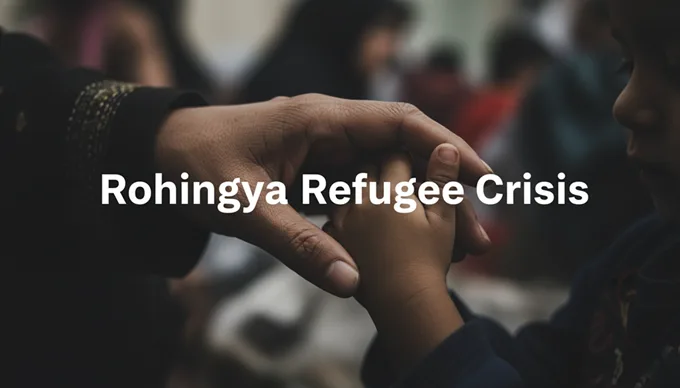
The Rohingya Refugee Crisis: Causes, Impacts, Challenges

From Current Affairs Notes for UPSC » Editorials & In-depths » This topic
The first-ever high-level conference addressing the Rohingya ethnic cleansing and refugee crisis at the U.N. General Assembly on September 30, proposed by Bangladesh, marked a crucial moment. Muhammad Yunus, the Chief Adviser of Bangladesh’s interim government, unveiled a seven-point plan for a sustainable solution, emphasizing the need for the expeditious repatriation of the refugees to their homeland in Rakhine State. Urging global action to prevent a catastrophe, Yunus underscored that the Rohingya crisis originated in Myanmar, and thus, its ultimate solution must also be found there. This renewed international focus highlights the urgency of addressing one of the world’s most pressing humanitarian challenges.
What is the Rohingya Crisis?
The Rohingya crisis refers to the systematic persecution, displacement, and statelessness of the Rohingya people, an ethnic Muslim minority primarily from the Rakhine State of Myanmar.
- Meaning of the crisis
- It embodies a profound humanitarian catastrophe, involving widespread human rights violations.
- It is characterized by forced displacement, rendering a large population stateless and reliant on humanitarian aid.
- The crisis is a complex interplay of historical grievances, legal discrimination, and targeted violence.
- Features of the crisis
- Statelessness: The Rohingya are largely denied citizenship in Myanmar, making them one of the world’s largest stateless populations. This denial stems from the 1982 Citizenship Law, which does not recognize them as one of Myanmar’s “national races.”
- Persecution and Discrimination: They face severe restrictions on movement, marriage, education, and access to healthcare, often described as akin to apartheid.
- Forced Displacement: Repeated military crackdowns and violence have led to massive outflows of Rohingya, primarily to neighboring Bangladesh, but also to other countries.
- International Concern: The United Nations has described the military actions against the Rohingya in 2017 as a “textbook example of ethnic cleansing.”
Why did the Rohingya crisis happen?
The crisis is rooted in a long history of discrimination, political exclusion, and targeted violence against the Rohingya in Myanmar.
- Historical context of discrimination
- Colonial era divisions: British colonial policies exacerbated tensions between different ethnic groups in the region, laying groundwork for future conflicts.
- Post-independence nationalism: Following Myanmar’s independence in 1948, a strong sense of national identity emerged, often excluding groups like the Rohingya who were perceived as outsiders.
- Military rule and nationalist agenda: Since the 1962 military coup, successive military regimes have pursued a nationalist agenda that systematically deprived Rohingya of political and human rights.
- Root causes of the conflict
- 1982 Citizenship Law: This law is a critical factor, as it effectively stripped the Rohingya of their citizenship by not recognizing them as one of the 135 official ethnic groups.
- The law repealed previous citizenship acts, making it difficult for many Rohingya to prove their residency and lineage.
- It created a legal framework for intergenerational statelessness, as children born to non-citizens also become stateless.
- Sections 29 and 51 of the law specifically contribute to statelessness by making it difficult for children of associate or naturalized citizens to acquire citizenship if a parent loses identity.
- Systematic Human Rights Violations: Decades of state-led repression have included restrictions on movement, denial of access to education and jobs, and confiscation of land.
- Targeted Violence and Military Operations:
- Operation Nagamin (1978): This “citizenship verification” operation led to over 200,000 Rohingya fleeing to Bangladesh.
- Military crackdowns in 1991-1992: Another wave of persecution forced more Rohingya to seek refuge in Bangladesh.
- 2012 violence: Clashes between Rohingya and Rakhine Buddhists resulted in significant displacement and heightened tensions.
- 2016-2018 crackdowns: A severe military offensive starting in August 2017, in response to attacks by the Arakan Rohingya Salvation Army (ARSA), resulted in widespread killings, sexual violence, and village burnings. This forced over 700,000 Rohingya to flee to Bangladesh, joining an estimated 1 million already there. The violence continued to cause displacement, with 1 million Rohingya sheltering in Bangladesh as of August 2024.
- 1982 Citizenship Law: This law is a critical factor, as it effectively stripped the Rohingya of their citizenship by not recognizing them as one of the 135 official ethnic groups.
Where are the Rohingya refugees located?
The majority of Rohingya refugees are concentrated in Bangladesh, with significant populations also in other countries in the region.
- Primary host country: Bangladesh
- Cox’s Bazar: This district hosts the world’s largest refugee settlement, housing over 1 million Rohingya in 33 densely populated camps.
- Bhasan Char: Approximately 37,000 Rohingya have been relocated to this island, intended to alleviate overcrowding in the Cox’s Bazar camps.
- As of May 2025, Bangladesh hosts 1.13 million Rohingya refugees.
- Over 95% of Rohingya in Bangladesh are dependent on humanitarian aid.
- The UN High Commissioner for Refugees (UNHCR) anticipates an additional 150,000 new Rohingya arrivals in Bangladesh between June and December 2025.
- Other host countries
- India: An estimated 40,000 Rohingya refugees reside in India.
- Malaysia: A significant number of Rohingya have sought refuge in Malaysia, often arriving by sea.
- Indonesia and Thailand: These countries also host smaller populations of Rohingya refugees.
- Globally, approximately 1.28 million stateless Rohingya remain displaced as of May 2025, with about 130,000 across the region outside of Bangladesh.
When did the Rohingya crisis escalate?
The crisis has a long history, but experienced significant escalations, particularly in 1978, 1991-92, and most severely in 2017.
- Early historical presence
- The Rohingya have inhabited the Rakhine (formerly Arakan) region of Myanmar for centuries, with historical records indicating their presence long before British colonial rule.
- During the British colonial period, there was significant migration of Indian laborers to Myanmar, which became a point of contention after independence.
- Key escalation points
- 1978: Operation Nagamin: This military operation led to the displacement of over 200,000 Rohingya.
- 1991-1992 crackdown: Another military offensive forced around 250,000 Rohingya into Bangladesh.
- 2012 communal violence: Significant clashes between Rohingya and Rakhine Buddhists resulted in hundreds of deaths and over 140,000 displaced, mostly Rohingya.
- August 2017 crackdown: This marks the most severe and widely recognized escalation, where a brutal military response to ARSA attacks caused over 700,000 Rohingya to flee to Bangladesh within a few months. This event led to the UN’s declaration of “ethnic cleansing.”
- The UN’s top court mandated Myanmar to protect the Rohingya in January 2020.
- August 25th, 2024, marked seven years since the mass displacement of Rohingya from Rakhine State.
Who are the key actors in the crisis?
Various state and non-state actors play significant roles in the Rohingya crisis, from perpetrators to aid providers.
- Affected population
- Rohingya people: The primary victims, a stateless ethnic Muslim minority from Myanmar’s Rakhine State.
- Perpetrators/Drivers of the crisis
- Myanmar Military (Tatmadaw): Accused of orchestrating the 2017 crackdown, which involved widespread human rights abuses.
- Myanmar Government: Implementing discriminatory laws, most notably the 1982 Citizenship Law, and failing to protect the Rohingya.
- Rakhine Nationalist Groups: Local groups in Rakhine State who often view the Rohingya as illegal immigrants and contribute to anti-Rohingya sentiment.
- International and regional responders
- United Nations (UN): Involved in humanitarian aid, human rights monitoring, and calling for accountability and durable solutions.
- The UN Secretary-General has consistently called for accountability and safe return for the Rohingya.
- UN agencies like UNHCR, IOM, and UNICEF are central to coordinating humanitarian responses.
- Bangladesh Government: Hosts the vast majority of Rohingya refugees and leads efforts for their repatriation.
- International Non-Governmental Organizations (INGOs): Provide essential services such as food, shelter, healthcare, and education in refugee camps.
- Donor Countries: Provide financial assistance for humanitarian efforts, with contributions often managed through UN agencies and INGOs. The EU has allocated €32.3 million to support Rohingya in Bangladesh, with a total of €76 million for crises in South and Southeast Asia. The World Bank approved $700 million in May 2024 for basic services and resilience for displaced Rohingya and host communities.
- Association of Southeast Asian Nations (ASEAN): Has been urged to take a more active role in resolving the crisis and ensuring regional stability.
- United Nations (UN): Involved in humanitarian aid, human rights monitoring, and calling for accountability and durable solutions.
How are efforts being made to resolve the crisis?
Efforts to resolve the crisis involve humanitarian aid, diplomatic engagement, and calls for accountability, though progress remains slow.
- Humanitarian assistance and support
- Joint Response Plans (JRPs): These annual plans, led by the Bangladesh Government in collaboration with the UN and partners, coordinate international humanitarian efforts.
- The 2024 JRP sought $852.4 million to assist 1.3 million people in Bangladesh.
- The 2025-26 JRP, launched on March 24, 2025, seeks $\text{934.5 million in its first year to assist approximately 1.48 million people, including Rohingya refugees and host communities.
- As of August 31, 2025, the 2025 JRP is 37\% funded, having received }$342 million against the appeal.
- Provision of basic services: Aid organizations provide food, shelter, medical care, water, sanitation, and education in refugee camps.
- Addressing new arrivals: The 2025 JRP includes provisions for 50,000 confirmed new arrivals and potentially another 50,000 undergoing biometric identification, who recently fled to Bangladesh. A flash appeal in 2025 requires $\text{455.6 million for immediate humanitarian assistance.
- Joint Response Plans (JRPs): These annual plans, led by the Bangladesh Government in collaboration with the UN and partners, coordinate international humanitarian efforts.
- Repatriation efforts
- Voluntary and dignified return: The ultimate goal is the safe, voluntary, and dignified return of Rohingya to their homes in Rakhine State.
- Bilateral discussions: Bangladesh and Myanmar have held discussions on repatriation, with Myanmar assuring Bangladesh of their return. 180,000 Rohingya have been identified for return, and verification for another 70,000 is underway.
- Challenges to repatriation: Concerns about security, citizenship rights, and safety in Rakhine State continue to hinder large-scale returns. The political instability and insecurity in Myanmar also make repatriation efforts challenging.
- Accountability and justice
- International Court of Justice (ICJ): The Gambia filed a case against Myanmar for genocide, leading to an ICJ order in 2020 for Myanmar to protect the Rohingya.
- International Criminal Court (ICC): Has opened an investigation into alleged crimes against humanity against the Rohingya.
- UN Human Rights Council: Continuously monitors the situation and calls for justice and accountability for the atrocities committed against the Rohingya.
Recent Developments and Bangladesh’s Proposal
The UN General Assembly served as a platform for intensified international focus on the crisis, particularly through Bangladesh’s advocacy.
- UN Conference on September 30, 2025
- Bangladesh proposed the first-ever high-level conference dedicated to the Rohingya crisis, highlighting its severe impact.
- The conference aimed to galvanize international support and seek concrete solutions for the repatriation of Rohingya refugees.
- Muhammad Yunus’s Seven-Point Proposal
- Bangladesh’s Chief Adviser, Muhammad Yunus, presented a comprehensive seven-point plan for a sustainable resolution to the crisis.
- Key proposals include:
- Developing a practical roadmap for safe, dignified, and voluntary repatriation to Rakhine State, ensuring reasonable stabilization of the region.
- Mobilizing international support to stabilize Rakhine and establish an international civilian presence for monitoring the situation on the ground.
- Supporting confidence-building measures for the sustainable integration of Rohingya into Rakhine society and governance.
- Exerting effective pressure on Myanmar and the Arakan Army to cease violence against the Rohingya and initiate sustainable repatriation.
- Mobilizing donor contributions to fully fund the Joint Response Plans, acknowledging that current funding is dwindling.
- Pursuing accountability and restorative justice for the atrocities committed against the Rohingya.
- Dismantling the narco-economy and combating transboundary crimes, which have destabilized the region and created security concerns.
- Yunus emphasized that Bangladesh cannot afford to employ Rohingya within its borders due to its own developmental challenges and that the crisis’s solution lies within Myanmar. He also stressed that existing initiatives are insufficient and stronger international action is needed.
What is India’s role in the crisis?
India, as a neighboring country, has a complex and evolving stance on the Rohingya crisis, balancing humanitarian concerns with national security and demographic considerations.
- Geographical proximity and historical ties
- India shares a border with both Myanmar and Bangladesh, placing it directly in the region affected by the crisis.
- Historically, India has provided refuge to various persecuted groups, though it is not a signatory to the 1951 Refugee Convention.
- Evolving policy towards Rohingya
- Initial reception: Some Rohingya refugees have historically found refuge in India, including around 40,000 currently residing there.
- Government stance: The Indian government officially considers Rohingya as “illegal immigrants” rather than refugees.
- Detention and deportation: There have been reports of Indian authorities detaining Rohingya and deporting them to Myanmar or Bangladesh, often without proper rights protections. For instance, in May 2025, 40 Rohingya refugees were allegedly deported from India to Myanmar. Several hundred Rohingya have been arbitrarily detained.
- Humanitarian aid: India has provided some humanitarian assistance to Bangladesh for Rohingya refugees, including Operation Insaniyat in 2017, which supplied aid materials.
- Security concerns: India often cites national security concerns as a reason for its cautious approach to Rohingya refugees.
- Policy gaps: Reports highlight significant shortcomings in India’s refugee policies regarding the Rohingya, noting the absence of a comprehensive legal framework for refugees.
What are the limitations and challenges?
Despite international efforts, numerous limitations and challenges hinder a sustainable resolution to the Rohingya crisis.
- Lack of political will and accountability in Myanmar
- Military junta: The current military regime in Myanmar has shown little willingness to address the root causes of the crisis or facilitate safe returns.
- Denial of citizenship: The continued refusal to grant Rohingya citizenship remains a fundamental barrier to their integration and return.
- Impunity for crimes: Lack of accountability for past atrocities perpetuates a climate of fear and distrust among the Rohingya.
- Challenges in host countries
- Overcrowding and strain on resources: Bangladesh faces immense pressure due to hosting over a million refugees, straining its natural resources and public services.
- Dwindling humanitarian funding: Global crises and donor fatigue have led to significant cuts in aid, causing deteriorating conditions in refugee camps. The 2025 JRP is only 37\% funded as of August 2025.
- Safety and security in camps: Refugee camps face issues of crime, trafficking, and radicalization, particularly with the rise of narco-flows from Rakhine.
- Monsoon seasons and natural disasters: The camps in Cox’s Bazar are vulnerable to cyclones, floods, and landslides, particularly during monsoon seasons.
- International community limitations
- Ineffective pressure on Myanmar: International sanctions and diplomatic pressure have largely failed to compel Myanmar to change its policies.
- Lack of unified approach: Divisions among international actors sometimes hinder a cohesive and strong response.
- Focus on aid over solutions: While humanitarian aid is crucial, there is a perceived over-reliance on temporary relief rather than investing in durable political solutions.
How can we move forward for a lasting solution?
A comprehensive and coordinated approach is essential, involving sustained international pressure, robust humanitarian support, and long-term development strategies.
- Strengthening international advocacy and pressure
- Unified international front: Global leaders must maintain a united and consistent stance in demanding Myanmar uphold human rights and allow for safe, dignified returns.
- Targeted sanctions: Imposing targeted sanctions on individuals and entities responsible for human rights abuses can increase pressure on the Myanmar regime.
- Continued legal action: Supporting ongoing cases at the ICJ and ICC to ensure accountability for atrocities.
- Facilitating dignified and voluntary repatriation
- Creating conducive conditions in Rakhine: This includes ensuring security, guaranteeing citizenship rights, and providing access to basic services for returning Rohingya.
- International monitoring: Establishing an independent international civilian presence in Rakhine State to monitor the safety and well-being of returnees.
- Confidence-building measures: Implementing programs that foster inter-communal harmony and trust between Rohingya and Rakhine communities.
- Sustaining humanitarian support and resilience
- Increased and predictable funding: Donors must ensure consistent and adequate financial support for Joint Response Plans to meet the refugees’ urgent needs. In March 2025, UN partners sought }$934.5 million for aid for 1.5 million people.
- Education and livelihoods: Investing in education and skills training for Rohingya youth can empower them and reduce dependency on aid, preparing them for future self-reliance.
- Environmental mitigation: Addressing the environmental impact of refugee camps in Bangladesh, including reforestation and waste management efforts.
- Support for host communities: Providing development assistance to host communities in Bangladesh to mitigate the socio-economic and environmental strain caused by the refugee presence.
Comparison of Key Aspects of the Rohingya Crisis
| Aspect | Key Features in Bangladesh (Host) | Key Features in Myanmar (Origin) |
|---|---|---|
| Refugee Numbers | Over 1.1 million, mainly in Cox’s Bazar and Bhasan Char. 50,000 new arrivals confirmed in 2025. | Approximately 600,000 remain, many internally displaced and facing restrictions. |
| Citizenship Status | Considered refugees; lack official citizenship in their country of origin. | Denied citizenship under the 1982 Citizenship Law; largely stateless. |
| Humanitarian Needs | High; dependent on international aid for food, shelter, healthcare, education. Requires $934.5 million in 2025. | Limited access to basic services due to restrictions; continued insecurity. |
| Security Concerns | Overcrowding, crime, trafficking, narco-flows. Camps vulnerable to natural disasters. | Ongoing conflict, military repression, inter-communal tensions in Rakhine. |
| Repatriation Status | Bangladesh advocates for expeditious repatriation; 180,000 identified for return, but safety concerns remain. | Myanmar assures repatriation but conditions for safe and dignified return are not yet met. |
| International Response | Focus on humanitarian aid, JRPs, and advocacy for repatriation. Bangladesh leads international coordination efforts. | International condemnation, calls for accountability (ICJ, ICC), but limited concrete action to change Myanmar’s policies. |
Conclusion
The Rohingya refugee crisis remains a profound human tragedy, characterized by mass displacement, statelessness, and systematic human rights abuses. Originating from decades of persecution and discriminatory laws in Myanmar, the crisis has forced over a million Rohingya to seek refuge, primarily in Bangladesh. Recent international attention, including the UN conference initiated by Bangladesh and Muhammad Yunus’s seven-point proposal, underscores the urgent need for a durable solution. While humanitarian efforts continue to provide crucial aid, the fundamental challenges of ensuring safe, dignified, and voluntary repatriation to Rakhine State persist due to a lack of political will in Myanmar, dwindling international funding, and complex security issues. A sustained and unified global approach focusing on accountability, effective diplomatic pressure, and comprehensive support for both refugees and host communities is essential to navigate this protracted crisis towards a just and lasting resolution.
Q. How can international bodies balance state sovereignty with the imperative to protect stateless populations like the Rohingya? (250 words)

Related Posts
If you like this post, please share your feedback in the comments section below so that we will upload more posts like this.

Responses