
The Snapback Mechanism & Iran Nuclear Deal: Explained

From Current Affairs Notes for UPSC » Editorials & In-depths » This topic
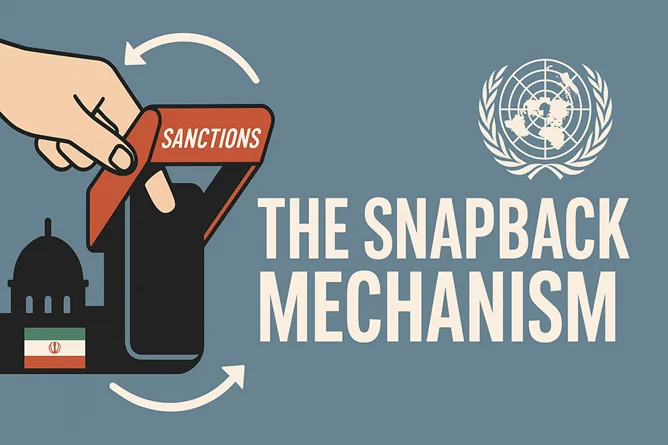
The landscape of international relations is currently witnessing a significant diplomatic maneuver centered on the Iran nuclear deal. Iran’s parliament, dominated by conservatives, is considering a withdrawal from the landmark Treaty on the Non-Proliferation of Nuclear Weapons (NPT). This reactive measure follows the decision by the E3 group of nations—Britain, France, and Germany—to activate the snapback mechanism embedded within the 2015 nuclear agreement, formally known as the Joint Comprehensive Plan of Action (JCPOA). This activation could lead to the swift re-imposition of United Nations sanctions on Iran, which were lifted as a reward for curbing its nuclear program. The situation creates a high-stakes environment, escalating tensions between Iran and the West, while also leaving a narrow window for last-minute diplomacy to salvage the collapsing agreement and prevent a deeper crisis. This complex scenario brings the unique and powerful snapback mechanism into sharp focus on the global stage.
What Is The Snapback Mechanism?
- The snapback mechanism is a special and powerful tool created in international law.
- It allows for the quick re-imposition of international sanctions that had been previously lifted.
- Think of it like an automatic reversal switch. If a country fails to follow its commitments under an agreement, this switch can be flipped to bring back the old penalties.
- It is most famously associated with the 2015 Iran nuclear deal, or the JCPOA.
- The deal was made between Iran and a group of world powers called the P5+1 (the five permanent members of the UN Security Council – China, France, Russia, the UK, the US – plus Germany).
- Under the deal, Iran agreed to seriously limit its nuclear activities. In return, the UN, US, and EU lifted their heavy economic sanctions on Iran.
- The snapback mechanism was included as a safety net.
- Key Feature: It was designed to be veto-proof.
- Normally, any of the five permanent members of the UN Security Council (P5) can block, or veto, a new resolution to impose sanctions.
- The snapback process is different. It is designed to happen automatically unless the Security Council votes to prevent it. A single country cannot stop it.
- Key Feature: It is triggered by a claim of ‘significant non-performance’.
- This means if any of the participant countries believe Iran is seriously violating the terms of the nuclear deal, they can start the snapback process.
- This provides a strong enforcement tool that does not depend on achieving a full consensus among all world powers, some of whom might have different interests. For example, in 2025, it is the E3 (Britain, France, and Germany) who have claimed that Iran’s enrichment of uranium to 60% purity, far beyond the 3.67% limit set by the deal, constitutes significant non-performance.
- Key Feature: It was designed to be veto-proof.
Why Was This Mechanism Created?
- The primary reason for creating the snapback mechanism was to build trust and ensure compliance.
- Negotiators of the Iran nuclear deal knew that it would be difficult to trust that all sides would stick to their promises over the long term, which was set for a period of over 10 years.
- The Western powers, particularly the US, were concerned that Iran might secretly cheat on the deal.
- They wanted a powerful guarantee that if Iran broke the rules, the international sanctions that brought it to the negotiating table could be quickly put back in place.
- It was designed to overcome the geopolitical divisions in the UN Security Council.
- The creators of the snapback were aware that countries like Russia and China have different relationships with Iran compared to Western countries.
- They worried that if Iran were to violate the deal, Russia or China might use their veto power to protect Iran from renewed sanctions.
- The snapback cleverly reverses the logic.
- Instead of needing a “yes” vote from everyone to impose sanctions, it requires a “yes” vote to stop the sanctions from coming back.
- Any permanent member wanting the sanctions back can simply veto the resolution that would continue the sanctions relief, making the snapback almost unstoppable.
- It served as a deterrent.
- The very existence of such a powerful and automatic punishment was intended to discourage Iran from even considering non-compliance.
- It sent a clear message: the consequences for breaking the deal would be swift and severe, restoring a comprehensive sanctions regime that had crippled Iran’s economy with measures like limiting its oil sales to 1 million barrels per day.
How Does The Snapback Process Work?
- The process is laid out in UN Security Council Resolution 2231, which endorsed the JCPOA.
- Step 1: A Complaint of Non-Performance
- Any of the original participants in the JCPOA (one of the P5+1 countries) can start the process.
- They must send a formal letter to the President of the UN Security Council.
- In this letter, they state that they believe Iran is in ‘significant non-performance’ of its commitments under the deal. For instance, the E3’s 2025 letter cited Iran’s continued non-compliance with its commitments as the legal basis for their action.
- Step 2: The Dispute Resolution Mechanism (Optional First Step)
- The JCPOA has its own internal process to handle disagreements, called the Joint Commission.
- Before going to the UN, countries are encouraged to use this commission to try and solve the problem through talks which can last for 15 days, with extensions possible. Both the E3 (in January 2020) and Iran (in July 2020) have previously triggered this mechanism.
- However, a country can still trigger the snapback even if this process fails or if they choose to bypass parts of it.
- Step 3: The 30-Day Countdown at the UN Security Council
- Once the complaint letter is submitted, a 30-day clock starts ticking.
- During these 30 days, the Security Council must vote on a new resolution.
- This resolution would be to “continue the lifting of sanctions” on Iran.
- Step 4: The Veto-Proof Outcome
- For the sanctions to stay lifted, this new resolution needs to be passed. It requires at least nine “yes” votes and no vetoes from any of the five permanent members (US, UK, France, Russia, China).
- However, the country that triggered the snapback (for example, the US or France) can simply veto this resolution.
- If the resolution is not passed within the 30-day window for any reason (including a veto), the snapback happens automatically on the 31st day.
- All the old UN sanctions against Iran come back into full effect. This includes six previous resolutions (1696, 1737, 1747, 1803, 1835, and 1929) that impose restrictions on everything from uranium enrichment to arms sales and financial transactions.
What Is The Recent News About Iran?
- In late August 2025, the three European powers in the Iran deal – Britain, France, and Germany (the E3) – officially triggered the snapback mechanism.
- They sent a letter to the UN Security Council declaring that Iran was in “significant non-performance” of its nuclear commitments.
- Reasons cited by the E3:
- Iran has been in clear violation of its obligations for years, with no concrete remedial steps taken.
- A significant portion of its uranium is enriched to levels close to what is needed for a nuclear weapon.
- Iran is operating advanced centrifuges not permitted under the deal.
- This move comes just before a crucial deadline.
- The snapback provision of the JCPOA is set to expire on October 18, 2025.
- The E3 acted because they feared losing this powerful tool forever. They chose to trigger it rather than let it expire while Iran was not complying with the deal.
- Iran’s Reaction:
- Iran has reacted with anger, calling the E3’s action illegal and unjustified.
- In a significant move, Iran’s conservative-led parliament is now drafting a bill that could lead to Iran’s withdrawal from the Nuclear Non-Proliferation Treaty (NPT).
- The NPT is the cornerstone of global efforts to prevent the spread of nuclear weapons. A withdrawal would be a major blow to the international non-proliferation regime and would escalate the crisis dramatically.
- Global Implications:
- The activation of the snapback sets the stage for the formal collapse of the 2015 Iran nuclear deal.
- It renews the threat of comprehensive UN sanctions on Iran, which will hurt its economy and increase its isolation.
- It creates a tense diplomatic situation, with Russia and China likely opposing the move and siding with Iran, further straining relations within the UN Security Council.
What Is The Significance Of This Mechanism?
- Upholding International Agreements:
- It represents a novel attempt to create a strong enforcement mechanism for a major international treaty without relying on the complete agreement of all major powers.
- It provides a credible threat of punishment, making diplomatic agreements more than just paper promises.
- A Tool of Coercive Diplomacy:
- The threat of snapback is a powerful lever in negotiations. It can be used to pressure a country to comply with its obligations.
- For countries like India, which depend heavily on oil imports, the stability of such agreements is crucial. The use of such a powerful tool can cause major market volatility and impact energy security. For instance, the mere threat of sanctions on a major supplier like Iran can cause crude oil prices to jump by 5-10%, directly affecting India’s import bill.
- A New Model for Disarmament:
- The snapback concept could be a model for future arms control and non-proliferation treaties.
- It offers a way to address the challenge of ensuring compliance when dealing with sensitive issues like nuclear programs, where trust is low and the stakes are high.
What Are The Limitations and Challenges?
- Risk of Escalation:
- While designed to enforce a deal, triggering the snapback can also be seen as a point of no return.
- It can destroy the very agreement it was meant to protect, leading the targeted country to abandon all its commitments. Iran’s threat to leave the NPT is a clear example of this risk.
- Political and Diplomatic Fallout:
- Using the snapback is a highly confrontational act. It can deepen divisions between world powers.
- In the case of the JCPOA, the US withdrawal in 2018 already weakened the deal. The E3’s triggering of the snapback now, while legally justified by them, is opposed by Russia and China, who argue it is a destructive move that punishes Iran after the US was the first to break the deal. This can lead to a fractured and less effective UN Security Council.
- Limited Practical Impact?:
- Some analysts argue that the snapback may be more symbolic than practical at this stage.
- The US has already re-imposed its own powerful unilateral sanctions on Iran after 2018. These “secondary sanctions” are so extensive that they have already deterred most international companies from doing business with Iran.
- Therefore, the return of UN sanctions may not add a significant amount of new economic pressure, but it does carry immense political and legal weight.
- Questions of Legitimacy:
- The legitimacy of using the snapback has been questioned.
- In 2020, the Trump administration tried to trigger the snapback after having already withdrawn the US from the JCPOA. Most of the world, including the other participants, rejected this move, arguing that a country that has left an agreement can no longer use its provisions. This created a debate about who legally has the right to use the mechanism.
Comparison Chart: Snapback vs. Standard UN Sanctions
| Feature | Standard UN Sanctions Process | JCPOA Snapback Mechanism |
|---|---|---|
| Initiation | Requires a new Security Council resolution to be proposed and voted on. | Initiated by a single JCPOA participant notifying the Security Council of non-performance. |
| Voting Logic | A “Yes” vote is needed to impose sanctions. | A “No” vote (or veto) is needed to prevent sanctions from being re-imposed. |
| Veto Power | Any of the P5 members (US, UK, France, Russia, China) can veto and block the imposition of sanctions. | Any of the P5 members can veto the resolution to continue sanctions relief, thereby ensuring sanctions are re-imposed. |
| Outcome | Requires consensus or at least no opposition from P5 members to pass. | Designed to be almost automatic and unstoppable by opponents of sanctions. |
| Timeline | Can be a long and drawn-out process of negotiation and voting. | Follows a strict 30-day timeline. |
| Purpose | To respond to a new threat to international peace and security. | To enforce compliance with a pre-existing agreement (the JCPOA). |
What Is The Way Forward?
- A Small Window for Diplomacy:
- Even after the snapback is triggered, the 30-day window before sanctions are officially re-imposed offers a final, slim opportunity for diplomacy.
- Intense negotiations could lead to a last-minute agreement, where Iran might take steps to return to compliance in exchange for the E3 and US offering some concessions or a path to future relief.
- De-escalation is Critical:
- The immediate priority for all parties should be to de-escalate the situation.
- This means avoiding provocative actions. For Iran, this would mean not rushing to withdraw from the NPT. For the Western powers, it would mean keeping a channel of communication open.
- Thinking Beyond the JCPOA:
- With the JCPOA effectively dead, world powers need to start thinking about what comes next.
- A new, more comprehensive agreement might be needed. This future deal might need to address not only Iran’s nuclear program but also its ballistic missile program and its regional activities, which were concerns not fully covered by the JCPOA.
- However, getting Iran to negotiate such a deal under the threat of renewed sanctions will be extremely challenging.
Conclusion
The snapback mechanism is a fascinating and powerful innovation in international law, representing a double-edged sword. On one hand, it is a robust tool designed to enforce compliance and give credibility to diplomatic agreements, overcoming the perennial problem of the Security Council veto. On the other hand, its activation is an extreme measure that can lead to the total collapse of the agreement it was meant to protect, risking major geopolitical escalation and undermining international legal norms. The current situation with Iran demonstrates this paradox perfectly. As the world watches the final days of the JCPOA, the legacy of the snapback mechanism will be judged by whether it ultimately served as a guarantor of peace and non-proliferation, or as a trigger for a new and more dangerous chapter of confrontation.
Q. Critically examine the effectiveness of the snapback mechanism as a tool for enforcing international agreements in a multipolar world. (250 words)

Related Posts
If you like this post, please share your feedback in the comments section below so that we will upload more posts like this.

Responses