
U.S. Tariffs on Indian Exports: A Comprehensive Analysis

From Current Affairs Notes for UPSC » Editorials & In-depths » This topic
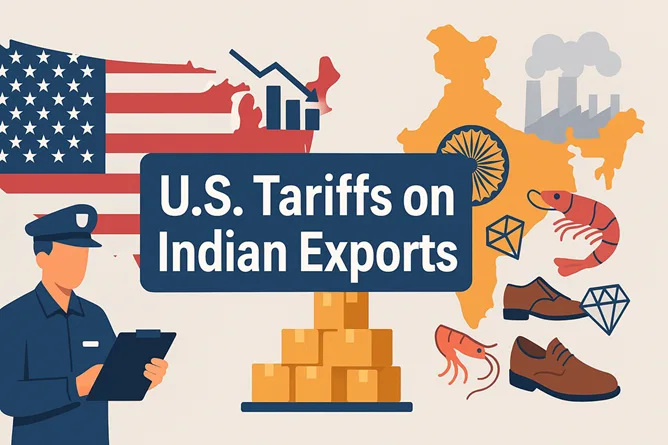
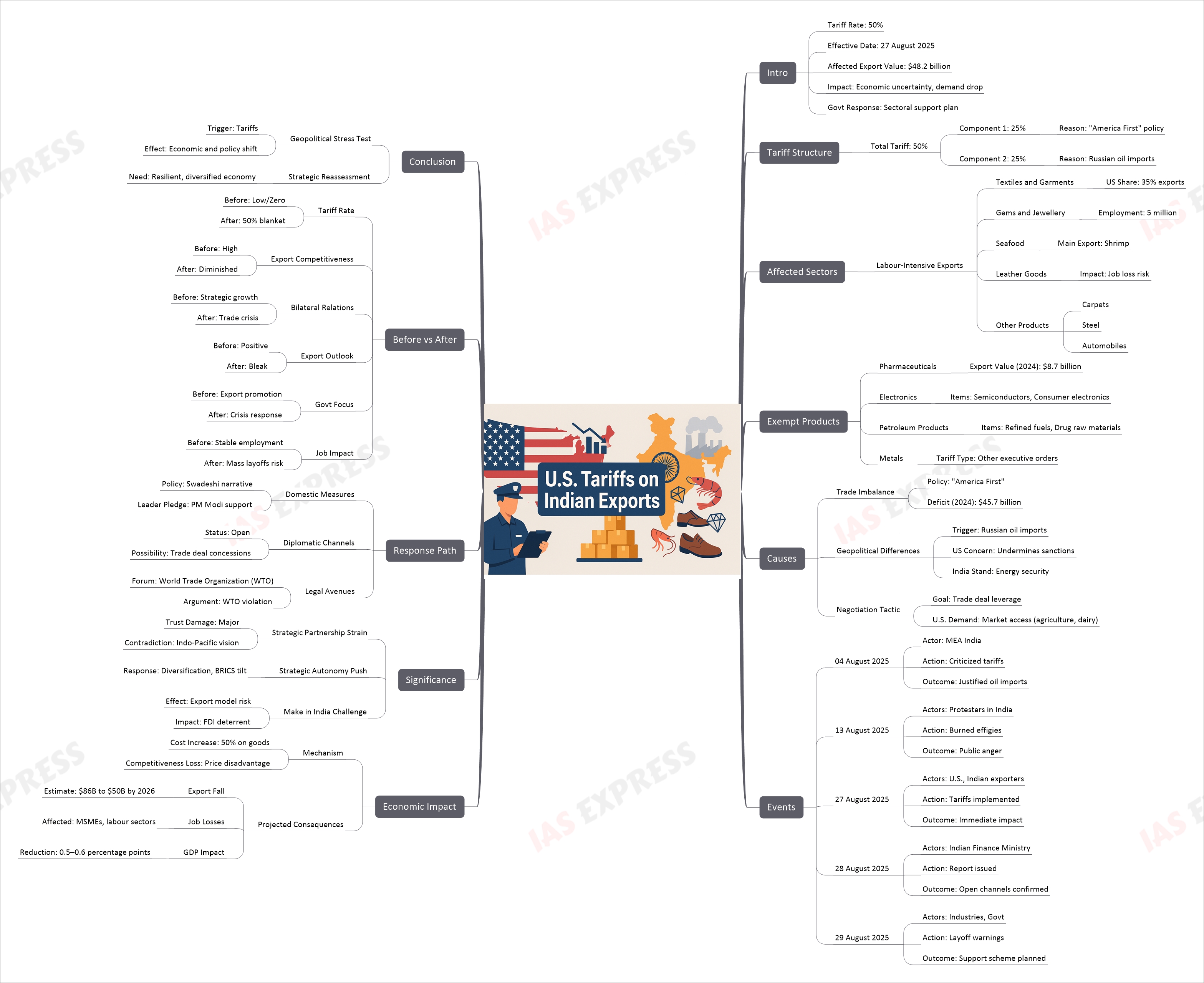
The 50% tariffs imposed by the U.S. on imports from India came into effect on August 27, 2025, sending ripples through the Indian economy and the government. This punitive measure, targeting an estimated $\text{48.2 billion worth of Indian exports, has created significant uncertainty for industries and policymakers alike. Several sectors, many of them labor-intensive, have the U.S. as a major export destination, and many are already seeing a significant dip in demand. The government is cognisant of this and is devising a plan to support these sectors, at least in the short term, while navigating a complex diplomatic path forward.
What Exactly Do These New U.S. Tariffs on Indian Goods Entail?
- Understanding the Tariff Structure
- The United States has implemented a comprehensive tariff of 50\% on a wide variety of goods being imported from India.
- This high rate is not a single levy but a combination of two distinct components:
- A 25\% tariff is part of the broader “America First” campaign, aimed at reducing the U.S. trade deficit with its partners.
- An additional 25\% tariff was specifically added as a punitive action in response to India’s significant and ongoing purchases of Russian oil.
- Which Products and Sectors Are Most Affected?
- The tariffs have been applied broadly, but they disproportionately impact India’s labour-intensive export sectors, which are critical for mass employment.
- Key industries facing the most severe impact include:
- Textiles and Garments: This sector, a cornerstone of Indian manufacturing exports, relies on the U.S. for more than 35\% of its global export share and is now at a severe disadvantage.
- Gems and Jewellery: A vital industry that employs approximately 5 million workers and contributes significantly to India’s GDP, is now bracing for a collapse in U.S. orders.
- Seafood: India is one of the leading suppliers of shrimp to the U.S., and the 50\% tariff threatens to make these exports commercially unviable.
- Leather Goods: Footwear and other leather product exporters have described the tariff as a “shock” that will reduce domestic labour opportunities.
- Other Affected Products: The list also includes items like carpets, steel, and automobiles, which will find it extremely difficult to compete.
- Are There Any Indian Products Exempt From These Tariffs?
- Yes, the U.S. has strategically exempted certain critical products from this new tariff regime, likely to avoid disrupting its own domestic supply chains.
- Products that are currently spared from the 50\% tariff include:
- Pharmaceuticals: India’s pharmaceutical exports to the U.S., worth approximately }$8.7 billion in 2024, are currently exempt, safeguarding a crucial trade category.
- Electronics: Key electronic goods, including semiconductors and other consumer electronics, have separate, sector-specific tariff structures and are not part of this blanket 50% rate.
- Petroleum Products: Refined fuels and certain raw materials for drugs are also on the exemption list for now.
- Metals: While steel and aluminum face their own set of U.S. tariffs under a different executive order, they are not subject to this additional 50% duty.
Why Has the United States Imposed Such Punitive Tariffs?
- Addressing the Persistent Trade Imbalance
- A primary justification for the tariffs is the U.S. administration’s goal of reducing its trade deficit, a central plank of its “America First” economic policy.
- In 2024, the bilateral trade deficit in goods stood at $\text{45.7 billion in India’s favour, a figure the U.S. aims to shrink by making Indian imports more expensive.
- The logic is that these tariffs will encourage American companies and consumers to buy domestically produced goods instead of Indian ones.
- As a Punitive Measure Over Geopolitical Differences
- The tariffs serve as a powerful tool of economic statecraft to influence India’s foreign policy.
- The U.S. has explicitly stated that a key reason for the additional 25\% tariff is to penalize India for its ramped-up purchases of Russian oil following the invasion of Ukraine.
- From the U.S. perspective, India’s energy trade with Russia undermines the impact of Western sanctions. India, however, has maintained that these purchases are essential for its energy security.
- As a High-Stakes Negotiating Tactic
- Some analysts view the severe tariffs as a “strategic shock” designed to force India back to the negotiating table for a broader trade deal.
- The U.S. has long sought greater market access for its agricultural and dairy products in India, which has been a sticking point in trade negotiations.
- By creating a crisis, the U.S. may hope to gain leverage and extract concessions from India that were previously unattainable.
What Does the Recent Timeline of This Trade Dispute Look Like?
- August 4, 2025
- India’s Ministry of External Affairs publicly criticized the proposed U.S. tariffs as unjustified and unreasonable, defending its oil imports from Russia as a measure to ensure affordable energy for its 1.4 billion citizens.
- August 13, 2025
- As tensions mounted, protests involving the burning of effigies of the U.S. President were held in Indian cities like Kolkata, demonstrating public anger against the tariff hikes.
- August 27, 2025
- The 50\% tariffs officially came into effect. The date meant that any shipment of goods from India arriving in the U.S. would now be subject to this new, higher rate, immediately impacting trade flows.
- August 28, 2025
- A Finance Ministry report in India acknowledged the challenges posed by the secondary and tertiary effects of the tariffs on the wider economy. Government sources confirmed that communication channels with the U.S. remained open to find a resolution.
- August 29, 2025
- Reports emerged of Indian industries, particularly in labour-intensive sectors, bracing for large-scale layoffs as U.S. orders began to dry up. The government assured businesses that it was preparing a support scheme.
How Do These Tariffs Practically Impact Trade and the Economy?
- The Direct Economic Mechanism
- A tariff is simply a tax on imports. The 50\% tariff dramatically increases the landing cost of Indian products in the U.S. market.
- For an American importer, this means an Indian-made leather shoe that previously cost }$50 might now cost $\text{75 before it even reaches the store, making it far more expensive than a similar shoe from a competitor nation like Vietnam or Mexico.
- This price disadvantage effectively erases India’s competitiveness in many key product categories.
- Projected Consequences for the Indian Economy
- Drastic Fall in Exports: The Global Trade Research Initiative (GTRI), a New Delhi-based think tank, has estimated that exports from the hardest-hit sectors could plunge by as much as 70\%. Overall shipments to the U.S. could fall from over }$86 billion to around $\text{50 billion by 2026.
- Significant Job Losses: With falling orders, Indian factories in sectors like textiles, gems, and seafood are facing the prospect of shutting down production lines. This could endanger hundreds of thousands of jobs, particularly affecting MSMEs (Micro, Small, and Medium Enterprises).
- Impact on GDP Growth: Economists have warned that if the high tariffs remain in place for the next fiscal year, they could reduce India’s GDP growth forecast by 0.5 to 0.6 percentage points, a significant blow to the world’s fastest-growing major economy.
What Is the Broader Significance of This U.S. Action?
- A Major Strain on the Strategic Partnership
- The tariff crisis has severely damaged the trust between the United States and India. It undermines decades of diplomatic investment aimed at building a “mega partnership.”
- This move walks back from the U.S. declaring India a “Major Defense Partner” and challenges the shared strategic vision of a free and open Indo-Pacific, which was partly aimed at counterbalancing China’s influence.
- Fueling a Push for Strategic Autonomy in India
- The use of economic coercion by the U.S. has reinforced the argument within India for greater strategic autonomy.
- It may push India to deepen its engagement with other global powers and plurilateral forums like BRICS, potentially strengthening ties with Russia and China to reduce its reliance on the West.
- A Direct Challenge to ‘Make in India’
- The tariffs are a significant setback for the ‘Make in India’ initiative, which aims to establish India as a global manufacturing hub.
- By making Indian manufactured goods uncompetitive in their largest export market, the policy questions the viability of an export-led growth model heavily dependent on the U.S. and could deter future foreign investment in India’s manufacturing sector.
What Is the Way Forward in This Trade Standoff?
- Immediate Domestic Measures by India
- The Indian government is actively promoting a ‘Swadeshi’ or self-reliance narrative, encouraging domestic consumption to support local industries.
- Prime Minister Narendra Modi has pledged to stand like a “wall” to protect domestic producers. The government is preparing a report to formulate a support scheme to prevent layoffs in the most affected sectors.
- Diplomacy and Negotiation Channels
- Despite the harsh measures, both governments have confirmed that communication channels remain open. The most viable solution lies in high-level diplomatic talks to de-escalate the situation.
- A potential resolution could involve a comprehensive trade deal where India might offer some market access concessions in exchange for a complete rollback of the 50\% tariffs.
- Exploring International Legal Avenues
- India retains the option to challenge the U.S. tariffs at the World Trade Organization (WTO).
- India can argue that these unilateral tariffs, justified by the U.S. under its domestic trade laws (like Section 232 and 301), violate WTO rules and principles of multilateral trade. While this process is typically long, it offers a rules-based path to resolution.
A Comparative Overview: Before and After the Tariffs
| Aspect | Before August 27, 2025 | After August 27, 2025 |
|---|---|---|
| U.S. Tariff Rate | Relatively low average tariffs; some goods had duty-free access. | A blanket 50\% tariff on a majority of Indian goods. |
| Export Competitiveness | Indian goods were competitive, with bilateral trade at a record }$\text{129.2 billion in 2024. | Severely diminished; uncompetitive against rivals in Asia and Latin America. |
| U.S.-India Relations | A strong and deepening strategic partnership, despite some trade friction. | Highly strained with a significant trust deficit; a full-blown trade crisis. |
| Indian Export Outlook | Positive, with steady growth driven by initiatives like ‘Make in India’. | Bleak; exports could fall by over 40\%, threatening }$48.2 billion in trade. |
| Indian Government Focus | Primarily on export promotion and attracting foreign investment. | Crisis management, providing domestic support, and pushing for self-reliance. |
| Impact on Indian Jobs | Labour-intensive export sectors were major and stable employment generators. | High risk of hundreds of thousands of job losses, especially in MSMEs. |
Concluding Thoughts
The imposition of 50% tariffs by the United States marks a critical inflection point in its relationship with India. It is more than just a trade dispute; it is a geopolitical stress test that challenges India’s economic ambitions and its policy of strategic autonomy. While the immediate economic pain—job losses, factory closures, and slower GDP growth—is undeniable, the long-term repercussions could be even more profound. This crisis forces India to re-evaluate its heavy reliance on the U.S. market and may accelerate its efforts to forge stronger economic alliances elsewhere. The path to resolution requires deft diplomacy from New Delhi, but it also necessitates a strategic recalculation to build a more resilient economic future, one that is less vulnerable to the unilateral actions of a single trading partner.
Q. Critically examine how the imposition of unilateral tariffs by the U.S. challenges India’s strategic autonomy and its ‘Make in India’ initiative. (250 words)
Related Posts
If you like this post, please share your feedback in the comments section below so that we will upload more posts like this.

Responses