China’s Lunar Exploration Programme

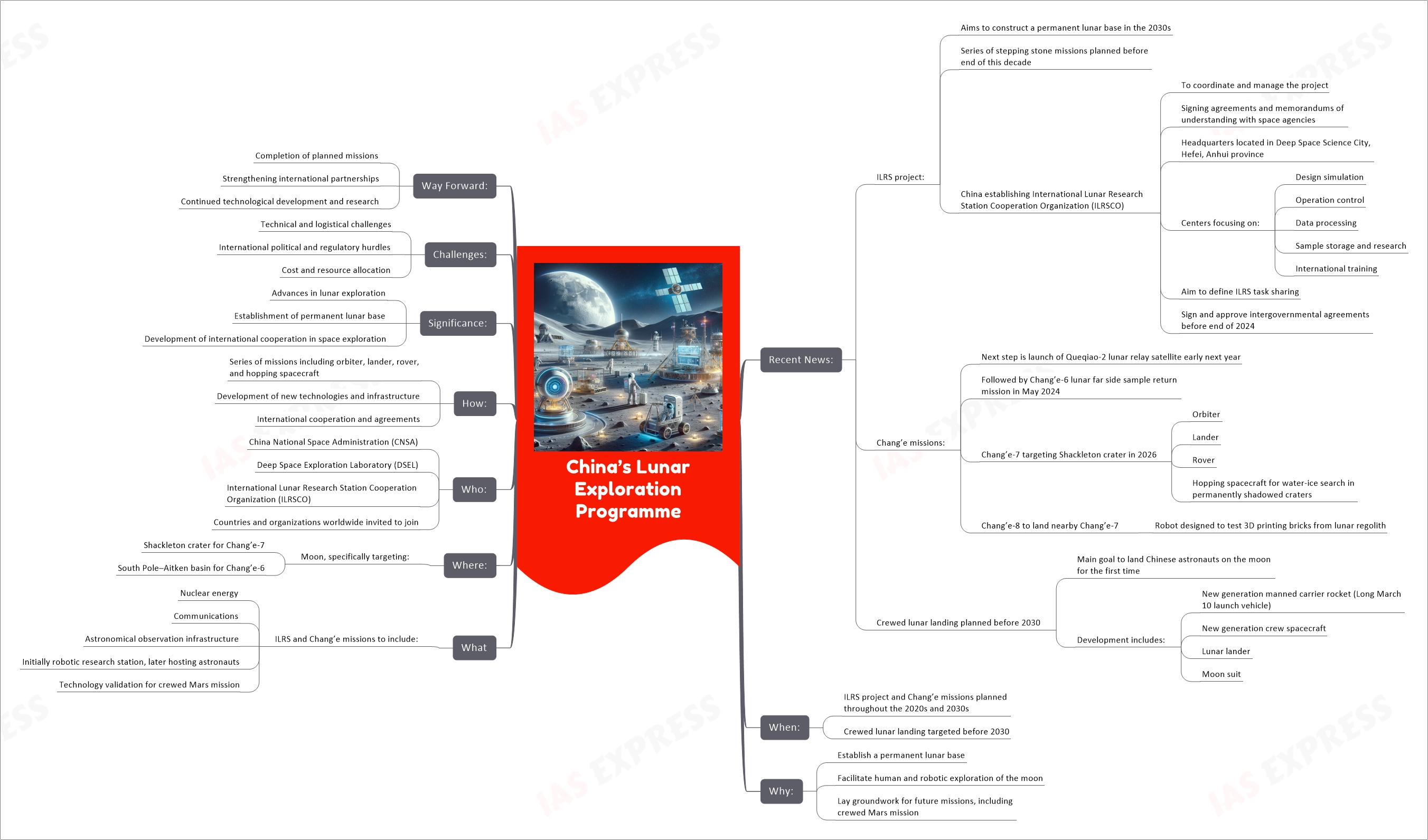
China’s Lunar Exploration Programme mind map

  Recent News:
    ILRS project:
      Aims to construct a permanent lunar base in the 2030s
      Series of stepping stone missions planned before end of this decade
      China establishing International Lunar Research Station Cooperation Organization (ILRSCO)
        To coordinate and manage the project
        Signing agreements and memorandums of understanding with space agencies
        Headquarters located in Deep Space Science City, Hefei, Anhui province
        Centers focusing on:
          Design simulation
          Operation control
          Data processing
          Sample storage and research
          International training
        Aim to define ILRS task sharing
        Sign and approve intergovernmental agreements before end of 2024
    Chang’e missions:
      Next step is launch of Queqiao-2 lunar relay satellite early next year
      Followed by Chang’e-6 lunar far side sample return mission in May 2024
      Chang’e-7 targeting Shackleton crater in 2026
        Orbiter
        Lander
        Rover
        Hopping spacecraft for water-ice search in permanently shadowed craters
      Chang’e-8 to land nearby Chang’e-7
        Robot designed to test 3D printing bricks from lunar regolith
    Crewed lunar landing planned before 2030
      Main goal to land Chinese astronauts on the moon for the first time
      Development includes:
        New generation manned carrier rocket (Long March 10 launch vehicle)
        New generation crew spacecraft
        Lunar lander
        Moon suit
  When:
    ILRS project and Chang’e missions planned throughout the 2020s and 2030s
    Crewed lunar landing targeted before 2030
  Why:
    Establish a permanent lunar base
    Facilitate human and robotic exploration of the moon
    Lay groundwork for future missions, including crewed Mars mission
  What
    ILRS and Chang’e missions to include:
      Nuclear energy
      Communications
      Astronomical observation infrastructure
      Initially robotic research station, later hosting astronauts
      Technology validation for crewed Mars mission
  Where:
    Moon, specifically targeting:
      Shackleton crater for Chang’e-7
      South Pole–Aitken basin for Chang’e-6
  Who:
    China National Space Administration (CNSA)
    Deep Space Exploration Laboratory (DSEL)
    International Lunar Research Station Cooperation Organization (ILRSCO)
    Countries and organizations worldwide invited to join
  How:
    Series of missions including orbiter, lander, rover, and hopping spacecraft
    Development of new technologies and infrastructure
    International cooperation and agreements
  Significance:
    Advances in lunar exploration
    Establishment of permanent lunar base
    Development of international cooperation in space exploration
  Challenges:
    Technical and logistical challenges
    International political and regulatory hurdles
    Cost and resource allocation
  Way Forward:
    Completion of planned missions
    Strengthening international partnerships
    Continued technological development and research

China’s Lunar Exploration Programme is a broad and ambitious initiative aimed at exploring the Moon through a series of robotic missions and eventually establishing a permanent lunar base in the 2030s. This programme encompasses the launch of various Chang’e missions, each with specific goals ranging from lunar sample returns to testing technologies for in-situ resource utilization and constructing infrastructure for a robotic, and later, crewed lunar research station. The programme also includes plans for China’s first crewed lunar landing before 2030, leveraging breakthroughs in space technology, including new spacecraft, launch vehicles, and moon suits. Central to these efforts is the International Lunar Research Station (ILRS), proposed to be a collaborative international project aimed at lunar exploration and beyond. The initiative underlines China’s commitment to becoming a leading power in space exploration, fostering international cooperation, and setting the stage for future interplanetary missions.
Related Posts
If you like this post, please share your feedback in the comments section below so that we will upload more posts like this.

Responses

🖍️ Highlight
HomeCoursesPlansAccount