Quasar

Quasar mind map
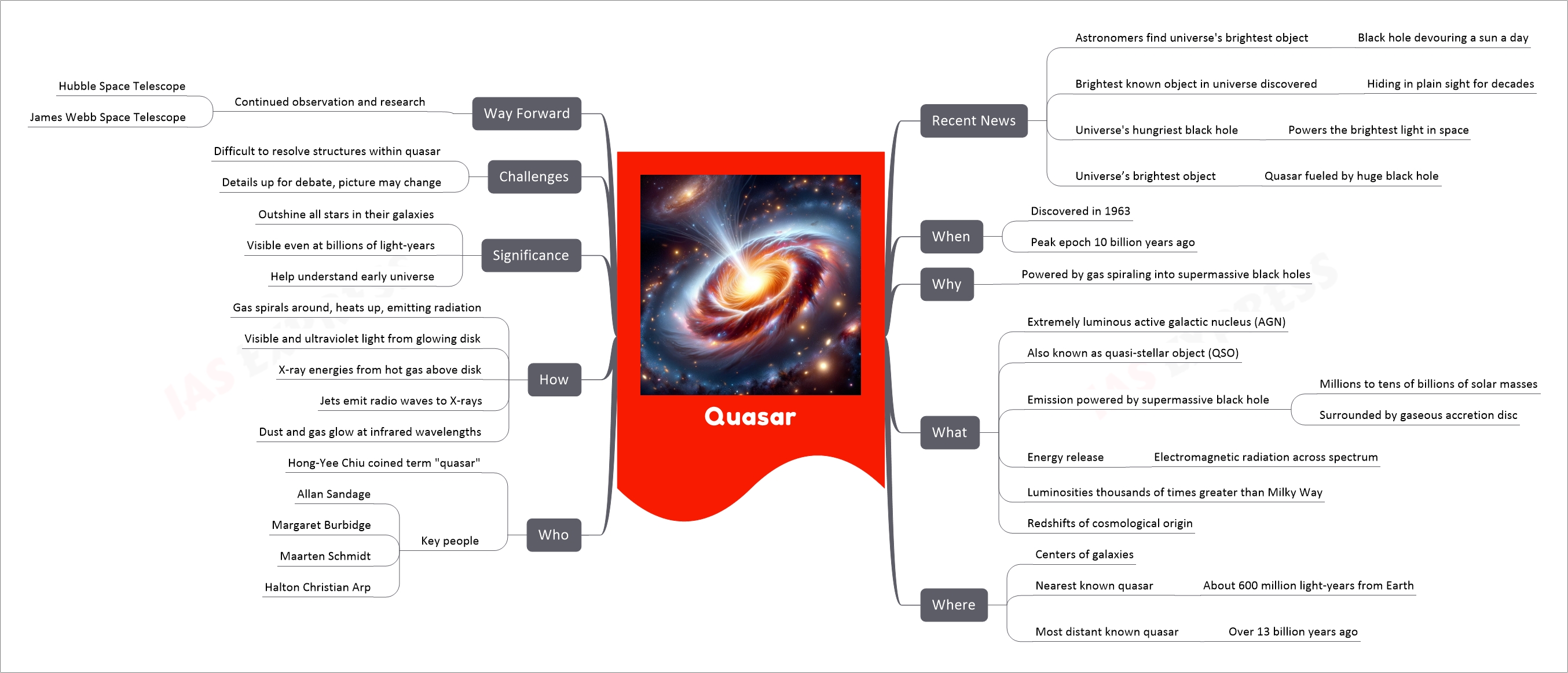
  Recent News
    Astronomers find universe's brightest object
      Black hole devouring a sun a day
    Brightest known object in universe discovered
      Hiding in plain sight for decades
    Universe's hungriest black hole
      Powers the brightest light in space
    Universe’s brightest object
      Quasar fueled by huge black hole
  When
    Discovered in 1963
    Peak epoch 10 billion years ago
  Why
    Powered by gas spiraling into supermassive black holes
  What
    Extremely luminous active galactic nucleus (AGN)
    Also known as quasi-stellar object (QSO)
    Emission powered by supermassive black hole
      Millions to tens of billions of solar masses
      Surrounded by gaseous accretion disc
    Energy release
      Electromagnetic radiation across spectrum
    Luminosities thousands of times greater than Milky Way
    Redshifts of cosmological origin
  Where
    Centers of galaxies
    Nearest known quasar
      About 600 million light-years from Earth
    Most distant known quasar
      Over 13 billion years ago
  Who
    Hong-Yee Chiu coined term "quasar"
    Key people
      Allan Sandage
      Margaret Burbidge
      Maarten Schmidt
      Halton Christian Arp
  How
    Gas spirals around, heats up, emitting radiation
    Visible and ultraviolet light from glowing disk
    X-ray energies from hot gas above disk
    Jets emit radio waves to X-rays
    Dust and gas glow at infrared wavelengths
  Significance
    Outshine all stars in their galaxies
    Visible even at billions of light-years
    Help understand early universe
  Challenges
    Difficult to resolve structures within quasar
    Details up for debate, picture may change
  Way Forward
    Continued observation and research
      Hubble Space Telescope
      James Webb Space Telescope

Quasars are extremely luminous objects found in the centers of some galaxies, powered by gas spiraling at high velocity into enormous black holes. They can outshine all the stars in their host galaxies, making them visible even from billions of light-years away. Quasars are not only significant for their brightness but also for what they can teach us about the early universe and the formation of galaxies. They were first discovered in the 1960s as quasi-stellar objects due to their star-like appearance and radio emissions. Since then, our understanding of quasars has evolved significantly, thanks to the advancements in astronomical observations and technologies such as the Hubble Space Telescope​​​​​​.

Related Posts

If you like this post, please share your feedback in the comments section below so that we will upload more posts like this.

Responses

🖍️ Highlight
HomeCoursesPlansAccount