H3 Rocket

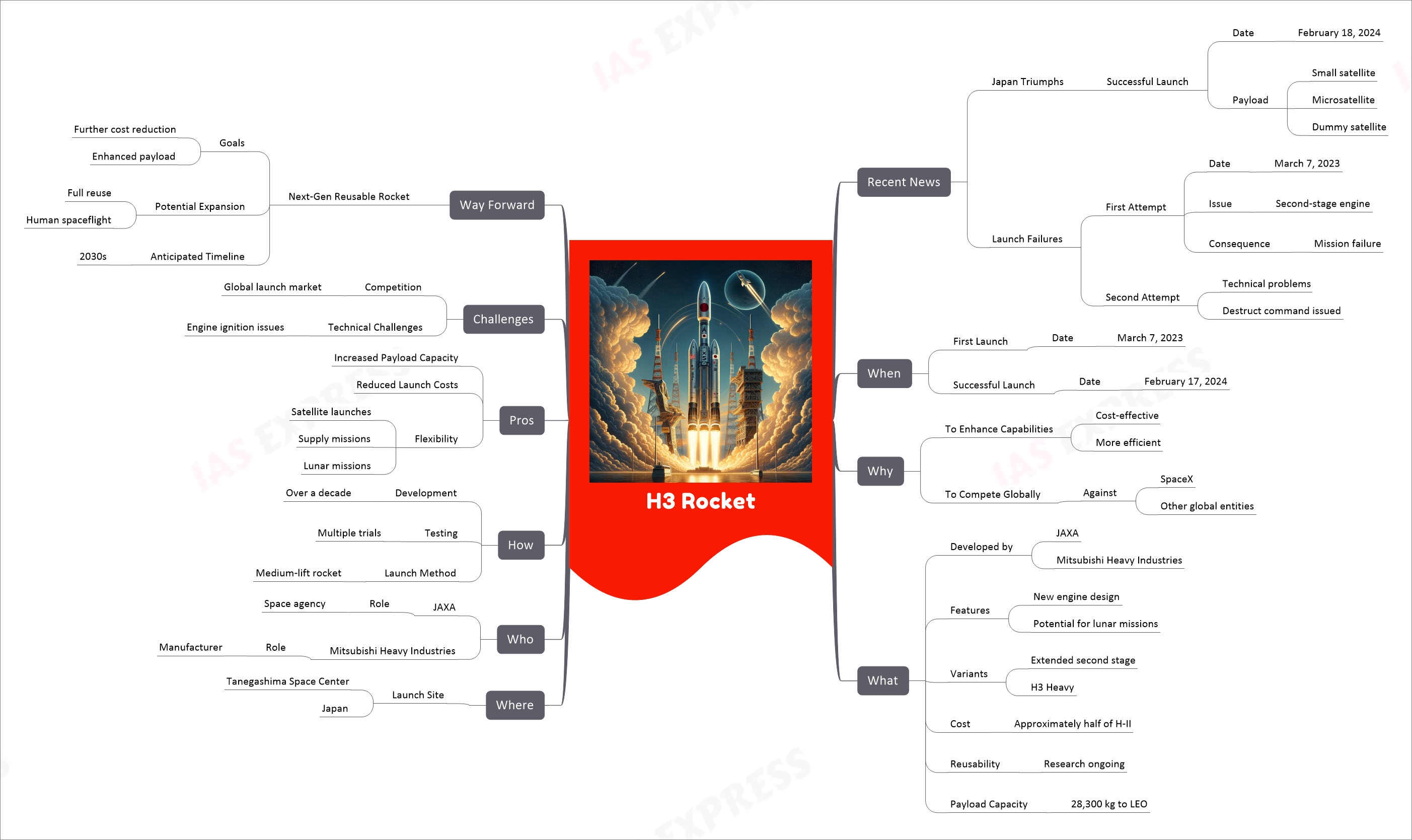
H3 Rocket mind map
  Recent News
    Japan Triumphs
      Successful Launch
        Date
          February 18, 2024
        Payload
          Small satellite
          Microsatellite
          Dummy satellite
    Launch Failures
      First Attempt
        Date
          March 7, 2023
        Issue
          Second-stage engine
        Consequence
          Mission failure
      Second Attempt
        Technical problems
        Destruct command issued
  When
    First Launch
      Date
        March 7, 2023
    Successful Launch
      Date
        February 17, 2024
  Why
    To Enhance Capabilities
      Cost-effective
      More efficient
    To Compete Globally
      Against
        SpaceX
        Other global entities
  What
    Developed by
      JAXA
      Mitsubishi Heavy Industries
    Features
      New engine design
      Potential for lunar missions
    Variants
      Extended second stage
      H3 Heavy
    Cost
      Approximately half of H-II
    Reusability
      Research ongoing
    Payload Capacity
      28,300 kg to LEO
  Where
    Launch Site
      Tanegashima Space Center
      Japan
  Who
    JAXA
      Role
        Space agency
    Mitsubishi Heavy Industries
      Role
        Manufacturer
  How
    Development
      Over a decade
    Testing
      Multiple trials
    Launch Method
      Medium-lift rocket
  Pros
    Increased Payload Capacity
    Reduced Launch Costs
    Flexibility
      Satellite launches
      Supply missions
      Lunar missions
  Challenges
    Competition
      Global launch market
    Technical Challenges
      Engine ignition issues
  Way Forward
    Next-Gen Reusable Rocket
      Goals
        Further cost reduction
        Enhanced payload
      Potential Expansion
        Full reuse
        Human spaceflight
      Anticipated Timeline
        2030s

The H3 rocket, developed by JAXA and Mitsubishi Heavy Industries, is Japan’s latest advancement in space technology. Its development spanned over a decade, facing challenges including a failed first launch in March 2023 due to second-stage engine issues, and a subsequent failed attempt. However, it achieved success on February 18, 2024, launching a small satellite, a microsatellite, and a dummy satellite. This rocket is designed for efficiency and cost-effectiveness, aiming to halve the launch costs compared to its predecessor, the H-II rocket. The H3 is flexible, capable of launching satellites, supplying space stations, and supporting lunar missions. Future plans include developing a next-generation reusable rocket as part of Japan’s space policy, aimed at further reducing costs, increasing payload capacity, and potentially supporting human spaceflight by the 2030s.

Related Posts
If you like this post, please share your feedback in the comments section below so that we will upload more posts like this.

Responses

🖍️ Highlight
HomeCoursesPlansAccount