Egg Freezing

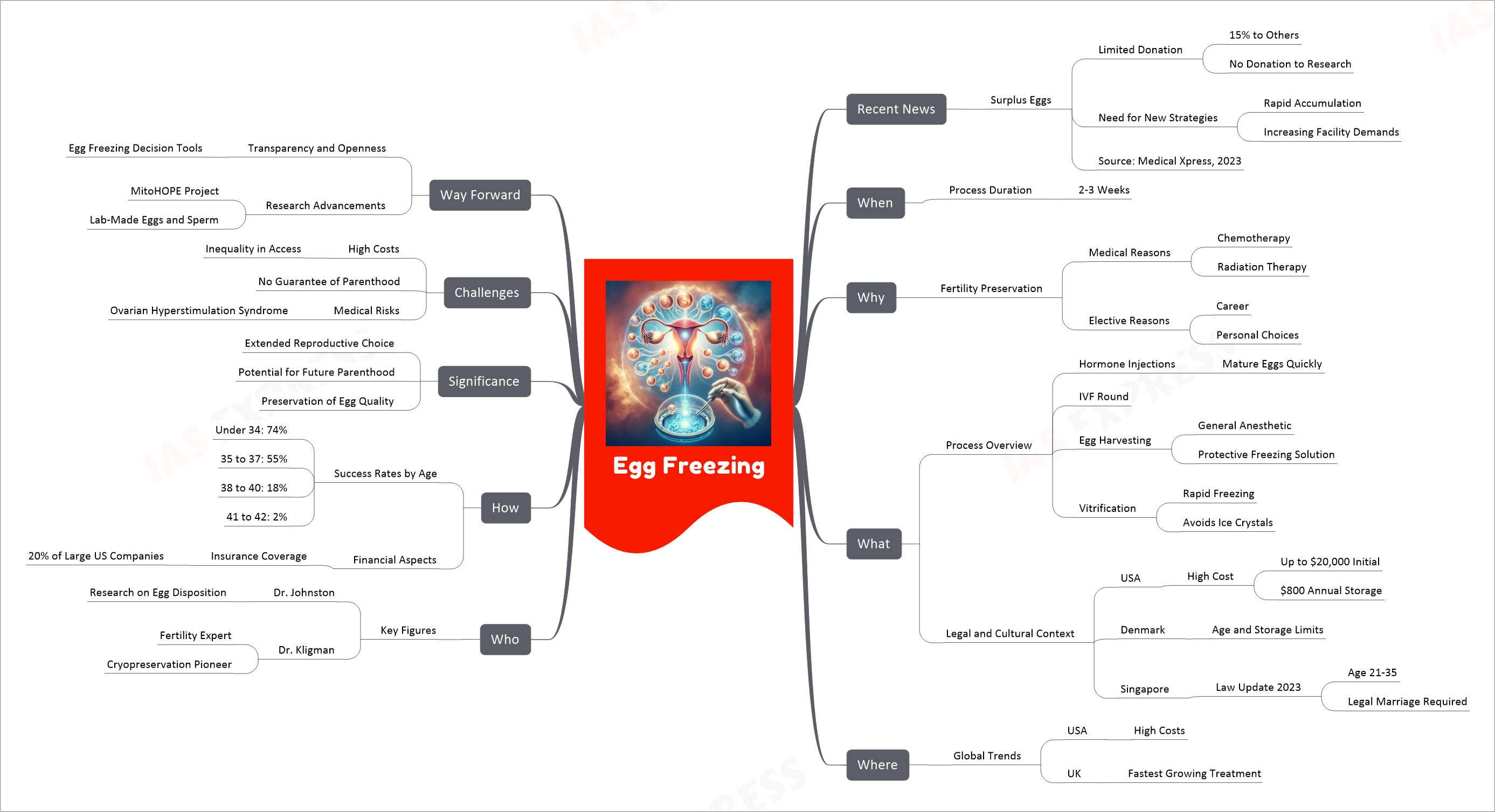
Egg Freezing mind map
  Recent News
    Surplus Eggs
      Limited Donation
        15% to Others
        No Donation to Research
      Need for New Strategies
        Rapid Accumulation
        Increasing Facility Demands
      Source: Medical Xpress, 2023
  When
    Process Duration
      2-3 Weeks
  Why
    Fertility Preservation
      Medical Reasons
        Chemotherapy
        Radiation Therapy
      Elective Reasons
        Career
        Personal Choices
  What
    Process Overview
      Hormone Injections
        Mature Eggs Quickly
      IVF Round
      Egg Harvesting
        General Anesthetic
        Protective Freezing Solution
      Vitrification
        Rapid Freezing
        Avoids Ice Crystals
    Legal and Cultural Context
      USA
        High Cost
          Up to $20,000 Initial
          $800 Annual Storage
      Denmark
        Age and Storage Limits
      Singapore
        Law Update 2023
          Age 21-35
          Legal Marriage Required
  Where
    Global Trends
      USA
        High Costs
      UK
        Fastest Growing Treatment
  Who
    Key Figures
      Dr. Johnston
        Research on Egg Disposition
      Dr. Kligman
        Fertility Expert
        Cryopreservation Pioneer
  How
    Success Rates by Age
      Under 34: 74%
      35 to 37: 55%
      38 to 40: 18%
      41 to 42: 2%
    Financial Aspects
      Insurance Coverage
        20% of Large US Companies
  Significance
    Extended Reproductive Choice
    Potential for Future Parenthood
    Preservation of Egg Quality
  Challenges
    High Costs
      Inequality in Access
    No Guarantee of Parenthood
    Medical Risks
      Ovarian Hyperstimulation Syndrome
  Way Forward
    Transparency and Openness
      Egg Freezing Decision Tools
    Research Advancements
      MitoHOPE Project
      Lab-Made Eggs and Sperm

Egg freezing, also known as cryopreservation, is a process where a woman’s eggs are extracted, rapidly frozen, and stored for future use. This fertility preservation technique, developed initially for patients undergoing treatments like chemotherapy, has become more widely available and is now an option for women who wish to delay childbearing for various reasons, including career or personal choices. The process involves hormone injections to mature eggs, followed by an IVF round and the harvesting of eggs under anesthesia. Despite its rising popularity and technological advancements, egg freezing presents challenges such as high costs, unequal access, and no guaranteed success. Recent data shows success rates decrease with age, highlighting the importance of informed decision-making in this personal and complex choice.

Related Posts
If you like this post, please share your feedback in the comments section below so that we will upload more posts like this.

Responses

🖍️ Highlight
HomeCoursesPlansAccount