Codex Committee on Spices and Culinary Herbs (CCSCH)

Codex Committee on Spices and Culinary Herbs (CCSCH) mind map

  Recent News
    7th Session
      When
        Held from 29th January to 2nd February 2024
      Where
        Kochi, India
      Who
        109 Delegates
          From 31 Countries
        Latin American Countries
          First-time Participation
      What/Full Provisions
        Quality Standards Finalized
          Small Cardamom
          Turmeric
          Juniper Berry
          Allspice
          Star Anise
        Grouping Strategy
          Spices Derived from Fruits and Berries
        Draft Standard for Vanilla
          Progressed to Step 5
        New Proposals Accepted
          Dried Coriander Seeds
          Large Cardamom
          Sweet Marjoram
          Cinnamon
      How
        Physical Meeting Post-Covid-19
        Electronic Working Groups (EWGs)
          Chaired by Various Countries
          Continue Multinational Consultation
      Next Meeting
        After 18 Months
  Background
    Established in 2013
    Hosted by India
      Spices Board India as Secretariat
    Part of Codex Alimentarius Commission (CAC)
      Established by FAO and WHO
      Over 194 Country Members
      Rome-based
    Goals
      Formulate Internationally Accepted Food Standards
      Facilitate Global Trade
      Enhance Food Safety
  Significance
    WTO Recognition
      Standards as International Reference Points
      Trade Disputes Resolution
    Harmonization of Food Standards Globally
    Consumer Health and Safety

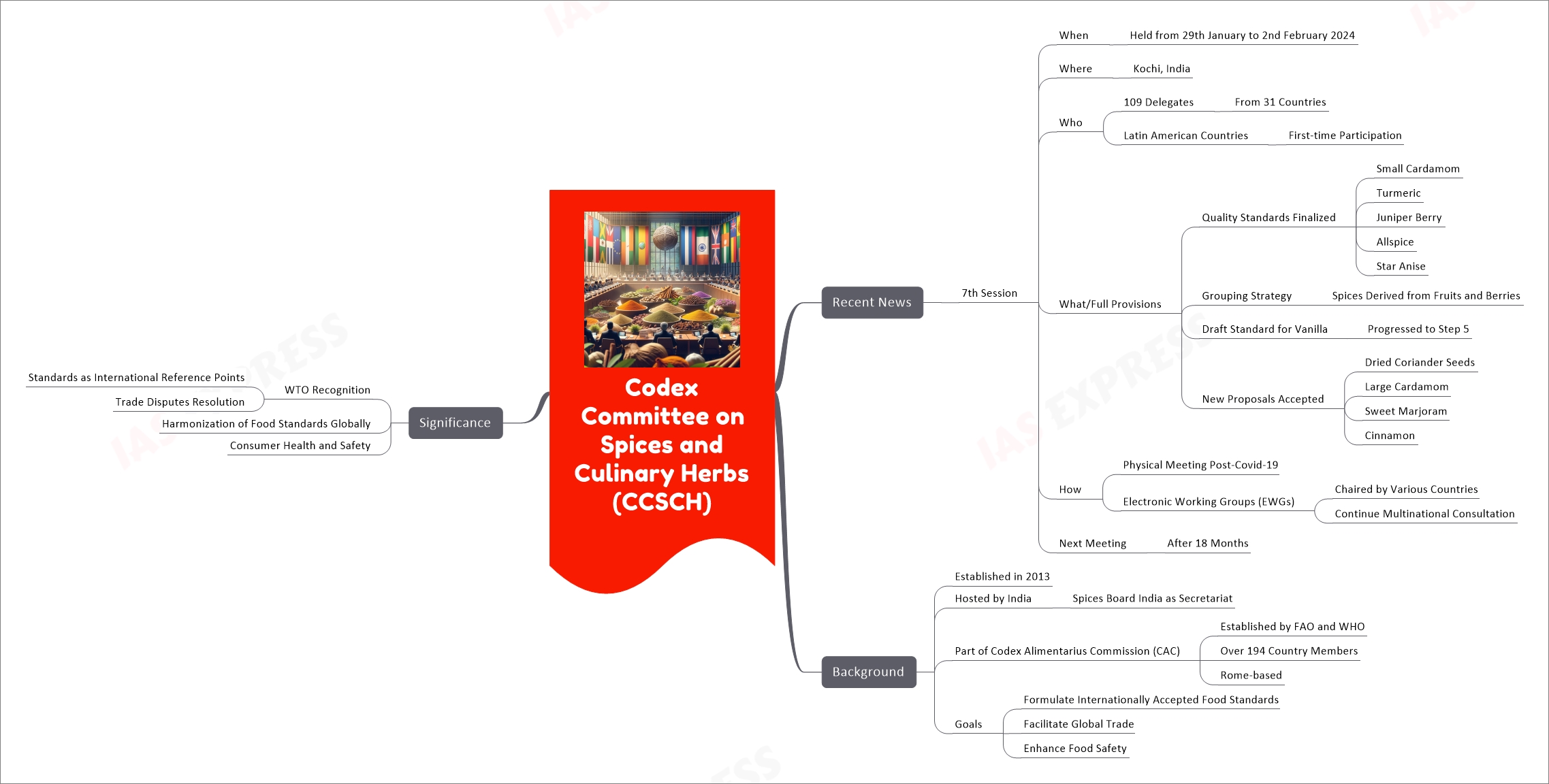
The Codex Committee on Spices and Culinary Herbs (CCSCH), a segment of the Codex Alimentarius Commission established by the FAO and WHO, recently concluded its 7th session in Kochi, India. This session, the first physical meeting post-Covid-19, was attended by 109 delegates from 31 countries, including a significant first-time participation from Latin American countries. The committee achieved notable results by finalizing quality standards for five spices—small cardamom, turmeric, juniper berry, allspice, and star anise—and adopting a novel strategy of grouping spices, starting with those derived from fruits and berries. Proposals for developing standards for dried coriander seeds, large cardamom, sweet marjoram, and cinnamon were also accepted. CCSCH’s work is crucial for formulating internationally accepted food standards, enhancing global food safety, and facilitating fair trade, with its standards recognized by the WTO as reference points for resolving trade disputes.

Related Posts

If you like this post, please share your feedback in the comments section below so that we will upload more posts like this.

Responses

🖍️ Highlight
HomeCoursesPlansAccount