[Newsbits] 22.01.2024: Surya Tilak, Nagara Style & more

newsbits mindmap notes

WHO Issues Guidance on Healthcare AI Ethics mind map
  Recent News
    WHO releases guidance
      For large multi-modal models (LMMs)
      Date: 18 January 2024
  When
    Released on 18 January 2024
  Why
    To manage risks
      Associated with AI in healthcare
  What
    Over 40 recommendations
      For governments, tech companies, healthcare providers
    Applications of LMMs
      Diagnosis and clinical care
      Patient-guided use
      Clerical and administrative tasks
      Medical and nursing education
      Scientific research and drug development
    Risks
      False, inaccurate, biased, incomplete statements
      Poor quality or biased data
      Accessibility and affordability
      Automation bias
      Cybersecurity risks
  Where
    Global application
      In healthcare sector
  Who
    World Health Organization (WHO)
      Dr. Jeremy Farrar, WHO Chief Scientist
    Stakeholders
      Governments
      Technology companies
      Healthcare providers
      Patients
      Civil society
  How
    Involvement of stakeholders
      At all stages
        Model development
        Implementation
    Governments to invest
      In non-profit structures
      In upholding ethical obligations
        And human rights standards
    Regulatory bodies
      Establish and introduce
        Mandatory post-publication review
        Impact assessment
  Significance
    Improving healthcare
      Enhancing clinical trials
      Improving diagnosis, treatment, self-care
      Supplementing professional knowledge
    Overcoming health inequities
  Challenges
    Potential for harm
      Due to inaccurate information
    Equity and accessibility issues
    Over-reliance on automation
  Way Forward
    Ethical use of AI
      Adhering to WHO guidelines
    Continuous monitoring
      And improvement

The World Health Organization (WHO) released guidance on the ethics and governance of large multi-modal models (LMMs), a type of rapidly growing generative AI technology with applications in healthcare. This guidance, issued on January 18, 2024, aims to manage the risks associated with AI in healthcare. It includes over 40 recommendations for governments, technology companies, and healthcare providers. The guidance addresses the potential for AI to improve healthcare but also highlights risks such as producing false or biased information, cybersecurity threats, and accessibility issues. WHO emphasizes the need for involving various stakeholders, including governments, technology companies, healthcare providers, patients, and civil society, in all stages of AI model development and implementation. The organization underscores the significance of these guidelines in improving healthcare and overcoming health inequities, while also acknowledging the challenges and potential for harm due to misuse or misinterpretation of AI technology in healthcare. The way forward includes adhering to these guidelines and continuously monitoring and improving the ethical use of AI in healthcare.

Alliance for Global Good-Gender Equity and Equality mind map
  Recent News
    Launch Date
      15-19 January 2024
    Event
      World Economic Forum
    Location
      Davos, Switzerland
  When
    January 2024
  Why
    Women-led Development
    Global Cooperation
  What
    Global Best Practices
    Knowledge Sharing
    Investments in
      Women’s Health
      Education
      Enterprise
    Follow up
      G20 Leaders’ Commitments
      Business 20
      Women 20
      G20 EMPOWER
  Where
    Global Scale
  Who
    Indian Delegation
      Led by
        Smt. Smriti Zubin Irani
    Supported by
      Bill and Melinda Gates Foundation
      CII Centre for Women Leadership
      World Economic Forum
      Invest India
    Industry Partners
      Over 10,000
      Including
        Mastercard
        Uber
        Tata
        TVS
        Bayer
        Godrej
        Serum Institute of India
        IMD Lausanne
  How
    Bringing Together
      Industry
      Enterprise
      Humanity
  Significance
    Gender Equality
    Women Empowerment

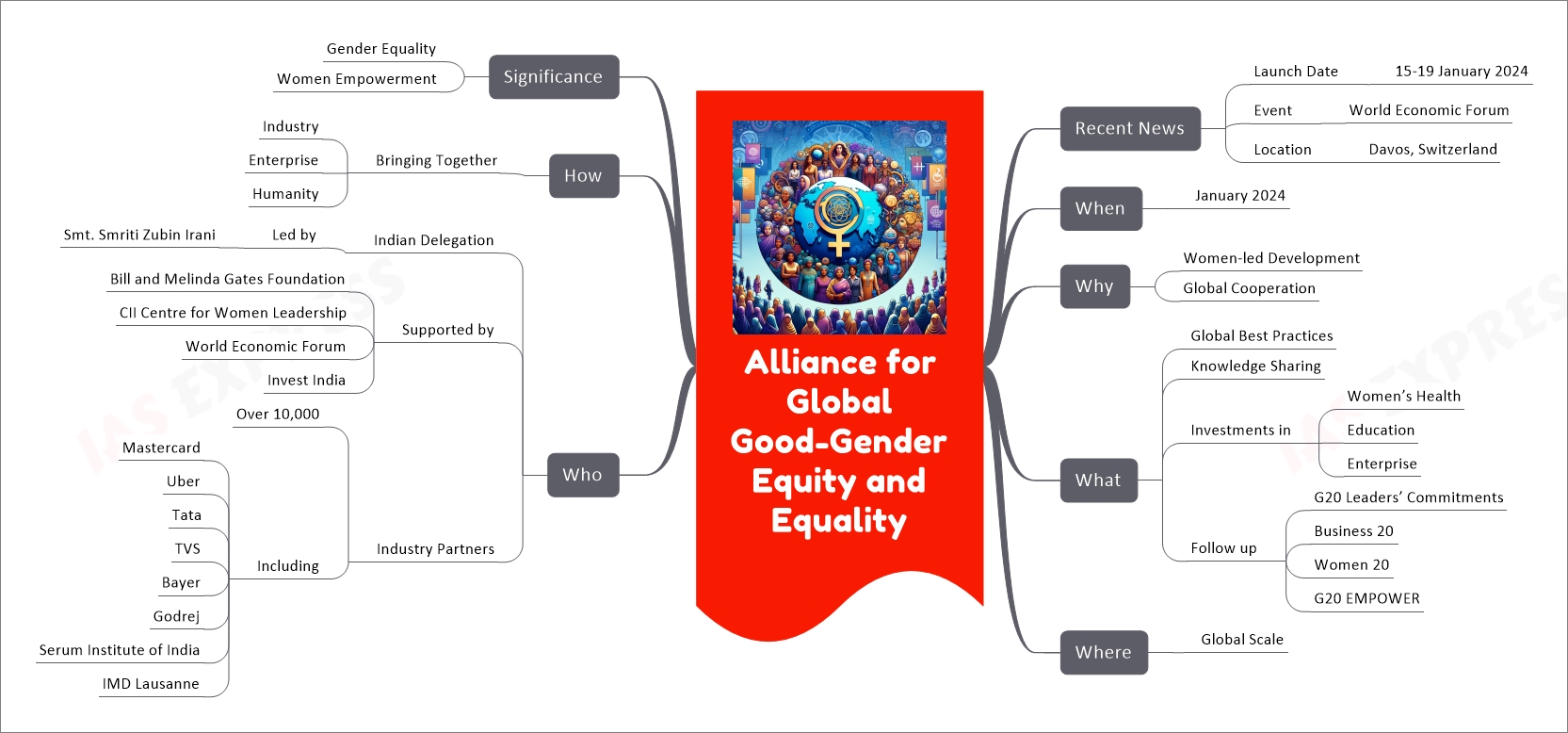
The Alliance for Global Good-Gender Equity and Equality, launched at the World Economic Forum in Davos, Switzerland in January 2024, aims to promote gender equity and equality globally. It focuses on women-led development and includes global best practices, knowledge sharing, and investments in women’s health, education, and enterprise. Supported by influential organizations like the Bill and Melinda Gates Foundation and the CII Centre for Women Leadership, the Alliance has garnered substantial support from over 10,000 industry partners. This initiative is part of India’s commitment to global cooperation and women-led development, emphasizing the collaboration of industry, enterprise, and humanity for gender equality.

Somnath Temple mind map
  Recent News:
    January 2024:
      Congress Response:
        To BJP's Charge:
          On 'Somnath Temple' Remark:
            Context:
              Nehru's Transparency:
                Letters On Somnath Temple:
                  Public Domain
                  Vol 16-I:
                    Of Second Series
                Nehru's Correspondence:
                  With Rajaji:
                    Home Minister
                  With President Rajendra Prasad
                Nehru's Stance:
                  Preferred Non-Association:
                    Of President:
                      In Inauguration
                  Left Discretion:
                    To President
                  Clarified:
                    Government's Non-Involvement:
                      In Parliament
      Sudhanshu Trivedi's Claim:
        Congress Rejecting:
          Gandhi's 'Ram Rajya' Concept
        Congress' Actions:
          Under Indira Gandhi:
            Fired On Cow-Slaughter Protesters
          Under Sonia Gandhi:
            Lord Ram Portrayed:
              As Fictional Entity
  When:
    First Temple:
      Original Construction:
        Associated With:
          Legend Of Daksha's Curse:
            On Moon (Chandra Deva)
      Built By:
        Chandra Deva:
          In Gold:
            For Lord Shiva
          Installed First Jyotirlinga:
            Named Somnath Mahadev
    Rebuilt Several Times:
      Due To Destruction:
        By Muslim Invaders:
          Notably:
            Mahmud Ghazni:
              11th Century
  Why:
    Chandra Deva's Favoritism:
      Towards Rohini:
        More Than Other Wives
    Daksha's Curse:
      On Chandra Deva:
        For Inequity
    Chandra Deva's Repentance:
      Advised By Lord Brahma:
        To Bathe:
          In Triveni Sangam
        To Worship Lord Shiva
  What
    Architectural Significance:
      Striking Architecture:
        Intricate Carvings
        Majestic Spire
      Presence Of Arabian Sea:
        On Its Shores
    Cultural Significance:
      Pilgrimage Site:
        Millions Of Pilgrims:
          And Tourists
    Religious Significance:
      First Of Twelve Jyotirlingas:
        Lord Shiva's Sacred Abodes
      Legends And Mythology:
        Associated With:
          Lord Krishna's Raas Lila
          Moon God's Atonement
    Reconstruction Efforts:
      Post-Independence:
        Supported By:
          Government Of India
          Devotee Contributions
      Rani Ahilyabai Holkar:
        18th Century:
          Maratha Queen
      Chaulukya Dynasty:
        King Bhima I:
          12th Century
      Mughal Era:
        Attempted Demolition:
          By Emperor Aurangzeb
  Where:
    Located In:
      Prabhas Patan:
        Near Veraval
      Gujarat, India
    Proximity:
      To Ancient Trading Port:
        Veraval
      Along Coastline:
        In Saurashtra Region
  Who:
    Important Personalities:
      Chandra Deva:
        Moon God:
          Original Builder
      Daksha:
        Put Curse On Chandra
      Lord Brahma:
        Advised Chandra Deva
      Lord Shiva:
        Released Chandra:
          From Curse
      Rani Ahilyabai Holkar:
        Maratha Queen:
          Reconstruction Effort
      King Bhima I:
        Chaulukya Dynasty:
          Rebuilding Mission
      Emperor Aurangzeb:
        Attempted Destruction
  Significance:
    Spiritual Significance:
      Tranquility And Spirituality:
        At Triveni Sangam
      Devotion And Worship:
        Blessings And Divine Grace
    Cultural Hub:
      Festivals Celebrated:
        Mahashivratri
        Kartik Purnima
        Diwali
    Historical Resilience:
      Symbol Of Hindu Resilience:
        Against Foreign Invaders
  Challenges:
    Repeated Destruction:
      Throughout History:
        By Various Invaders
    Maintenance Of Heritage:
      Continual Efforts:
        For Preservation
  Way Forward:
    Preservation Of Heritage:
      Importance Of Maintaining:
        Temple's Integrity
    Promoting Cultural Tourism:
      Attracting More Visitors:
        To Enhance Awareness

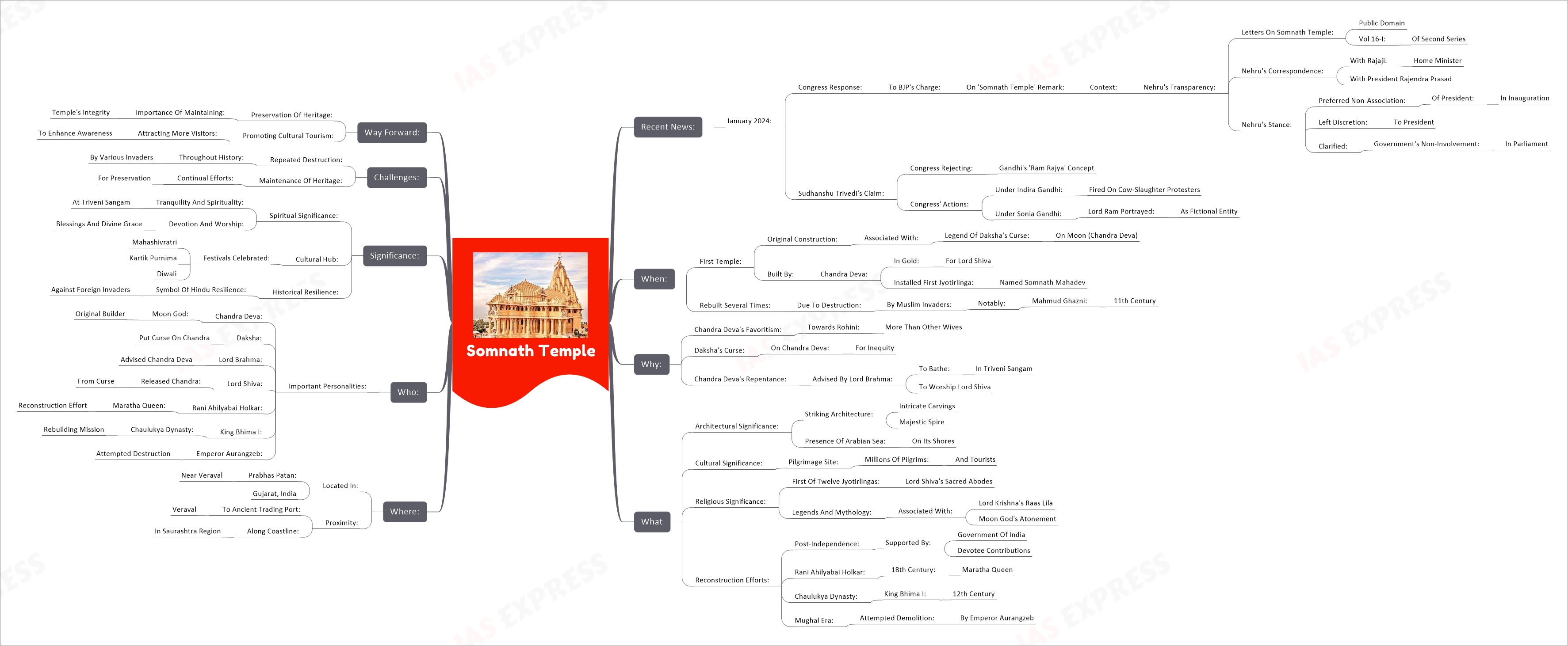
The Somnath Temple, located in Prabhas Patan near Veraval in Gujarat, India, is a significant Hindu pilgrimage site and one of the twelve Jyotirlingas of Lord Shiva. Its history involves multiple reconstructions following destructions by various invaders, notably Mahmud Ghazni in the 11th century. The temple has a deep spiritual and religious significance, being a site of legends and mythology, including the story of the Moon God, Chandra Deva, who originally built the temple as a form of atonement. The temple’s architecture, with intricate carvings and a majestic spire, reflects India’s rich cultural heritage. It is also a cultural hub, celebrating festivals like Mahashivratri, Kartik Purnima, and Diwali. The temple’s resilience in the face of adversity has made it a symbol of Hindu faith and cultural heritage. Efforts to preserve this historical and spiritual landmark continue, highlighting its importance in India’s cultural and religious landscape.

Nagara Style Temple Architecture mind map
  Recent News
    Ram Mandir Consecration
      Date
        January 22, 2024
      Location
        Ayodhya, India
      Preparations
        Floral decorations
        Security heightened
        Railways live streaming
      Government Actions
        Half-day announcements
        Sale of meat, fish, liquor banned
      Cultural Significance
        Ram Lalla idol installation
        Celebrations in Nepal
      Challenges
        Technical issues in idol installation
  When
    Originated 5th century CE
  Where
    North India
    Examples
      Odisha
      Madhya Pradesh
      Gujarat
  What
    Key Features
      Towering spires (Shikharas)
      Intricate carvings
      Symbolic representations
  Who
    Architects
      Chandrakant B Sompura
      Ashish Sompura
    Organizations
      Indian Railways
      State Governments
      Ayodhya's Ram Temple Authority
  How
    Construction Techniques
      Without steel or iron
      Traditional methods
  Significance
    Cultural Heritage
      Represents ancient Indian architecture
    Religious Importance
      Hinduism significance
  Challenges
    Technical Issues
      Idol installation
    Political Controversy
      Land dispute history
  Way Forward
    Annual Celebrations
      Ram Pran Pratishtha Divas
    Increased Tourism
      Boost to Ayodhya's economy
    Inter-State Collaboration
      Cultural events
      Security arrangements

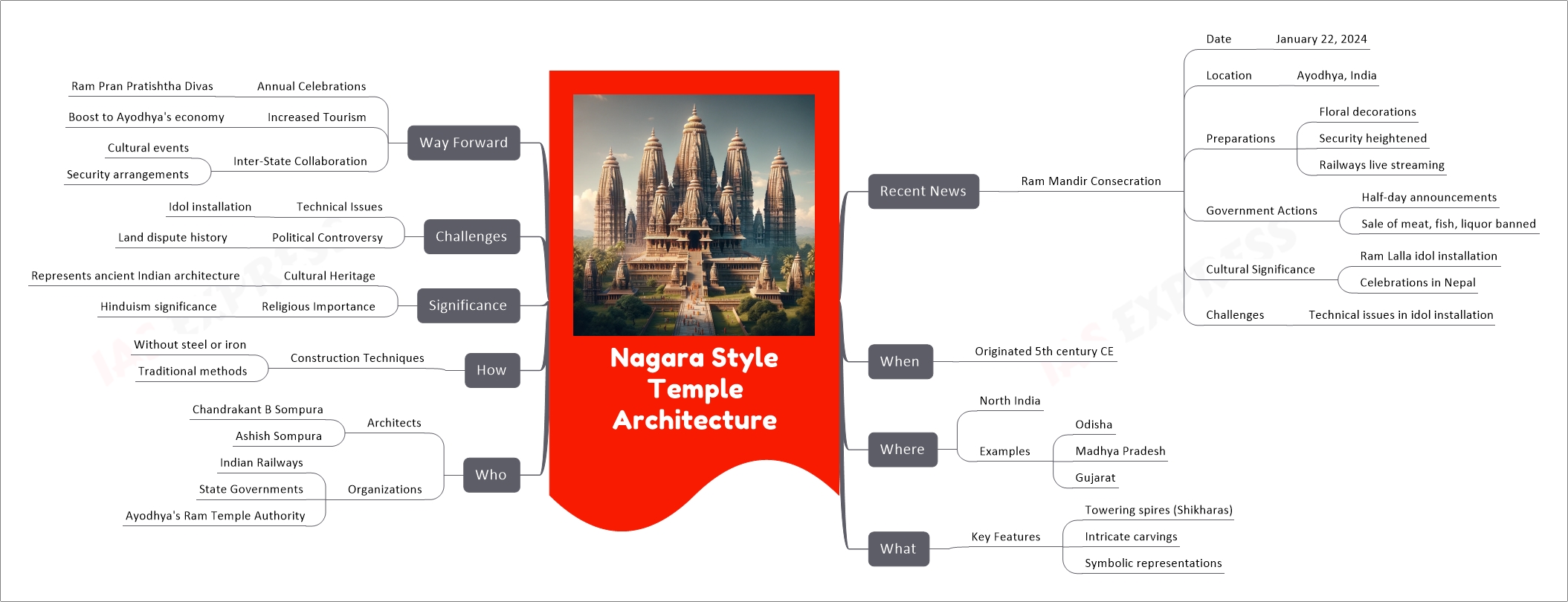
The Nagara style, originating around the 5th century CE in North India, is renowned for its distinctive architectural features like towering spires (Shikharas) and intricate carvings. This style is prominently showcased in the recent construction of the Ram Mandir in Ayodhya, India. This temple, a symbol of cultural heritage and religious significance, has been built adhering to traditional methods without using steel or iron. The inauguration of the temple not only marks a significant cultural event but also highlights the architectural richness of the Nagara style, reflecting ancient Indian craftsmanship and religious importance in Hinduism.

Ayodhya's Ties to Korean Queen Heo mind map
  Recent News (January 2024)
    South Korean Ambassador to India
      Ayodhya's historical significance
    Ram Temple Inauguration
      South Korean high-level participation
    Commercial Interest
      Attraction for companies
        Hyundai, LG, Samsung
  When
    48 A.D.
      Queen Heo's journey
  Why
    Dream guidance
      Parents of Queen Heo
    Marriage
      To King Kim Suro
  What
    Queen Heo
      Real name Suriratna
      Princess of Ayodhya
      Married King Suro
    King Suro
      Founder of Karak dynasty
    Karak Dynasty
      Descendants trace lineage
        Six million Koreans
    Cultural Exchange
      Revived mid-1990s
    Queen Huh Memorial Park
      In Ayodhya
  Where
    Ayodhya, India
    Gimhae City, South Korea
  Who
    Queen Heo Hwang-ok
      Daughter of King Padmasen
    King Kim Suro
      Korean king
    Descendants
      Significant Korean figures
  How
    Travel
      By boat
    Cultural Link
      Genealogical connections
  Significance
    Cultural Bond
      Deepening India-Korea relations
    Sister Cities
      Ayodhya and Gimhae
    Historical Awareness
      Greater understanding
  Challenges
    Evidence Debate
      Varied historical interpretations
    Religious Divide
      Ayodhya as a volatile city
  Way Forward
    Cultural Exchange
      Strengthening relations
    Research
      Further historical studies

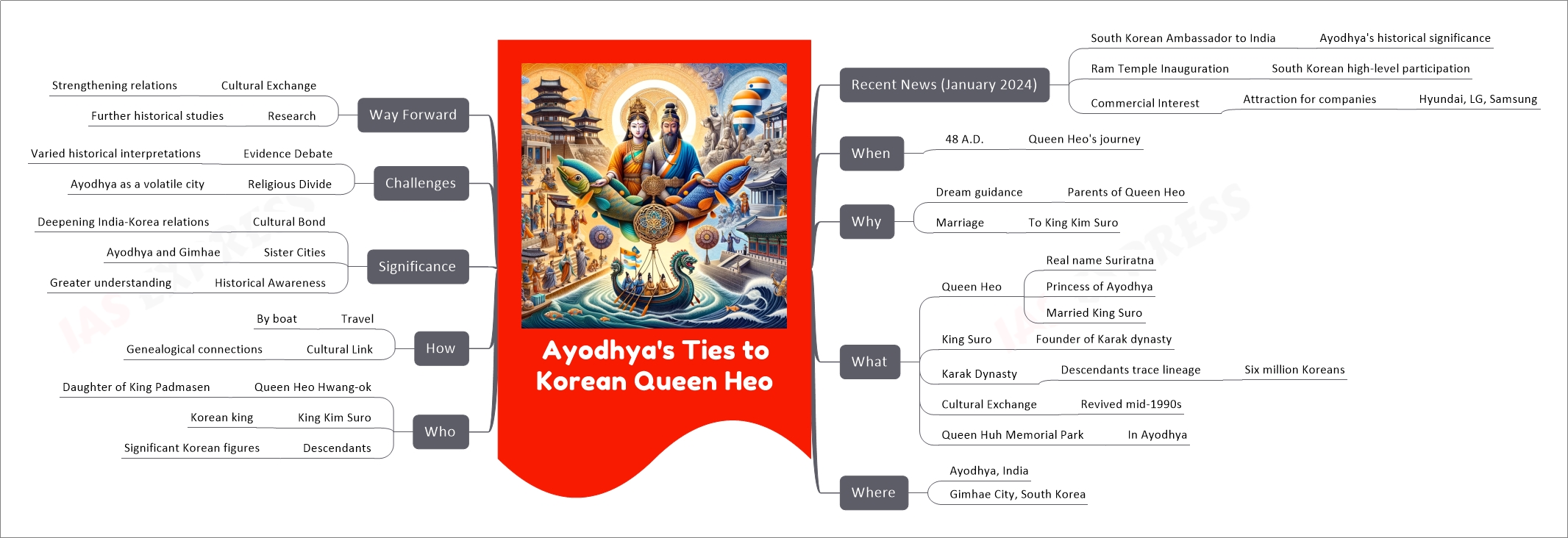
The ties between Ayodhya and Korean Queen Heo Hwang-ok revolve around a historical connection dating back to 48 A.D. According to the legend, Queen Heo, originally named Suriratna, was a princess from Ayodhya who married King Kim Suro of Korea, thereby establishing the Karak dynasty. This connection has fostered a deep cultural bond between India and Korea, evident in the significant number of Koreans tracing their lineage to this union. The significance of this tie has been highlighted in modern times through various cultural exchanges, the establishment of the Queen Huh Memorial Park in Ayodhya, and the designation of Ayodhya and Gimhae as sister cities. The story, however, is subject to debate regarding its historical accuracy, with various interpretations and a lack of concrete evidence. Despite this, the narrative continues to play a crucial role in the cultural and diplomatic relations between India and South Korea, with potential for further strengthening these ties through ongoing research and cultural exchange.

Surya Tilak mind map
  Recent News (January 2024)
    Ayodhya Ram Temple
      Consecration ceremony
        Presence
          PM Modi
          Senior politicians
          Actors
      Surya Tilak feature
        Suryadev applies Tilak
          On every Navami
          To Ramchandra's forehead
        Sun's rays
          Fall on idol
          Duration
            Approximately 6 minutes
          Timing
            At noon
    Ram Navami celebration
      Significance
        Lord Ram's birthday
        Ninth day
          First month
            Hindu calendar
            March-April
  When
    Shri Ram Navami
      Ninth day
        First month
          Hindu calendar
  Why
    Celebration
      Lord Ram's birthday
  What
    Surya Tilak system
      Crafted by
        CSIR-CBRI
        Indian Institute of Astrophysics
      Gearbox
        Reflective mirrors/lenses
      Path tracking
        Sun's rays
          From third floor
            Near shikara
          To sanctum sanctorum
  Where
    Ayodhya
      Ram Temple
  Who
    Indian Institute of Astrophysics
      Provided technical assistance
    CSIR-CBRI Roorkee
      Played important role
    CSIR-NGRI Hyderabad
      Inputs on
        Foundation design
        Seismic/earthquake safety
  How
    Arrangement
      Lenses and mirrors
        Direct sunbeam
          To idol's forehead
  Significance
    Celebration
      Lord Ram's birth
    Spiritual significance
      Hindu tradition
    Innovation
      Combining tradition with technology

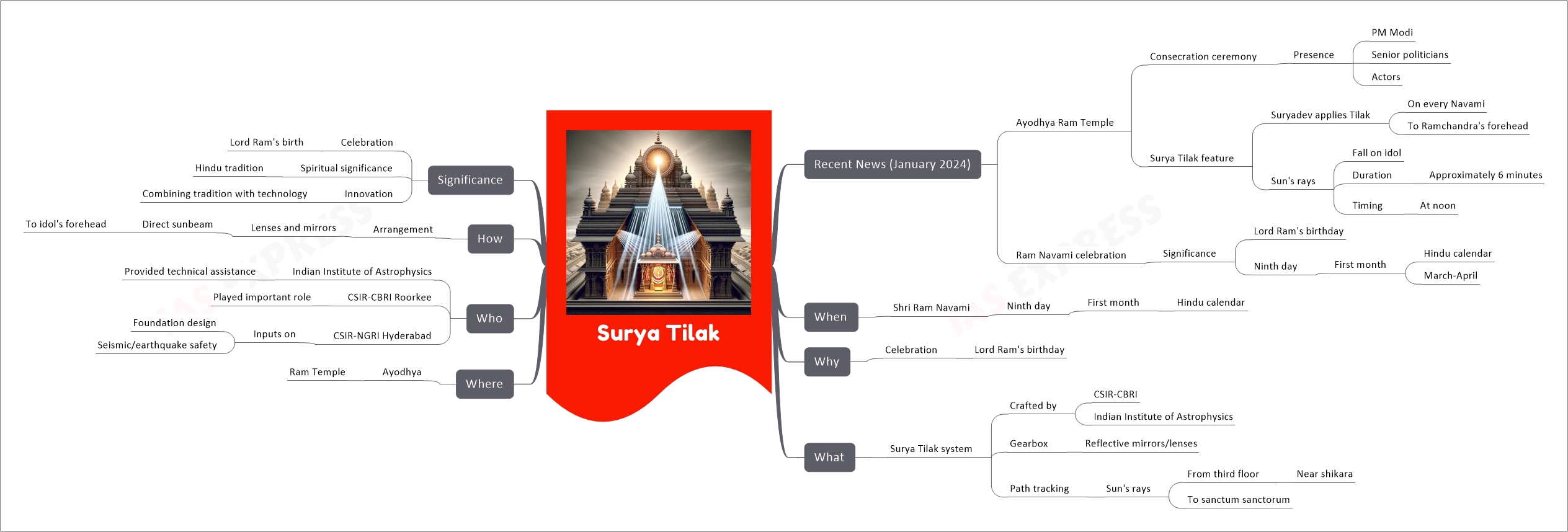
The “Surya Tilak” is a special feature of the Ayodhya Ram Temple, designed to apply a symbolic tilak (mark) using the sun’s rays on the forehead of Lord Ram’s idol every year on Shri Ram Navami. This innovative system, developed in collaboration with the Indian Institute of Astrophysics and CSIR-CBRI Roorkee, involves a gearbox and reflective mirrors/lenses to track and direct the sun’s rays from the temple’s third floor to the sanctum sanctorum. The occurrence symbolizes the celebration of Lord Ram’s birthday and merges traditional spiritual practices with modern technology.

/ Education
2023 State of Teachers, Teaching and Teacher Education Report mind map
  Recent News
    Teacher Shortage Statistics
      Low pay a serious issue
        78% educators agree
      Desire for uniformity in salaries
      84% spend on classroom supplies
      45% feel disrespected by public
    Teacher Diversity Policies
      Focus on racial, linguistic diversity
      Grow Your Own programs
      Registered Apprenticeships
      Teacher Residencies
      High school pipeline programs
    Teacher Attrition
      8% public teachers left in 2021
      Retirement a common reason
      Desire for better work-life balance
      Teachers seek more autonomy
  When
    Data collected in 2023
  Why
    Address teacher shortage
    Improve education quality
    Promote teacher diversity
  What
    Increased support for teachers
      More classroom resources
      Respect for teachers' expertise
    Diverse teacher recruitment
      Grow Your Own initiatives
      Apprenticeships and residencies
    Enhanced teacher autonomy
      Control over schedules
      Input in school policies
  Where
    Across the United States
  Who
    Educators
    Policy Makers
    Teaching Institutions
  How
    Implementing new programs
      Grow Your Own
      Apprenticeships
    Policy changes
      Diversity initiatives
      Salary adjustments
  Significance
    Improved teacher retention
    Greater diversity in teaching
    Enhanced teaching quality
  Challenges
    Funding limitations
    Resistance to change
    Implementation hurdles
  Way Forward
    Continued policy development
    Greater resource allocation
    Ongoing teacher support

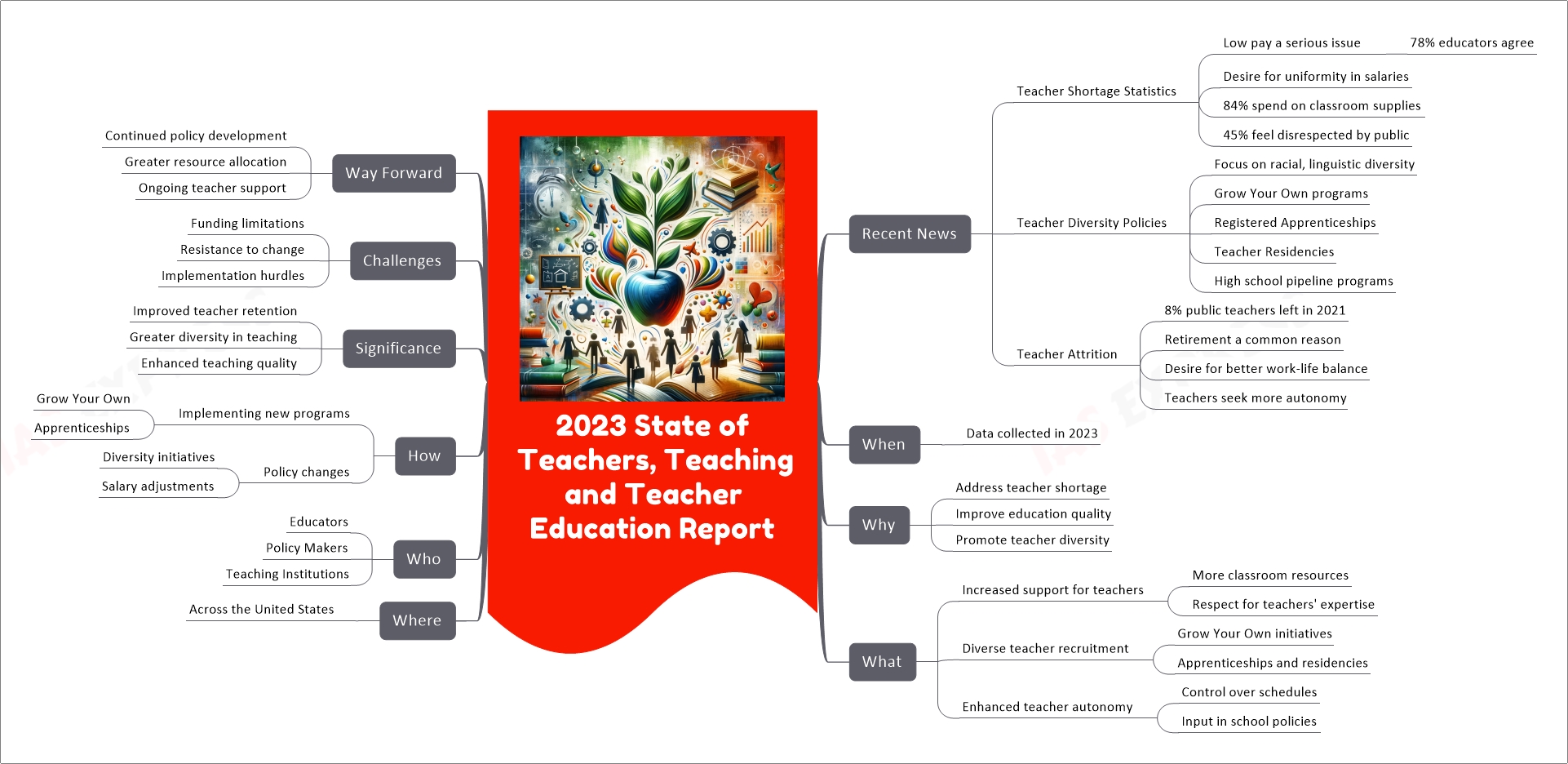
The 2023 State of Teachers, Teaching and Teacher Education Report highlights significant challenges and changes in the field of education in the United States. Key issues include the widespread problem of low teacher pay, with 78% of educators recognizing this as a serious concern. There’s a growing need for uniformity in teacher salaries across states. Teachers are also increasingly spending out of their pockets for basic classroom supplies. Another critical issue is the lack of respect for teachers from the public, affecting their professional satisfaction.

The report also discusses the importance of diversity in teaching, with policies focusing on racial and linguistic diversities, such as Grow Your Own programs, Registered Apprenticeships, and Teacher Residencies. High school pipeline programs are also part of these efforts.

Regarding teacher attrition, about 8% of public school teachers left the profession in 2021, with retirement cited as a common reason. Teachers are seeking better work-life balance and more autonomy in their roles.

The report suggests the way forward includes continued policy development, greater resource allocation, and ongoing support for teachers to address these challenges.
If you like this post, please share your feedback in the comments section below so that we will upload more posts like this.

Responses

🖍️ Highlight
HomeCoursesPlansAccount