Ayodhya’s Ties to Korean Queen Heo

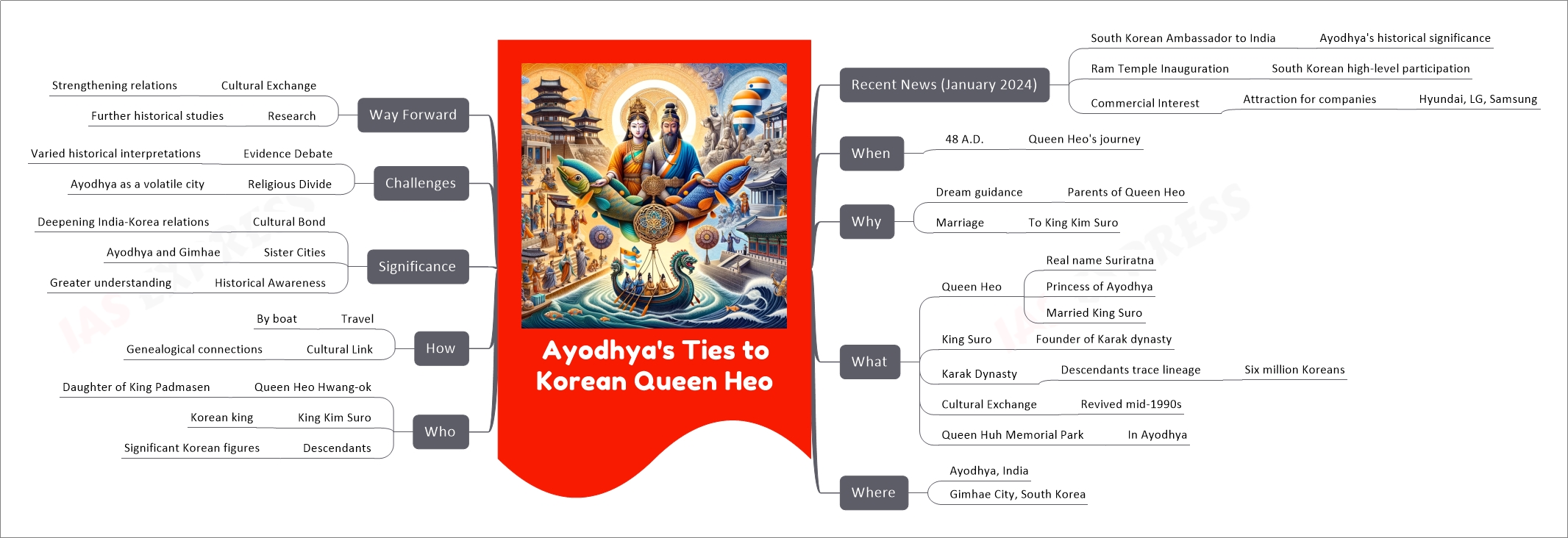
Ayodhya's Ties to Korean Queen Heo mind map
  Recent News (January 2024)
    South Korean Ambassador to India
      Ayodhya's historical significance
    Ram Temple Inauguration
      South Korean high-level participation
    Commercial Interest
      Attraction for companies
        Hyundai, LG, Samsung
  When
    48 A.D.
      Queen Heo's journey
  Why
    Dream guidance
      Parents of Queen Heo
    Marriage
      To King Kim Suro
  What
    Queen Heo
      Real name Suriratna
      Princess of Ayodhya
      Married King Suro
    King Suro
      Founder of Karak dynasty
    Karak Dynasty
      Descendants trace lineage
        Six million Koreans
    Cultural Exchange
      Revived mid-1990s
    Queen Huh Memorial Park
      In Ayodhya
  Where
    Ayodhya, India
    Gimhae City, South Korea
  Who
    Queen Heo Hwang-ok
      Daughter of King Padmasen
    King Kim Suro
      Korean king
    Descendants
      Significant Korean figures
  How
    Travel
      By boat
    Cultural Link
      Genealogical connections
  Significance
    Cultural Bond
      Deepening India-Korea relations
    Sister Cities
      Ayodhya and Gimhae
    Historical Awareness
      Greater understanding
  Challenges
    Evidence Debate
      Varied historical interpretations
    Religious Divide
      Ayodhya as a volatile city
  Way Forward
    Cultural Exchange
      Strengthening relations
    Research
      Further historical studies

The ties between Ayodhya and Korean Queen Heo Hwang-ok revolve around a historical connection dating back to 48 A.D. According to the legend, Queen Heo, originally named Suriratna, was a princess from Ayodhya who married King Kim Suro of Korea, thereby establishing the Karak dynasty. This connection has fostered a deep cultural bond between India and Korea, evident in the significant number of Koreans tracing their lineage to this union. The significance of this tie has been highlighted in modern times through various cultural exchanges, the establishment of the Queen Huh Memorial Park in Ayodhya, and the designation of Ayodhya and Gimhae as sister cities. The story, however, is subject to debate regarding its historical accuracy, with various interpretations and a lack of concrete evidence. Despite this, the narrative continues to play a crucial role in the cultural and diplomatic relations between India and South Korea, with potential for further strengthening these ties through ongoing research and cultural exchange.

Related Posts

If you like this post, please share your feedback in the comments section below so that we will upload more posts like this.

Responses

🖍️ Highlight
HomeCoursesPlansAccount