X-59 Quiet Supersonic Aircraft

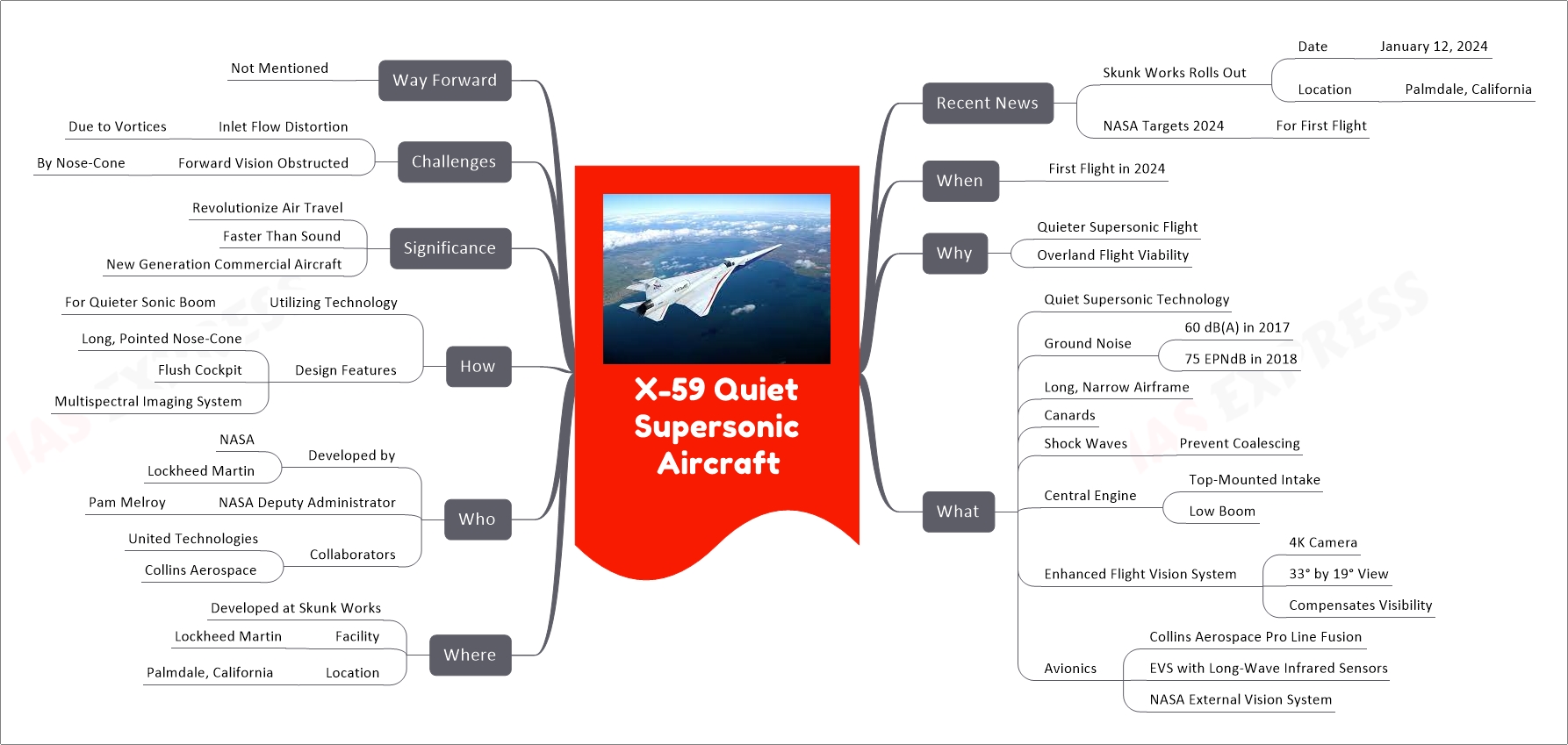
X-59 Quiet Supersonic Aircraft mind map

  Recent News
    Skunk Works Rolls Out
      Date
        January 12, 2024
      Location
        Palmdale, California
    NASA Targets 2024
      For First Flight
  When
    First Flight in 2024
  Why
    Quieter Supersonic Flight
    Overland Flight Viability
  What
    Quiet Supersonic Technology
    Ground Noise
      60 dB(A) in 2017
      75 EPNdB in 2018
    Long, Narrow Airframe
    Canards
    Shock Waves
      Prevent Coalescing
    Central Engine
      Top-Mounted Intake
      Low Boom
    Enhanced Flight Vision System
      4K Camera
      33° by 19° View
      Compensates Visibility
    Avionics
      Collins Aerospace Pro Line Fusion
      EVS with Long-Wave Infrared Sensors
      NASA External Vision System
  Where
    Developed at Skunk Works
    Facility
      Lockheed Martin
    Location
      Palmdale, California
  Who
    Developed by
      NASA
      Lockheed Martin
    NASA Deputy Administrator
      Pam Melroy
    Collaborators
      United Technologies
      Collins Aerospace
  How
    Utilizing Technology
      For Quieter Sonic Boom
    Design Features
      Long, Pointed Nose-Cone
      Flush Cockpit
      Multispectral Imaging System
  Significance
    Revolutionize Air Travel
    Faster Than Sound
    New Generation Commercial Aircraft
  Challenges
    Inlet Flow Distortion
      Due to Vortices
    Forward Vision Obstructed
      By Nose-Cone
  Way Forward
    Not Mentioned

The X-59 Quiet Supersonic Aircraft, developed jointly by NASA and Lockheed Martin, represents a significant advancement in aeronautical engineering. Unveiled on January 12, 2024, at Lockheed Martin’s Skunk Works facility in Palmdale, California, this aircraft is designed to fly at supersonic speeds while producing a much quieter sonic boom. Utilizing innovative technologies, it aims to address the challenge of supersonic flight over land. The aircraft’s unique features include a long, narrow airframe and specialized canards to manage shock waves, a top-mounted engine intake for lower boom, and an enhanced flight vision system to compensate for limited forward visibility due to its long nose-cone. The X-59 is set for its first flight in 2024 and is expected to revolutionize air travel by enabling faster-than-sound travel with minimal noise disruption, paving the way for a new generation of commercial supersonic aircraft.

Related Posts
If you like this post, please share your feedback in the comments section below so that we will upload more posts like this.

Responses

🖍️ Highlight
HomeCoursesPlansAccount