Anti-cancer Drug Camptothecin

Anti-cancer Drug Camptothecin mind map 

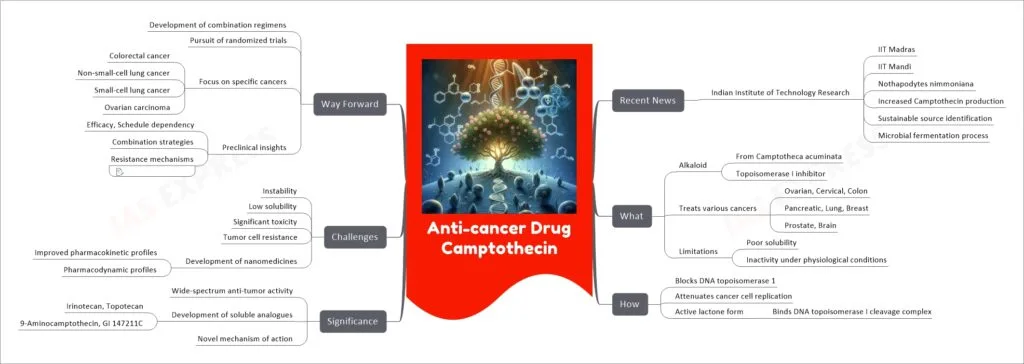
  Recent News
    Indian Institute of Technology Research
      IIT Madras
      IIT Mandi
      Nothapodytes nimmoniana
      Increased Camptothecin production
      Sustainable source identification
      Microbial fermentation process
  What
    Alkaloid
      From Camptotheca acuminata
      Topoisomerase I inhibitor
    Treats various cancers
      Ovarian, Cervical, Colon
      Pancreatic, Lung, Breast
      Prostate, Brain
    Limitations
      Poor solubility
      Inactivity under physiological conditions
  How
    Blocks DNA topoisomerase 1
    Attenuates cancer cell replication
    Active lactone form
      Binds DNA topoisomerase I cleavage complex
  Significance
    Wide-spectrum anti-tumor activity
    Development of soluble analogues
      Irinotecan, Topotecan
      9-Aminocamptothecin, GI 147211C
    Novel mechanism of action
  Challenges
    Instability
    Low solubility
    Significant toxicity
    Tumor cell resistance
    Development of nanomedicines
      Improved pharmacokinetic profiles
      Pharmacodynamic profiles
  Way Forward
    Development of combination regimens
    Pursuit of randomized trials
    Focus on specific cancers
      Colorectal cancer
      Non-small-cell lung cancer
      Small-cell lung cancer
      Ovarian carcinoma
    Preclinical insights
      Efficacy, Schedule dependency
      Combination strategies
      Resistance mechanisms

Camptothecin is a potent anti-cancer drug derived from the Chinese tree, Camptotheca acuminata. It functions as a topoisomerase I inhibitor, blocking the enzyme crucial for DNA replication in cancer cells. This drug has shown effectiveness against various cancers, including ovarian, cervical, colon, and lung cancers. However, its clinical use has been limited due to issues like poor solubility and toxicity. Recent developments, particularly in India, include the enhanced production of camptothecin through metabolic engineering and the identification of sustainable sources, addressing some of these challenges. Researchers have also developed more soluble and less toxic analogues like irinotecan and topotecan. The future of camptothecin involves developing combination therapies, conducting more clinical trials, and improving its pharmacokinetic and pharmacodynamic profiles, particularly through nanomedicine.

Related Posts

If you like this post, please share your feedback in the comments section below so that we will upload more posts like this.

Responses

🖍️ Highlight
HomeCoursesPlansAccount