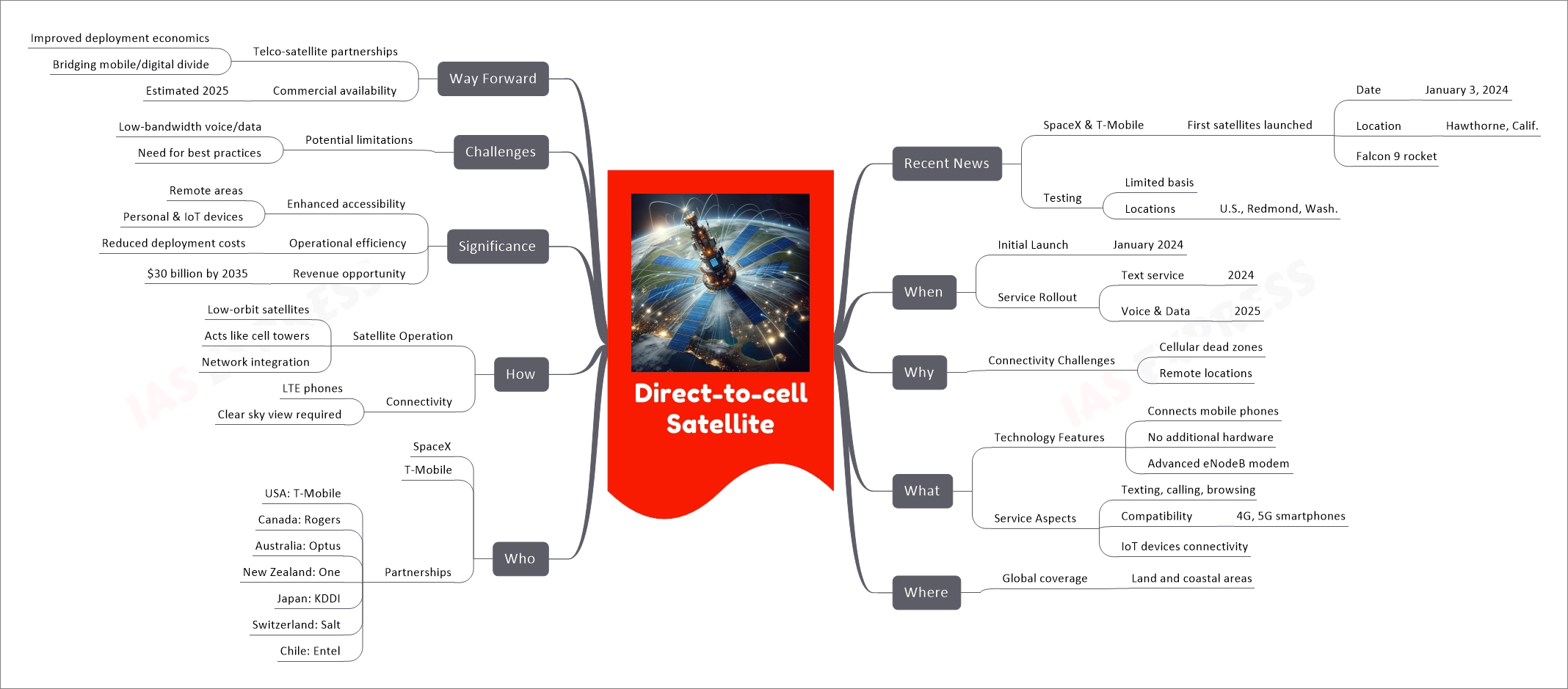
Direct-to-cell Satellite

Direct-to-cell Satellite mind map

  Recent News
    SpaceX & T-Mobile
      First satellites launched
        Date
          January 3, 2024
        Location
          Hawthorne, Calif.
        Falcon 9 rocket
    Testing
      Limited basis
      Locations
        U.S., Redmond, Wash.
  When
    Initial Launch
      January 2024
    Service Rollout
      Text service
        2024
      Voice & Data
        2025
  Why
    Connectivity Challenges
      Cellular dead zones
      Remote locations
  What
    Technology Features
      Connects mobile phones
      No additional hardware
      Advanced eNodeB modem
    Service Aspects
      Texting, calling, browsing
      Compatibility
        4G, 5G smartphones
      IoT devices connectivity
  Where
    Global coverage
      Land and coastal areas
  Who
    SpaceX
    T-Mobile
    Partnerships
      USA: T-Mobile
      Canada: Rogers
      Australia: Optus
      New Zealand: One
      Japan: KDDI
      Switzerland: Salt
      Chile: Entel
  How
    Satellite Operation
      Low-orbit satellites
      Acts like cell towers
      Network integration
    Connectivity
      LTE phones
      Clear sky view required
  Significance
    Enhanced accessibility
      Remote areas
      Personal & IoT devices
    Operational efficiency
      Reduced deployment costs
    Revenue opportunity
      $30 billion by 2035
  Challenges
    Potential limitations
      Low-bandwidth voice/data
      Need for best practices
  Way Forward
    Telco-satellite partnerships
      Improved deployment economics
      Bridging mobile/digital divide
    Commercial availability
      Estimated 2025

Direct-to-cell satellite technology represents a significant advancement in telecommunication, offering connectivity in remote or traditionally underserved areas. This technology enables mobile phones to connect directly to satellites, without the need for additional hardware. It facilitates not only personal communication through texting, calling, and browsing but also connects IoT devices, thereby broadening its utility. Initiated by SpaceX and T-Mobile, this technology involves low-orbit satellites acting as cell towers in space. The service is expected to roll out in phases, starting with text in 2024 and expanding to voice and data by 2025. The technology’s potential to improve operational efficiency and its projected revenue opportunity are substantial. However, it faces challenges such as bandwidth limitations and the need for adopting industry best practices. The way forward includes telco-satellite partnerships, aiming to bridge the mobile and digital divide, with commercial availability anticipated around 2025.

Related Posts
If you like this post, please share your feedback in the comments section below so that we will upload more posts like this.

Responses

🖍️ Highlight
HomeCoursesPlansAccount