
GSAT-20

GSAT-20 mind map
  Recent News
    NewSpace India Limited
      Undertaking GSAT-20 mission
      Q2 2024 planned launch
      Offering Ka-band HTS capacity
    Partnership with SpaceX
      Using Falcon 9 rocket
      First time ISRO using SpaceX
      Launch site Cape Canaveral
      For heavyweight satellite
  When
    Q2 2024
  Why
    Enhance communication infrastructure
    Support India's Smart Cities Mission
  What
    Weight
      4700 kg
    High throughput capacity
      Ka-Ka band
      70 Gbit/s throughput
      40 beams
      80 polarisations
    Coverage
      Pan-India
      Remote areas included
  Where
    Launch Site
      Cape Canaveral
    Orbital Position
      Geostationary orbit
      55° East longitude
  Who
    ISRO
      Joint development
      With Liquid Propulsion Systems Centre
    New Space India Limited
      Operator and owner
      Leasing capacity to Dish TV
    SpaceX
      Launch contractor
  How
    Electric Propulsion
      First Indian satellite with full reliance
      More efficient than chemical-based
  Significance
    Cost-effective broadband services
    Supports IFMC
    Aids cellular backhaul service
  Challenges
    Heavyweight satellite
      Surpasses ISRO's current launch capacity
  Way Forward
    Continued collaboration
      Between ISRO and SpaceX
    Expansion of high-throughput satellite services

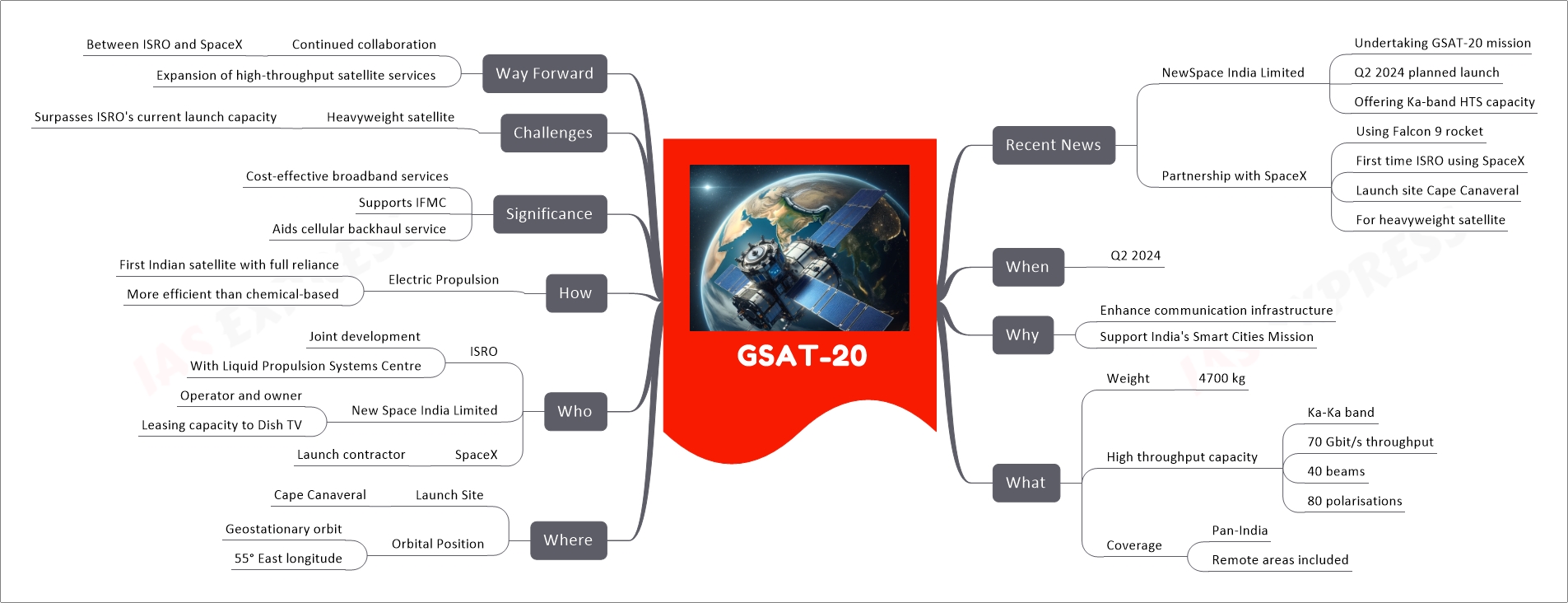
The GSAT-20 satellite, scheduled for launch in the second quarter of 2024, represents a significant advancement in India’s space capabilities. Operated by NewSpace India Limited and developed jointly by the Indian Space Research Organisation (ISRO) and the Liquid Propulsion Systems Centre, this mission marks the first time ISRO is partnering with SpaceX, using their Falcon 9 rocket. The GSAT-20, weighing 4,700 kg and employing electric propulsion, is designed to enhance India’s communication infrastructure, particularly supporting the Smart Cities Mission. It features a high-throughput Ka-band communications payload, capable of delivering 70 Gbit/s throughput across 40 beams, effectively creating 80 polarizations for extensive coverage, including remote areas of India. This mission underscores India’s commitment to advancing its satellite communication technology while addressing challenges such as the satellite’s heavyweight.

Related Posts

If you like this post, please share your feedback in the comments section below so that we will upload more posts like this.

Responses

🖍️ Highlight
HomeCoursesPlansAccount