Gene drive technology

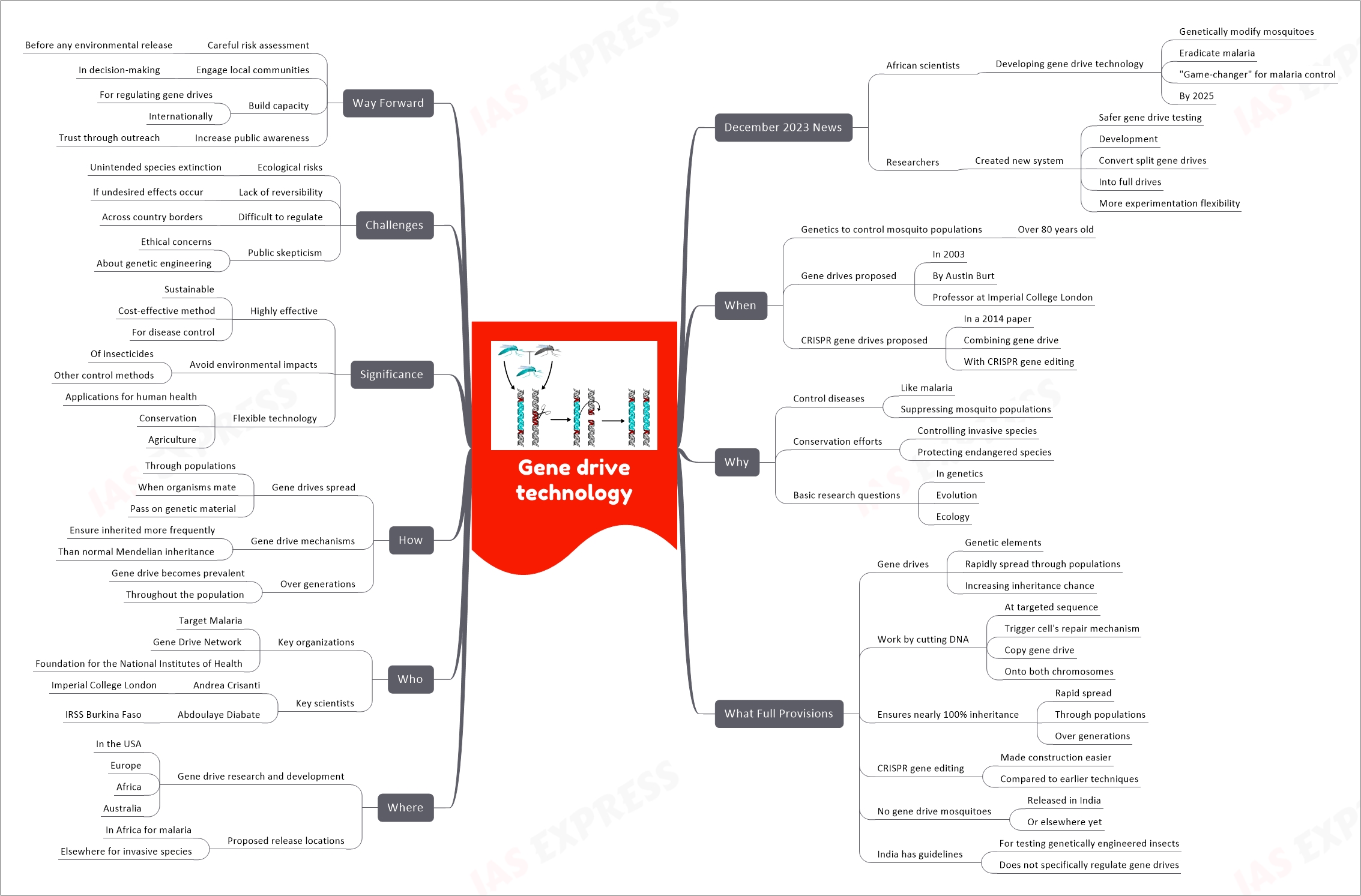
Gene drive technology mind map

  December 2023 News
    African scientists
      Developing gene drive technology
        Genetically modify mosquitoes
        Eradicate malaria
        "Game-changer" for malaria control
        By 2025
    Researchers
      Created new system
        Safer gene drive testing
        Development
        Convert split gene drives
        Into full drives
        More experimentation flexibility
  When
    Genetics to control mosquito populations
      Over 80 years old
    Gene drives proposed
      In 2003
      By Austin Burt
      Professor at Imperial College London
    CRISPR gene drives proposed
      In a 2014 paper
      Combining gene drive
      With CRISPR gene editing
  Why
    Control diseases
      Like malaria
      Suppressing mosquito populations
    Conservation efforts
      Controlling invasive species
      Protecting endangered species
    Basic research questions
      In genetics
      Evolution
      Ecology
  What Full Provisions
    Gene drives
      Genetic elements
      Rapidly spread through populations
      Increasing inheritance chance
    Work by cutting DNA
      At targeted sequence
      Trigger cell's repair mechanism
      Copy gene drive
      Onto both chromosomes
    Ensures nearly 100% inheritance
      Rapid spread
      Through populations
      Over generations
    CRISPR gene editing
      Made construction easier
      Compared to earlier techniques
    No gene drive mosquitoes
      Released in India
      Or elsewhere yet
    India has guidelines
      For testing genetically engineered insects
      Does not specifically regulate gene drives
  Where
    Gene drive research and development
      In the USA
      Europe
      Africa
      Australia
    Proposed release locations
      In Africa for malaria
      Elsewhere for invasive species
  Who
    Key organizations
      Target Malaria
      Gene Drive Network
      Foundation for the National Institutes of Health
    Key scientists
      Andrea Crisanti
        Imperial College London
      Abdoulaye Diabate
        IRSS Burkina Faso
  How
    Gene drives spread
      Through populations
      When organisms mate
      Pass on genetic material
    Gene drive mechanisms
      Ensure inherited more frequently
      Than normal Mendelian inheritance
    Over generations
      Gene drive becomes prevalent
      Throughout the population
  Significance
    Highly effective
      Sustainable
      Cost-effective method
      For disease control
    Avoid environmental impacts
      Of insecticides
      Other control methods
    Flexible technology
      Applications for human health
      Conservation
      Agriculture
  Challenges
    Ecological risks
      Unintended species extinction
    Lack of reversibility
      If undesired effects occur
    Difficult to regulate
      Across country borders
    Public skepticism
      Ethical concerns
      About genetic engineering
  Way Forward
    Careful risk assessment
      Before any environmental release
    Engage local communities
      In decision-making
    Build capacity
      For regulating gene drives
      Internationally
    Increase public awareness
      Trust through outreach

Summary: Gene drive technology is a method of genetic engineering that allows specific genes to spread rapidly through a population. This technology, which can override natural selection, is made possible by the gene editing tool CRISPR-Cas9. Gene drives can be used to control disease-carrying insects like mosquitoes, potentially eradicating diseases like malaria. However, the technology also poses significant ecological risks, including the possibility of unintended species extinction. Therefore, it’s crucial to conduct thorough testing and risk assessment before deploying gene drives. Additionally, public engagement and clear regulation are necessary to address ethical concerns and skepticism about genetic engineering. As of December 2023, gene drive research and development are ongoing in various parts of the world, including the USA, Europe, Africa, and Australia
Related Posts
If you like this post, please share your feedback in the comments section below so that we will upload more posts like this.

Responses

🖍️ Highlight
HomeCoursesPlansAccount