
e-FIR in India: Benefits & Challenges

From Current Affairs Notes for UPSC » Editorials & In-depths » This topic
In recent news, the Law Commission of India has recommended the adoption of electronic First Information Reports (e-FIRs) for various types of criminal offenses. This move towards digitizing the process of filing FIRs has raised several important considerations. In this comprehensive discussion, we will delve into the concept of e-FIRs, their implications, and the need for caution in their implementation.
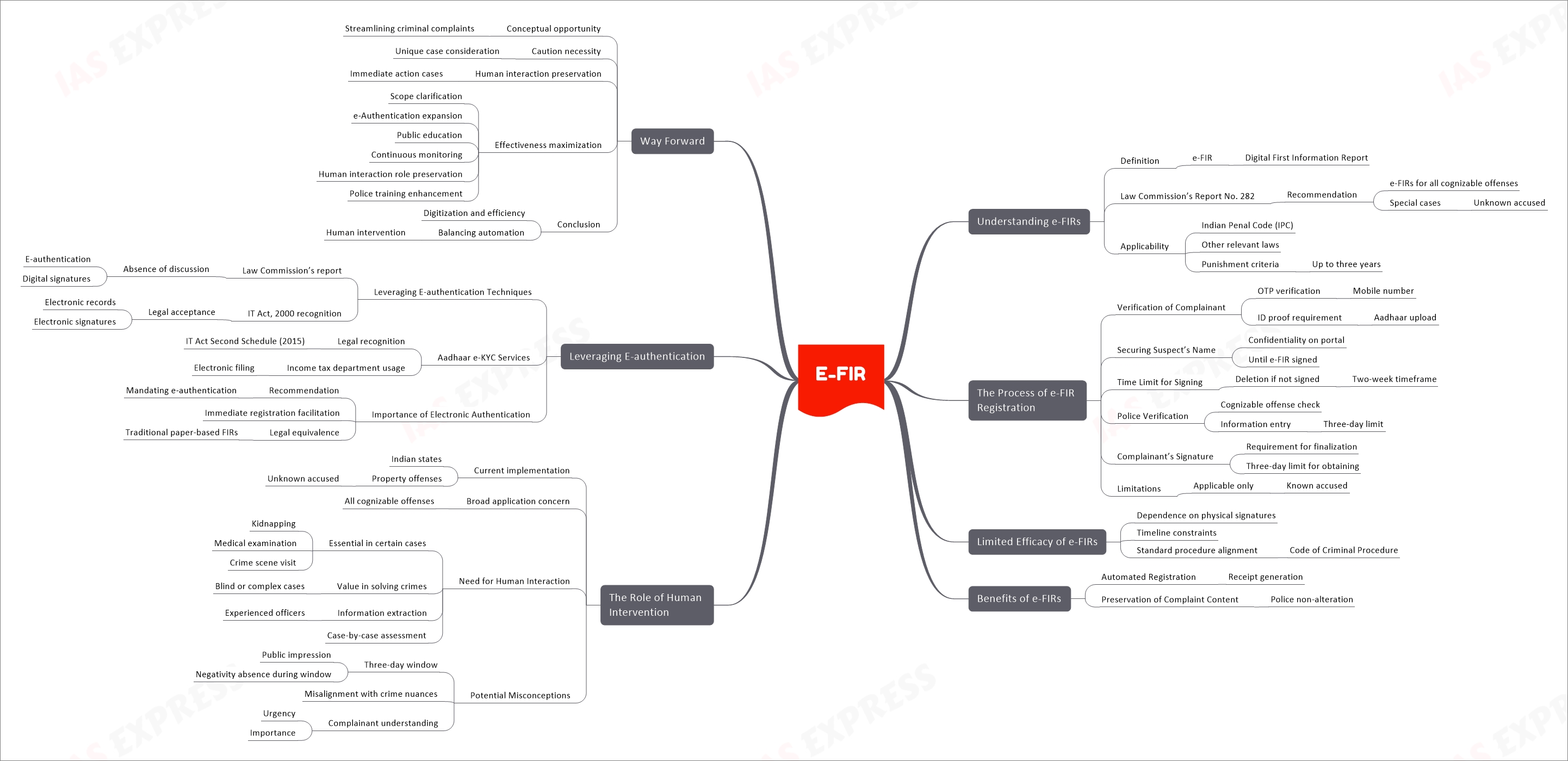
Understanding e-FIRs
An e-FIR is a digital version of the traditional First Information Report, a crucial document in criminal proceedings. The Law Commission’s Report No. 282 suggests that e-FIRs should be allowed for all cognizable offenses, especially when the accused is not known. For cases where the accused is known, e-FIR registration is recommended for offenses with a punishment of up to three years under the Indian Penal Code (IPC) and other relevant laws.
The Process of e-FIR Registration
The Law Commission’s report outlines the following process for e-FIR registration:
- Verification of Complainant: To ensure authenticity, the complainant’s mobile number is verified through a one-time password (OTP). Additionally, a valid ID proof, such as Aadhaar, must be uploaded.
- Securing Suspect’s Name: The name of the suspect is to be kept confidential on the centralized national portal until the e-FIR is signed by the complainant.
- Time Limit for Signing: If the registered information is not signed by the informant within the prescribed time frame, it will be deleted from the portal within two weeks.
- Police Verification: The police station checks the information received from the portal to determine if a cognizable offense is made out. If affirmative, the information is entered in the prescribed format within three days.
- Complainant’s Signature: The police officer must obtain the complainant’s signature within three days to finalize the e-FIR. If not obtained, the e-FIR will not be registered, and reasons will be communicated.
- Limitations: This process applies only when the accused is known.
Limited Efficacy of e-FIRs
It is essential to recognize that e-FIRs do not represent an entirely automated process; they rely on physical signatures of complainants within a specified time frame. This limitation means that investigations initiated before the formal registration of the FIR may not align with the standard procedures of the Code of Criminal Procedure.
Benefits of e-FIRs
Despite their limitations, e-FIRs offer some advantages:
- Automated Registration: The system generates a receipt automatically upon registration, ensuring the police take cognizance of the complaint.
- Preservation of Complaint Content: Once filed, the complaint contents cannot be altered by the police.
The Role of Human Intervention
While some Indian states have begun registering e-FIRs, primarily in cases of property offenses where the accused is unknown, the Law Commission’s recommendation extends to all cognizable offenses where the accused is not known. However, this broad application raises concerns.
Need for Human Interaction
In cases like kidnapping, immediate medical examination of the victim and timely visits to the crime scene may be essential. Additionally, human interaction with a police officer can be valuable in solving blind or complex crimes. Experienced officers may extract critical information from complainants or victims, aiding in identifying the culprits. Therefore, it is crucial to assess the necessity of human involvement on a case-by-case basis.
Potential Misconceptions
Allowing a three-day window for e-FIR registration might give the impression to the common man that it will not affect the case negatively during that period. However, this might not align with the nuances of certain crimes, and complainants may not fully grasp the urgency or importance of their cases.
Leveraging E-authentication Techniques
The Law Commission’s report does not delve into the utilization of e-authentication techniques or digital signatures, which are legally recognized under the Information Technology (IT) Act, 2000.
Legal Acceptance of Electronic Records
Under the IT Act, any information rendered or made available in an electronic form and accessible for subsequent reference is legally acceptable. Similarly, any electronic record can be authenticated by electronic signatures or authentication techniques considered reliable.
Aadhaar e-KYC Services
In 2015, the Second Schedule of the IT Act recognized ‘e-authentication techniques using Aadhaar e-KYC services’ as legally recognized methods. These are widely employed by the income tax department for electronic filing of returns.
Importance of Electronic Authentication
To enhance the authenticity of e-FIRs, it is advisable to mandate the use of e-authentication techniques for verifying complainants. This would facilitate immediate registration of e-FIRs, making them legally equivalent to traditional paper-based FIRs.
Way Forward
The concept of e-FIRs presents an opportunity to streamline and modernize the process of registering criminal complaints in India. However, it is crucial to proceed with caution, taking into consideration the unique circumstances of each case and ensuring that human interaction is not compromised, especially in cases where immediate action is essential.
To maximize the effectiveness of e-FIRs, it is advisable to:
- Clarify the Scope: Define the types of offenses for which e-FIRs are most suitable and establish clear guidelines for their use.
- Expand e-Authentication: Mandate the use of e-authentication techniques or digital signatures to enhance the authenticity of e-FIRs.
- Educate the Public: Ensure that the public is well-informed about the e-FIR process, its limitations, and the importance of timely reporting.
- Continuous Monitoring: Regularly assess the implementation of e-FIRs and make necessary adjustments to address emerging challenges.
- Preserve Human Interaction: Preserve the role of human interaction in cases where it is critical for effective investigations.
- Enhance Police Training: Provide training to law enforcement personnel to adapt to the changing landscape of FIR registration.
In conclusion, while the move towards e-FIRs is a positive step towards digitization and efficiency, it must be undertaken cautiously to ensure that it aligns with the diverse needs of the Indian criminal justice system. Balancing automation with human intervention is key to the success of this transition.
Practice Question for Mains
Discuss the concept of e-FIRs in India, highlighting their benefits and limitations. What are the key considerations for the effective implementation of e-FIRs, and how can they enhance the criminal justice system in the country? (250 words)
Reference:The Hindu – Move towards e-FIR, but with caution
Related Posts



If you like this post, please share your feedback in the comments section below so that we will upload more posts like this.

Responses