Indian Institute of Astrophysics (IIA)

Indian Institute of Astrophysics (IIA)

  Recent studies
    Clearer picture of sun’s magnetic field
      Influence on interplanetary magnetic space
    Study findings
      Step closer to identifying source of solar mean magnetic field (SMMF)
      SMMF
        Mean value of line-of-sight (LOS) component of solar vector magnetic field
          Averaged over visible hemisphere
          Relationship with Interplanetary Magnetic Field (IMF)
      IMF
        Extension of coronal magnetic field
          Dragged by solar wind to interplanetary space
      LOS
        Direct path between two points
      Similarity between SMMF at
        Chromospheric heights
        Photospheric heights
      Chromospheric SMMF value is lower than photospheric SMMF
      Possibility of primordial magnetic field as source of SMMF
    Data technique
      Calculation and analysis of SMMF
        Magnetic field measurements at
          Chromosphere
            A reddish gaseous layer above photosphere of the sun
          Photosphere
            Visible surface of the Sun
      Electrical currents generated by hot, ionised gases in sun’s convection zone
        Convection zone
          Outermost layer of interior portion of sun
          Extended to about 200,000 km
    Solar Mean Magnetic Field (SMMF)
      Mean value of LOS component of solar vector magnetic field
        Averaged over visible hemisphere of the sun
      Magnetic field generated by electrical currents
        Acts as a magnetic dynamo inside the sun
    Significance
      Studies confined to magnetic field measurements at photosphere
      Understanding source of SMMF and driving parameters
        Helps in understanding SMMF effect on IMF
  Indian Institute of Astrophysics (IIA)
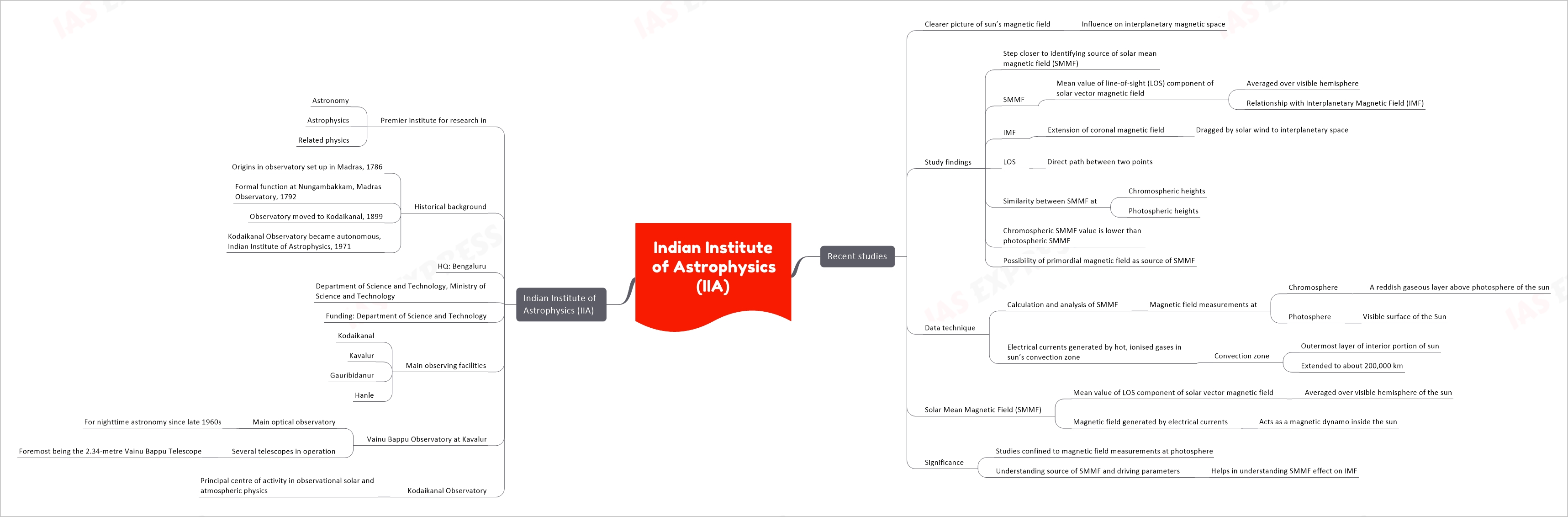
    Premier institute for research in
      Astronomy
      Astrophysics
      Related physics
    Historical background
      Origins in observatory set up in Madras, 1786
      Formal function at Nungambakkam, Madras Observatory, 1792
      Observatory moved to Kodaikanal, 1899
      Kodaikanal Observatory became autonomous, Indian Institute of Astrophysics, 1971
    HQ: Bengaluru
    Department of Science and Technology, Ministry of Science and Technology
    Funding: Department of Science and Technology
    Main observing facilities
      Kodaikanal
      Kavalur
      Gauribidanur
      Hanle
    Vainu Bappu Observatory at Kavalur
      Main optical observatory
        For nighttime astronomy since late 1960s
      Several telescopes in operation
        Foremost being the 2.34-metre Vainu Bappu Telescope
    Kodaikanal Observatory
      Principal centre of activity in observational solar and atmospheric physics

Related Posts

If you like this post, please share your feedback in the comments section below so that we will upload more posts like this.

Responses

🖍️ Highlight
HomeCoursesPlansAccount