
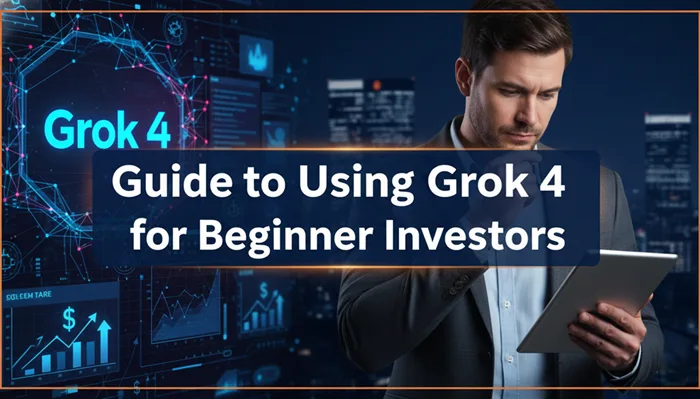
From Novice to Automated Trader: A Step-by-Step Guide to Using Grok 4 for Beginner Investors
The financial markets have long been portrayed as an exclusive club for Wall Street elites, high-frequency trading firms, and individuals with decades of experience. For the average novice investor, the barrier to entry wasn’t just capital—it was information and speed. However, the landscape of retail investing is undergoing a seismic shift. The democratization of artificial intelligence has handed powerful tools to everyday investors, leveling the playing field in ways previously unimaginable.
At the forefront of this revolution is automated trading, a method that removes emotional bias and executes strategies with machine precision. While “algo-trading” used to require advanced coding skills, the emergence of next-generation AI models like Grok 4 has changed the game. This guide will walk you through the journey from a complete novice to a confident automated trader, leveraging the advanced capabilities of Grok 4 to analyze, strategize, and execute trades.
The Evolution of the Retail Trader: Why Automation Matters
Before diving into the “how-to,” it is crucial to understand the “why.” Manual trading is fraught with psychological pitfalls. Fear of missing out (FOMO), panic selling, and revenge trading are common traps that deplete portfolios. Automated trading solves this by adhering strictly to a pre-defined set of rules. It monitors the markets 24/7, executes trades instantly when conditions are met, and manages risk without hesitation.
For beginners, the challenge has always been the technical hurdle of building these automated systems. This is where Grok 4 enters the picture. Unlike its predecessors, Grok 4 is not just a chatbot; it is a reasoning engine with a massive context window and real-time access to data, specifically designed to handle complex logical tasks and coding challenges.
Understanding Grok 4: Your New Trading Partner
Grok 4 represents a significant leap forward in AI capabilities. Developed by xAI, it distinguishes itself with two features critical for traders:
- Real-Time Knowledge: Unlike models trained on static datasets that cut off years ago, Grok 4 has a pulse on current events, capable of synthesizing real-time data streams and social sentiment.
- Superior Reasoning & Coding: Grok 4 excels at “first-principles” reasoning. It doesn’t just regurgitate information; it can analyze a financial hypothesis, write the Python code to test it, and debug that code in real-time.
By utilizing the tools available at the Grok AI Trading Bot’s Official website, investors can harness this raw power to create a trading infrastructure that works tirelessly on their behalf.
Step 1: Setting Up Your Digital Workspace
The first step in your journey is establishing a secure and functional environment. Automated trading requires a bridge between your AI “brain” (Grok 4) and the “execution arm” (your exchange).
Choose Your Trading Platform
Begin by selecting a reputable cryptocurrency or stock exchange that offers API (Application Programming Interface) support. The API is the key that allows software to send trade orders to your account automatically. Major platforms usually offer robust API documentation.
Security First
When generating API keys on your exchange, you will typically see options for “Read-Only,” “Trade,” and “Withdrawal.”
- Enable: Read-Only (so the bot can see prices and balances).
- Enable: Trade (so the bot can execute buy/sell orders).
- Strictly Disable: Withdrawal. This ensures that even if your setup is compromised, your funds cannot be removed from the exchange.
Integrating Grok 4
Access the Grok 4 interface. If you are using a specialized wrapper or the Grok AI Trading Bot, follow their specific onboarding flow to connect your API keys securely. The goal is to create a seamless pipeline where data flows in, decisions are made, and orders flow out.
Step 2: Developing Your First Strategy with AI
This is where the “educational” aspect of Grok 4 truly shines. You do not need to know how to write complex algorithms; you simply need to know how to ask the right questions.
The “Plain English” Approach
Grok 4 allows you to describe a trading strategy in natural language, and it can convert that into executable code (often Python).
Example Prompt for a Novice:
“I want to build a mean-reversion strategy for Bitcoin. If the price drops 3% below its 24-hour moving average, I want to buy. If it rises 3% above the average, I want to sell. Can you write a Python script for this using the CCXT library?”
Refining the Logic
Grok 4 will likely return a block of code. However, a good trader iterates. You can ask Grok 4 to improve the strategy:
- “Add a condition to only trade if the daily volume is above 10 million to ensure liquidity.”
- “Include a stop-loss mechanism that sells immediately if the price drops 2% from my entry point.”
This iterative dialogue helps you understand the logic behind the code, turning you from a passive user into an active architect of your financial future.
Step 3: The Crucial Phase—Backtesting
Never deploy a bot with real money immediately. The most common mistake beginners make is assuming a strategy that sounds good on paper will work in a live market. You must “backtest” it—running your strategy against historical data to see how it would have performed in the past.
Leveraging Grok 4 for Data Analysis
You can feed historical price data (CSV files) into Grok 4 and ask it to simulate your strategy.
- Ask:“Simulate this strategy over the market data from Q4 2024. What was the maximum drawdown? What was the win rate?”
Interpreting Results
- Drawdown: The largest drop in capital from a peak to a trough. A high drawdown indicates high risk.
- Win Rate: The percentage of profitable trades. Interestingly, a high win rate isn’t always necessary if your profitable trades are significantly larger than your losing ones.
Use Grok 4 to tweak parameters. If the drawdown is too high, ask the AI to adjust the position sizing or tighten the stop-losses.
Step 4: Implementing Risk Management
Risk management is the survival kit of trading. Automated bots can lose money faster than humans if not governed by strict rules. Grok 4 can help you code hard limits into your bot.
Position Sizing
A golden rule in trading is never to risk more than 1-2% of your total capital on a single trade. You can program your Grok-powered bot to calculate the trade size dynamically based on your current account balance.
Stop-Losses and Take-Profits
- Stop-Loss: An automatic sell order to limit losses.
- Take-Profit: An automatic sell order to lock in gains.
Educational Tip: Ask Grok 4 to explain “Trailing Stop-Losses.” This is an advanced feature where your stop-loss moves up as the price rises, effectively locking in profits while leaving the upside open.
Step 5: Live Deployment and Monitoring
Once you have backtested and set your risk parameters, it is time to go live. However, “automated” does not mean “abandoned.”
The “Paper Trading” Phase
Many platforms offer a “paper trading” or demo mode. This uses real-time market data but fake money. Run your Grok 4 strategy here for at least two weeks. This ensures there are no bugs in the code and that the strategy behaves as expected in current market conditions.
Going Live with Small Capital
When you switch to real capital, start small. If you have $5,000 to invest, maybe start the bot with only $500 allocated. Monitor its performance closely for the first few days.
Using Grok 4 for Sentiment Analysis
While your bot handles the technicals (price charts), you can use Grok 4 manually to gauge market sentiment.
- Prompt:“Search X (formerly Twitter) and recent news for ‘regulatory news crypto’. Summarize the sentiment as Bullish, Bearish, or Neutral.” If the sentiment is overwhelmingly negative due to a breaking news event, you might choose to pause your bot manually. This hybrid approach—automated execution + human oversight powered by AI—is often the sweet spot for investors.
Step 6: Continuous Learning and Optimization
The market is a living, breathing entity that changes constantly. A strategy that works in a “bull market” (upward trend) might fail miserably in a “crab market” (sideways movement).
Periodic Reviews
Set a schedule (e.g., every Sunday night) to review your bot’s performance. Download your trade history and upload it to Grok 4.
- Prompt:“Analyze my trade history for the past week. Identify patterns in the losing trades. Was it due to volatility or a specific time of day?”
Adapting to New Regimes
If Grok 4 identifies that your bot loses money during high volatility, you can work with the AI to add a “volatility filter” to your code, telling the bot to sit on the sidelines when markets are too choppy.
Conclusion: Embracing the Future of Finance
transitioning from a novice investor to an automated trader is a journey of education, discipline, and technological adoption. Grok 4 acts as the ultimate accelerator in this process, bridging the gap between complex coding requirements and your investment goals.
By following this step-by-step guide—setting up securely, strategizing with natural language, rigorous backtesting, and strict risk management—you are building a foundation for sustainable investing. Remember, the goal of automation is not to get rich quick, but to trade consistent, logical systems that protect your capital and grow it over time.
As you embark on this path, ensure you are using the best tools available. For more information on integrating these powerful AI capabilities into your workflow, visit the Official website and take the first step toward a smarter, more efficient trading future.
Disclaimer: This article is for educational purposes only and does not constitute financial advice. Trading involves risk, and you should never invest money you cannot afford to lose.



Responses