
5 Cybercrime in DeFi: What CISOs Need to Know to Safeguard Digital Assets

In 2025, the decentralized finance (DeFi) ecosystem is no longer a niche experiment. Billions of dollars flow through decentralized exchanges, lending platforms, and liquidity pools every day. Yet, with this unprecedented growth comes an equally staggering rise in deFi cybercrime.
Just last year, a single exploit on a cross-chain DeFi protocol resulted in losses exceeding $200 million, one of the largest attacks to date. For CISOs overseeing digital asset security, the message is clear: DeFi is a frontier of innovation, but it’s also a minefield of evolving cyber threats.
This blog breaks down the top cybercrime risks CISOs must address in 2025, explores real-world attack vectors, and outlines practical defense strategies. Finally, we’ll show how SecureDApp helps security leaders strengthen resilience in this high-stakes environment.
Understanding the Rise of Cybercrime in DeFi
To understand the threat landscape, it helps to recognize what makes DeFi so attractive to attackers. Traditional financial systems are heavily regulated, monitored, and centralized. DeFi, by contrast, is open, global, and permissionless. While these qualities drive innovation, they also create unique vulnerabilities.
Key reasons cybercrime thrives in DeFi:
- Smart contracts are public and can be probed for weaknesses by anyone.
- High-value liquidity pools present lucrative targets for attackers.
- Anonymous teams and lack of traditional oversight allow fraudulent actors to disappear overnight.
- Rapid innovation cycles mean security often lags behind product launches.
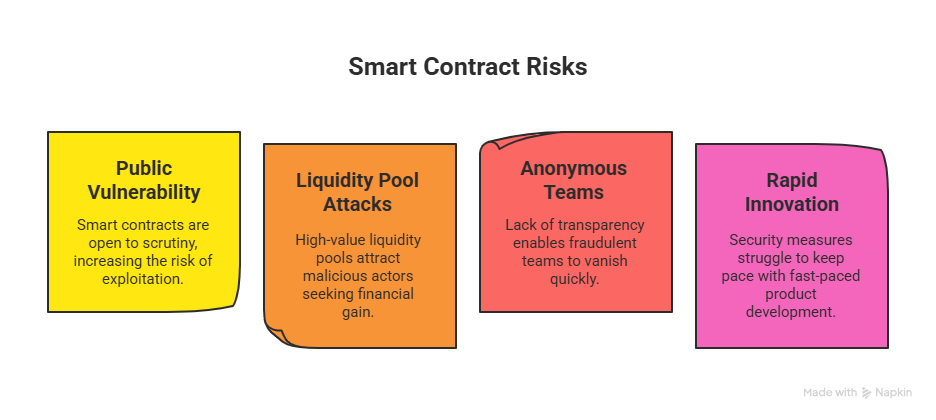
For CISOs, the takeaway is simple: DeFi platforms operate in a threat environment where the attack surface expands daily, and adversaries move faster than regulations.
Top 5 Cybercrime Threats Facing DeFi Platforms in 2025
CISOs must not only identify these threats but also prepare incident response strategies in advance. Below are the five most pressing DeFi security threats every enterprise security leader needs to understand.
Smart Contract Exploits and Vulnerabilities
At the heart of every DeFi platform is code, smart contracts that manage funds, automate lending, and execute trades. But code is only as secure as the humans who write it.
Common exploit types include:
- Reentrancy attacks (exploiting recursive calls to drain funds).
- Integer overflows/underflows (manipulating math errors to siphon assets).
- Logic flaws in token contracts or governance mechanisms.
For CISOs, preventing these threats requires rigorous smart contract audits, continuous code reviews, and penetration testing. Ignoring these steps can turn a minor bug into a multi-million-dollar loss.
Rug Pulls and Exit Scams
Not all threats are purely technical. Some are rooted in human behavior. Rug pulls occur when project founders or developers abruptly withdraw liquidity, leaving investors with worthless tokens.
In 2025, rug pulls remain common because launching a DeFi project requires minimal upfront costs. Fraudulent teams lure users with high returns, then exit with funds before regulators can intervene.
CISO takeaway: Beyond technical due diligence, organizations must vet project teams, governance models, and liquidity lock-in mechanisms. Implementing vendor and partner risk assessments is as important as code reviews.
Phishing and Social Engineering Attacks
Cybercriminals know that the human element is often the weakest link. In DeFi, phishing takes the form of malicious links, fake wallets, and cloned DeFi interfaces designed to steal private keys or seed phrases.
Emerging phishing trends in 2025:
- Deepfake-powered social engineering (impersonating trusted project leaders).
- Telegram and Discord scams targeting retail and institutional users alike.
- Fake browser extensions mimicking legitimate wallets.
For CISOs, the solution lies in user awareness campaigns, zero-trust principles, and continuous monitoring of communication channels. Even the most secure smart contract is useless if a private key is compromised.
Flash Loan Attacks
Flash loans allow users to borrow large sums without collateral, provided the loan is repaid in the same transaction. While innovative, this mechanism is often abused by attackers who manipulate token prices, exploit oracles, or destabilize liquidity pools.
In 2025, flash loan attacks are more frequent due to the rise of automated DeFi trading platforms and under-secured price oracles. Attackers exploit temporary imbalances to drain funds, sometimes within seconds.
CISO countermeasures include:
- Enforcing oracle diversity and reliability.
- Limiting transaction atomicity where feasible.
- Stress-testing smart contracts against synthetic flash loan simulations.
51% Attacks and Consensus Manipulation
While more common in smaller blockchains, 51% attacks remain a threat in 2025. By controlling the majority of mining or staking power, adversaries can rewrite transaction histories, double-spend assets, or block new transactions.
In DeFi, consensus manipulation also extends to governance: attackers may accumulate enough tokens to push malicious proposals or seize control of decision-making.
For CISOs, monitoring network health and governance participation is essential. Consensus manipulation is no longer a theoretical concern, it’s a real risk that can undermine trust in entire DeFi ecosystems.
Best Practices for CISOs to Protect Digital Assets
If threats are unavoidable, defense becomes the differentiator. Below are the best practices CISOs should champion in 2025 to safeguard digital assets.
Implementing Multi-Layer Security Frameworks
No single control can protect against every DeFi attack vector. CISOs must adopt a multi-layer security approach that spans:
- Smart contract security (audits, bug bounties, formal verification).
- Network and infrastructure defense (firewalls, DDoS protection, anomaly detection).
- User-side safeguards (MFA, secure wallets, education).
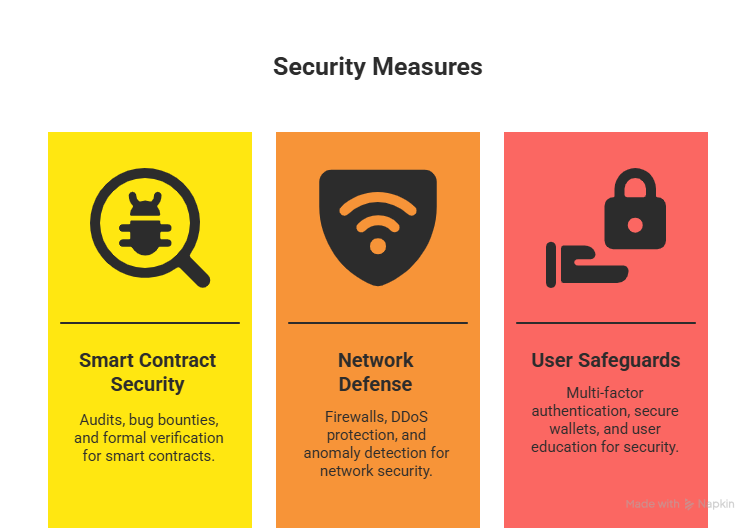
By layering defenses, organizations create redundancy, so even if one layer fails, others contain the damage.
Conducting Comprehensive Smart Contract Audits
Given that most DeFi exploits originate from coding flaws, comprehensive smart contract audits are non-negotiable. Audits must go beyond one-time reviews. Instead, CISOs should enforce:
- Pre-deployment assessments for all new contracts.
- Periodic re-audits after upgrades.
- Real-time monitoring to catch anomalies early.
Audits also serve as trust signals for investors, partners, and regulators. A well-audited project communicates CISO-led accountability.
Continuous Threat Monitoring and Incident Response
Even with preventive measures, incidents will occur. CISOs must therefore prepare incident response strategies tailored to DeFi.
Best practices include:
- 24/7 monitoring systems that flag suspicious activities.
- Predefined playbooks for flash loan attacks, oracle manipulation, or rug pulls.
- Collaboration with law enforcement and forensic specialists for post-breach recovery.
Ultimately, incident response is about minimizing impact and restoring trust swiftly.
How SecureDApp Empowers CISOs in DeFi Security
Addressing DeFi cybercrime requires both expertise and specialized tools. That’s where SecureDApp comes in.
SecureDApp empowers CISOs by providing:
- Advanced smart contract audits tailored to enterprise-grade DeFi platforms.
- Real-time threat intelligence for monitoring attack vectors across ecosystems.
- Governance and compliance support to align with global regulations.
- Incident response readiness to help CISOs act decisively during crises.
By partnering with SecureDApp, organizations gain more than technology, they gain a trusted ally in safeguarding digital assets.
FAQs: People Also Ask
Q1: What are the most common types of cybercrime in DeFi?
The most frequent attacks include smart contract vulnerabilities, rug pulls, phishing schemes, flash loan exploits, and consensus manipulation.
Q2: How can CISOs prevent smart contract vulnerabilities?
Smart contract vulnerabilities pose significant risks, including financial losses and reputational damage. CISOs play a critical role in preventing these vulnerabilities by adopting a proactive and comprehensive security strategy across the entire smart contract lifecycle. This approach involves a multi-layered defense incorporating technical controls, skilled personnel, and robust processes.
Q3: Why are flash loan attacks and rug pulls so prevalent in 2025?
Because they exploit structural weaknesses: flash loans manipulate oracles while rug pulls exploit trust in anonymous teams. Both offer high returns for attackers.
Q4: What incident response measures best protect digital assets?
Robust monitoring, prebuilt incident playbooks, and collaboration with security partners like SecureDApp.
Q5: How does SecureDApp enhance CISO-led DeFi security programs?
By delivering audits, real-time monitoring, compliance frameworks, and rapid-response capabilities tailored to DeFi platforms.
Conclusion: Why CISOs Must Act Now
The rise of DeFi cybercrime is not a temporary challenge, it’s the new normal. For CISOs, this means treating DeFi not as a side project but as a core element of digital asset security strategy.
From smart contract vulnerabilities to flash loan attacks and rug pulls, the risks are clear. Yet so are the solutions. By implementing multi-layer security frameworks, enforcing rigorous audits, and preparing incident response strategies, CISOs can transform DeFi from a liability into an innovation opportunity.
And with security partners like SecureDApp executives gain the tools and insights needed to stay ahead of adversaries in 2025 and beyond.
DeFi’s future will belong to the organizations that balance innovation with vigilance. For CISOs, the time to lead is now.




Responses